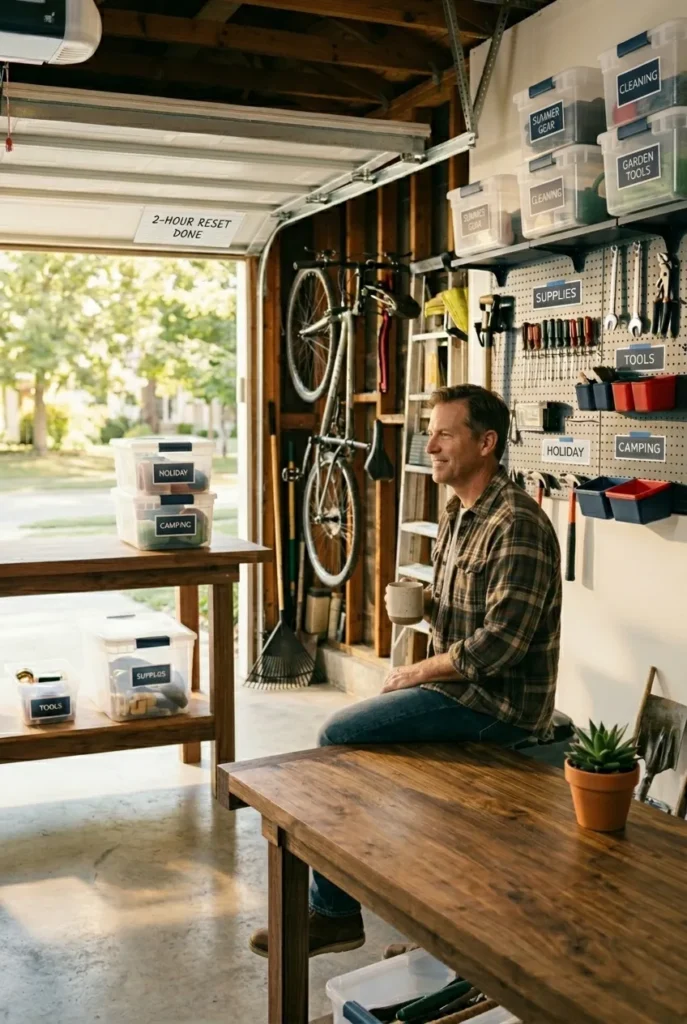

The Father’s Day Garage Reset: A 2-Hour Garage Organization Weekend Project You’ll Actually Finish
You walk into the garage on a Saturday morning, coffee in hand, and immediately wish you hadn’t. Bikes leaning on bikes. A rake somewhere behind the recycling bin. Last summer’s pool noodles, this winter’s snow shovel, three half-empty paint cans, and the tool you bought specifically so you’d stop borrowing your neighbor’s.
This garage organization weekend project changes that in 2 hours flat, not 2 weekends, and it doubles as the best Father’s Day gift you can give the person who’s been promising to “get to the garage” since 2024. Here’s what you’ll get: a zone map, a 30-60-30 minute plan, a budget under $100, and a system that holds for the rest of the year.
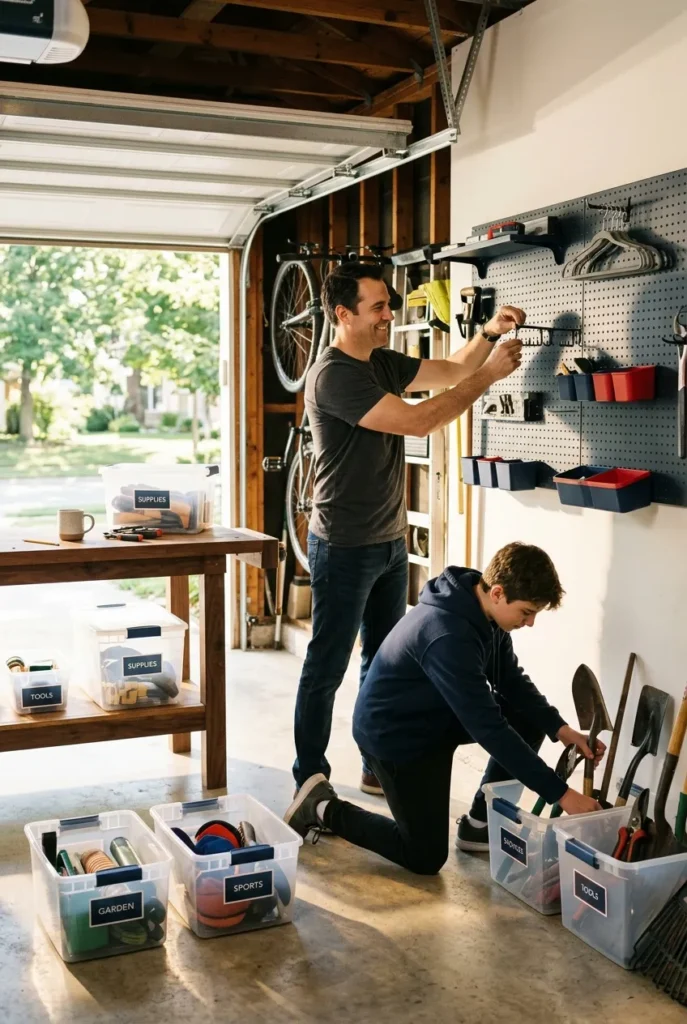
Why a 2-Hour Garage Organization Weekend Project Beats the All-Day Marathon
The all-day garage purge is why most garages stay messy. You start at 9 a.m., it’s 95 degrees by 1 p.m., the trip to Home Depot eats an hour, and by 4 p.m. everyone hates each other and the pile in the driveway is somehow bigger than what was in the garage. We’ve tried it. Twice.
A 2-hour weekend project works because it forces decisions. You can’t agonize over a 2009 lawn chair when the clock is running. You hang what hangs, you bin what bins, you donate the rest. Done.
The other reason this format wins: it’s the perfect Father’s Day window. The cookout starts at 5. Dad gets the morning. The kids get a job. The garage gets a glow-up. Everybody wins by lunchtime.
Quick math on why 2 hours is enough. The average US two-car garage measures 22 by 22 feet, or about 484 square feet. Split that into four zones of roughly 120 square feet each and you have 30 minutes per zone. That’s the whole game.
Meet the 2-Hour Garage Reset Triangle (Our Original Framework)
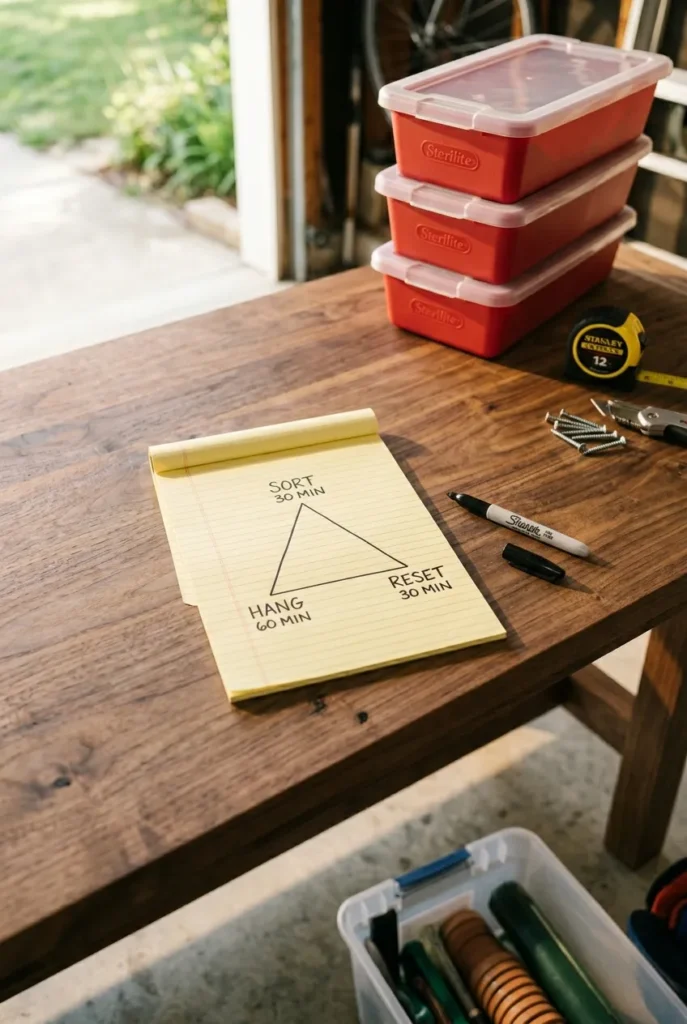
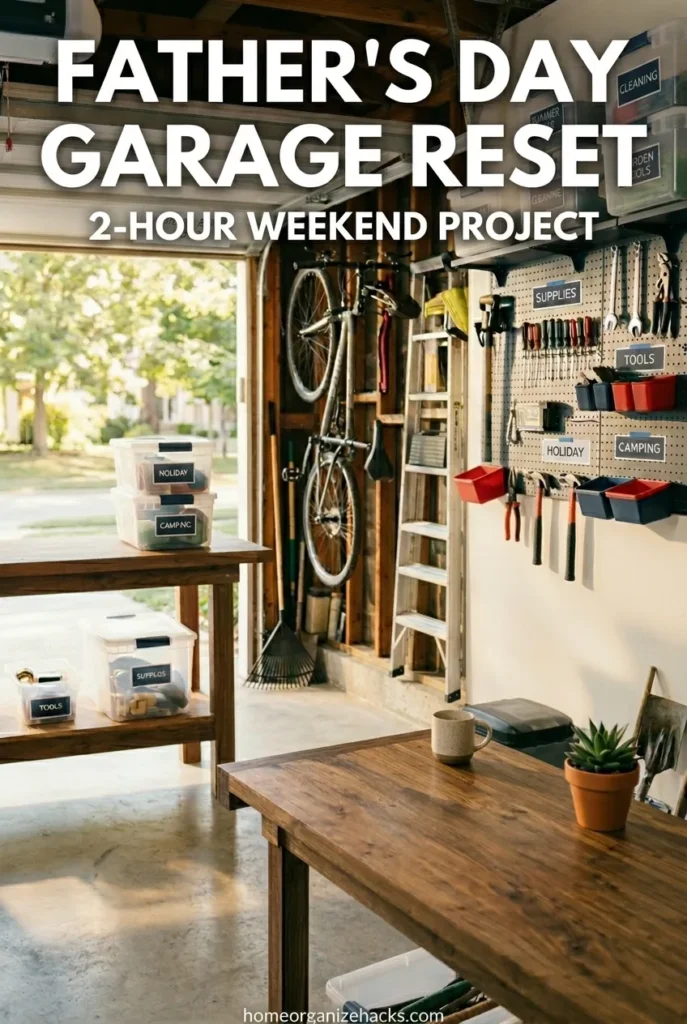
The 2-Hour Garage Reset Triangle is the backbone of this entire garage organization weekend project. Three corners, three time blocks, one finished garage. Sort takes 30 minutes. Hang takes 60. Reset takes 30. That’s it.
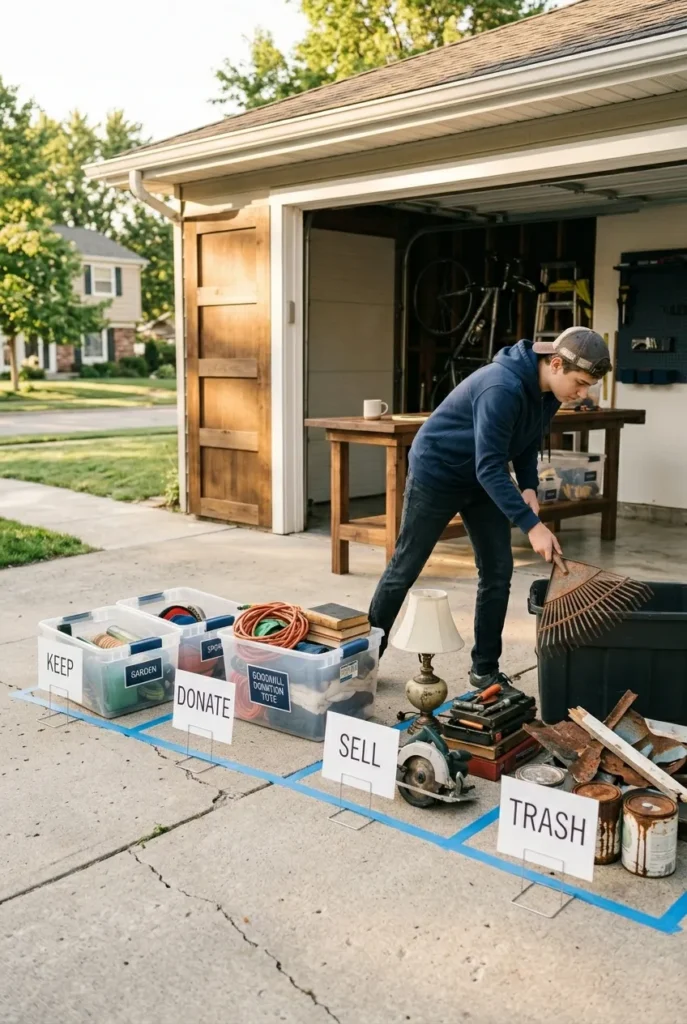
Sort means everything comes off the floor and into one of four piles: keep, donate, sell, trash. No “maybe” pile. Maybe is how garages got this way in the first place.
Hang means moving keep-pile items off the floor and onto walls, ceilings, and shelves. This is the work block. It’s loud. It’s satisfying. It’s the part you’ll photograph for the family group chat.
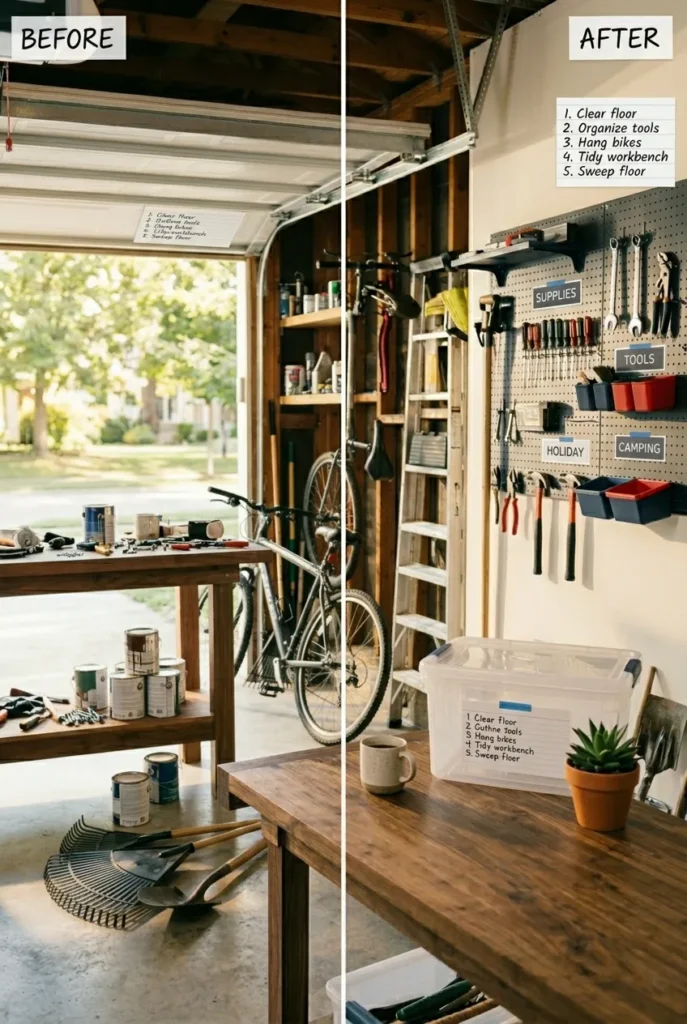
Reset means putting the labels on, sweeping the floor, breaking down boxes for recycling, and writing a 5-line maintenance note on the fridge. The reset is what keeps the garage organized in October, not just June.
Print this triangle on a sticky note, slap it on the door from the kitchen to the garage, and you have a permanent reminder. We’ll come back to it in every H2 below.
The Pre-Project 10-Minute Sweep (Do This Before You Buy Anything)
Here’s where most weekend projects die: people drive to Home Depot first. Don’t. Spend 10 minutes walking your garage with a notepad and answering three questions. What’s broken? What hasn’t been touched in 12 months? What’s actually being stored here that belongs inside the house?
Write it down. Take 8 phone photos, one of each wall and the ceiling. Those photos are the before shots you’ll text the family later. They’re also the layout map for the Hang block.
Now measure. Get the wall length, the ceiling height, and the depth between studs (US studs are typically 16 inches on center). Those three numbers decide which storage products fit and which don’t. A 32-inch slatwall panel will not save you if your only clear wall is 28 inches.
This pre-sweep is the budget protector. We’ve watched friends drop $340 at Home Depot before they realized half of it wouldn’t fit. Measure first, buy once.
For a deeper take on building a household reset that includes the garage, our [INTERNAL LINK: summer cleaning schedule for a lighter routine] folds garage day into the wider summer rhythm.
Sort Block: 30 Minutes, Four Piles, Zero Mercy
Set a phone timer for 30 minutes. Drag everything off the floor and out from the corners. Pile it in the driveway or front lawn. Yes, the neighbors will see. They’ve seen worse.
Now sort fast into four piles. Keep is anything you’ve used in the last 12 months or you’ll definitely use in the next 6. Donate is anything that works but you won’t use. Sell is anything worth over $25 that someone on Facebook Marketplace would buy by Tuesday. Trash is anything broken, expired, or rusted past saving.
The single sorting rule that makes this work: one touch per item. You pick it up once and it goes in a pile. No re-sorting. No second guessing. The pile is the decision.
Drop the donate pile in the car immediately. Drive it to Goodwill or Habitat for Humanity ReStore on Monday morning. If it stays in your driveway past Sunday night, it’s coming back into the garage. We promise.
The trash pile needs a quick safety pass per OSHA’s guidance on storing hazardous household chemicals. Old paint, gasoline, motor oil, and pesticides don’t go in the regular trash. Check your county’s hazardous waste collection schedule. Most US counties run a free drop-off twice a year.
The 4-Zone Garage Map: Where Everything Actually Goes
Before you start hanging anything, divide the garage into four zones. This is the layout step every Pinterest pin glosses over and every successful garage organization weekend project does first.
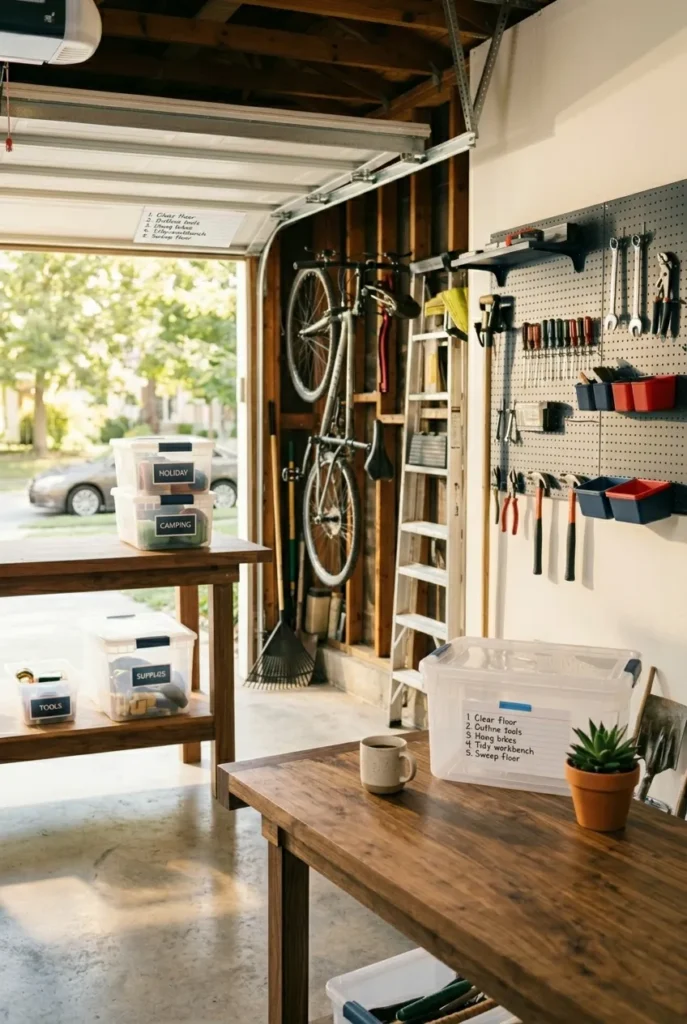
Zone 1 is the Daily-Use Wall. The wall closest to the door you actually use. Hooks for keys, dog leash, broom, a cleaning caddy. If you reach for it three times a week, it lives here.
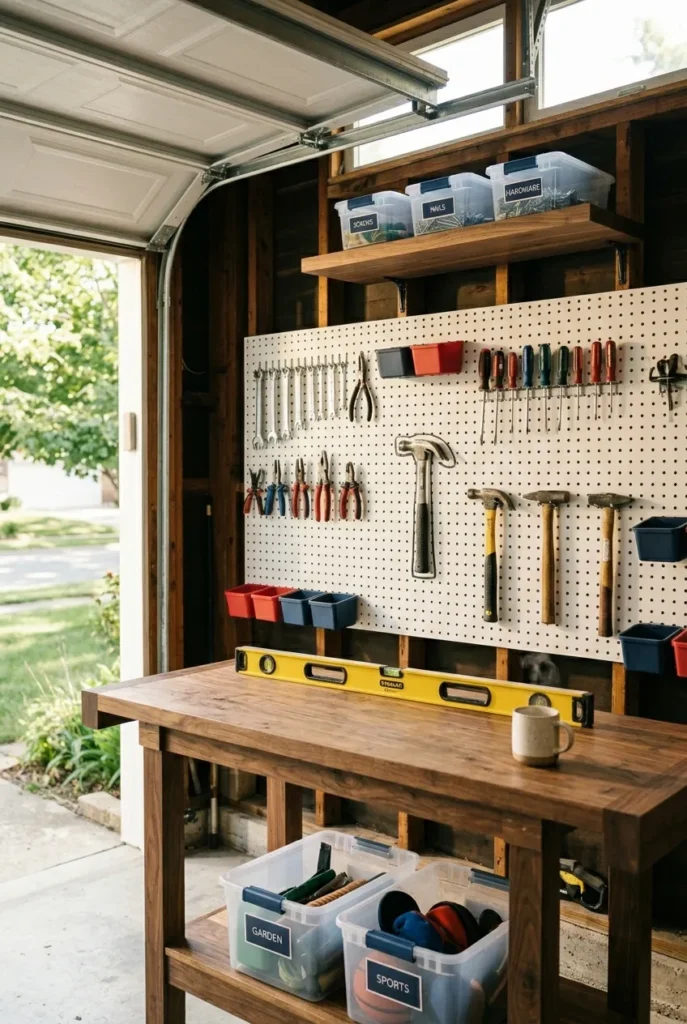
Zone 2 is the Tool & Workshop Wall. Pegboard or slatwall, the workbench, the toolbox. Hand tools at eye level. Power tools on a shelf above the bench. Painter’s tape and a level on a hook by the bench because you’ll always need them.
Zone 3 is the Sports & Seasonal Wall. Bikes vertical on wall hooks, a row of labeled Sterilite totes for holiday decor, a hanging caddy for sports balls. This is where ceiling storage earns its keep too, since holiday bins only come down twice a year.
Zone 4 is the Garden & Long-Handle Corner. Rakes, shovels, brooms, the leaf blower. A simple rail with hooks at 60 inches off the floor holds every long-handle tool in 18 inches of wall.
Map your zones on the notepad from the Pre-Project Sweep. Sketch a quick rectangle, label each wall. You now know exactly what goes where before you mount a single hook. That’s the entire trick.
Hang Block: 60 Minutes of Wall, Ceiling, and Pegboard Magic
The 60-minute Hang block is the loud, satisfying middle of the 2-Hour Garage Reset Triangle. Five sub-steps, twelve minutes each. Move fast.
First: mount the pegboard. A 32 by 48 inch pegboard from Home Depot runs about $24 and holds roughly 40 to 50 hand tools. Use 1.5-inch wood screws into studs, never just into drywall. Add 1-inch spacers so hooks slide in without scraping.
Second: install one Gladiator or Rubbermaid FastTrack rail along Zone 4 at 60 inches off the floor. A 4-foot rail with five hooks runs about $39 and clears every long-handle tool off the floor in one motion.
Third: hang the bikes vertical with wall hooks in Zone 3. Two Delta Cycle Leonardo hooks at $19 each save roughly 15 square feet of floor per bike. We did this in March; the floor space alone changed how the garage felt.
Fourth: install the ceiling rack if your garage has 8-foot or taller ceilings. A 4-by-8 foot SafeRacks overhead rack runs about $189 and holds up to 600 pounds. Per the US Department of Energy’s overhead-storage guidance, keep heat-sensitive items like candles, paint, and electronics off the ceiling rack in summer since attached garage ceilings can hit 110°F in direct sun.
Fifth: stack and label the totes in Zone 3. Clear bins for things you’ll need this season. Opaque red or green Sterilite totes for holiday decor (red for Christmas, green for fall is the universal shortcut). Label both the front and the top of every bin with a Sharpie on white painter’s tape so labels peel off cleanly when contents change.
The cleaning supply caddy that lives in Zone 1 is its own small system. For a full breakdown of what belongs in it and how to keep it stocked, see our take on [INTERNAL LINK: cleaning supplies storage that beats the kitchen sink].
The Renter-Friendly Hang Block (No Drilling Allowed)
Renting? Skip the slatwall and the screws. Use Command 3M Heavy Duty hooks (rated up to 7.5 pounds each) for brooms, extension cords, and bike helmets. Run a tension rod across the inside of a utility closet for hanging caddies. Use freestanding 5-tier Amazon Basics wire shelving (about $79 for a 36-by-18-inch unit) instead of mounted shelves. Stack Sterilite totes against the wall with the labels facing out. The system holds, the security deposit holds.
Reset Block: 30 Minutes to Lock It In
The Reset block is where most weekend projects fall short. People hang the pegboard, take the photo, and walk away with the labels still in the package. Don’t.
Spend the first 10 minutes labeling. White painter’s tape plus a black Sharpie is the workhorse. A label maker is nicer but adds $30 to the budget and saves no time at this scale.
Spend the next 10 minutes sweeping. A push broom across the polished concrete pulls out every last bit of dirt the sort block kicked loose. Wipe the workbench, the windowsill, and any horizontal surface.
Spend the last 10 minutes writing the 5-line maintenance note. Stick it inside the garage door. The lines: one, hang it where it lives. Two, no item touches the floor after 8 p.m. Three, the donate pile lives by the car. Four, the trash pile goes out Monday. Five, reset the floor every Sunday for 5 minutes.
This 5-line note is what keeps the garage organized through Labor Day, Thanksgiving, and the December chaos. Without it, the floor wins by August.
The Under-$100 Shopping List (What to Buy, What to Skip)
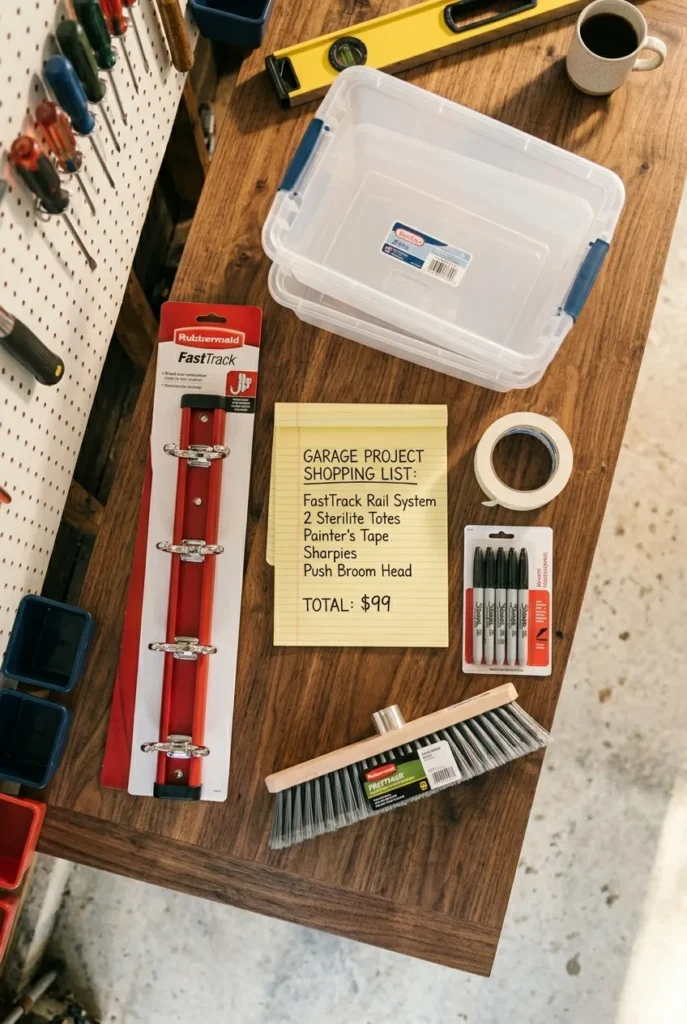
The whole garage organization weekend project should come in under $100 if you buy smart and skip the stuff Instagram tries to sell you. Here’s the exact list we use.
Buy the 32 by 48 inch pegboard kit from Home Depot for about $24. Buy a 4-foot Rubbermaid FastTrack rail with five hooks for about $39. Buy a pack of 50 white painter’s tape labels for about $4. Buy a single Sharpie 4-pack for $6. Buy two clear 27-quart Sterilite totes at Target Brightroom for about $14 total. Buy a fresh push broom for $12.
That’s $99 and it covers four walls of a real two-car garage.
Skip the matching tote sets that run $40 each. Skip the Instagram modular drawer systems. Skip anything with a brand-name pegboard hook that costs $3 per hook when generic Amazon Basics hooks run 50 cents.
Two upgrades worth considering if budget allows. A SafeRacks ceiling rack at $189 if you have 8-foot ceilings and a lot of holiday gear. A Husky 46-inch rolling toolbox at $179 if Dad’s tools currently live in five different plastic bins.
The Father’s Day Team Workflow: Two People, Two Hours
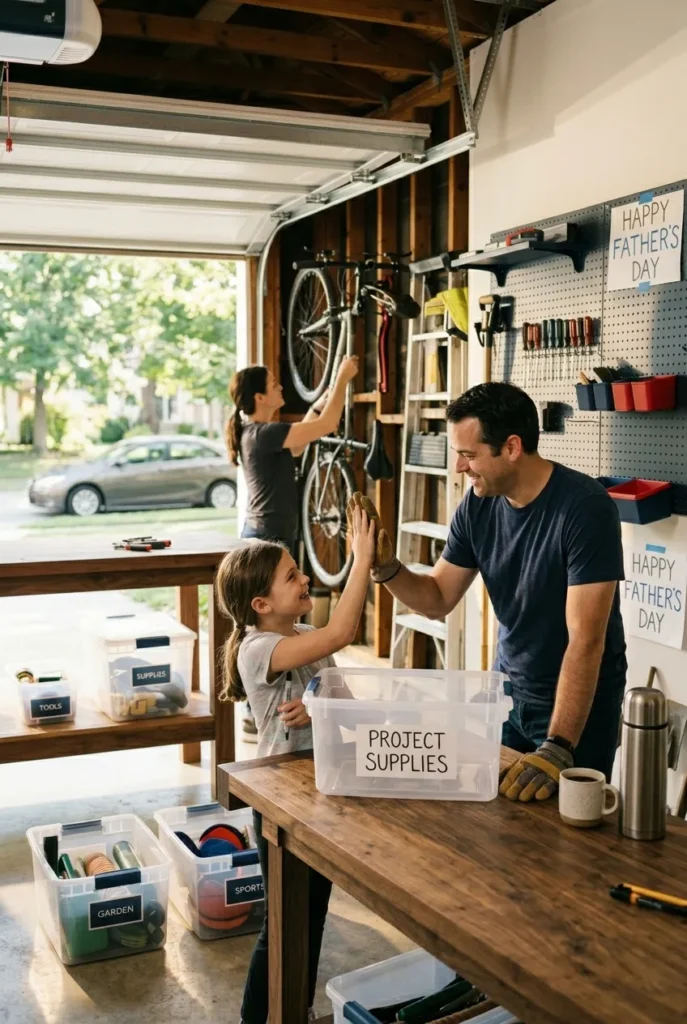
The Father’s Day twist on this garage organization weekend project is the partner workflow. One person sorts. One person hangs. The math triples the speed.
Hour one. Dad walks the garage with the notepad and runs the Sort block while the kids drag everything onto the driveway. By the 30-minute mark, the four piles are formed and the trash pile is bagged.
Hour two. Dad runs the Hang block on the pegboard and rail. The kids label totes and stack them in Zone 3. Mid-hour, swap roles for 15 minutes so everyone learns the system. End the hour with the Reset block run as a team.
The reason this works: nobody is alone with the decisions. When Dad hesitates on the 2009 hedge trimmer, a teenager will absolutely tell him to donate it. This is the single biggest accelerator we’ve found.
Kids 6 to 10 can label totes, sort screws into bins, and bag the trash pile. Kids 11 and up can mount pegboard hooks, hang bikes, and run the broom. For an age-by-age breakdown of what kids can actually own in a household reset, our [INTERNAL LINK: free printable chore chart by age] maps it out toddler to teen.
Six Garage Organization Hacks the Pinterest Top 10 Always Misses
These are the small ones that change everything. Pinterest’s top pins love the pegboard wall and the ceiling rack. They skip these.
One. Magnetic strip above the workbench. A 24-inch kitchen knife magnetic strip ($14 at IKEA Variera or Amazon) holds metal hand tools at eye level, no hooks needed. Screwdrivers, pliers, scissors. Snap on, snap off.
Two. Tennis ball drop guide. Hang a tennis ball from the ceiling on a string so it just touches the windshield when the car is parked perfectly. Free. Genius. Dad will love it.
Three. PVC pipe vertical garden tool holder. Cut a 4-inch PVC pipe into 18-inch segments, mount them vertical on a 2×4 plank, and drop the rakes and shovels handle-first. Stable, cheap, takes 20 minutes.
Four. Pool noodle bumper on the wall where the car door swings. A 6-foot pool noodle, slit lengthwise, slipped over a wall stud, glued in place with construction adhesive. $3 of dent prevention.
Five. Repurposed coffee can screw jars. Three empty Folgers cans on a shelf with labels reading SCREWS, NAILS, ANCHORS. Total cost: zero. Total satisfaction: high.
Six. The “go bag” hook. One canvas tote on a single Command hook by the door, stocked with sunscreen, bug spray, the trash bag roll, and a pair of work gloves. Grab it on the way out for any yard job. This is the hack people steal first.
How to Maintain the Garage After Your Weekend Project
The garage that stays organized is the one that gets a 5-minute weekly reset. Sunday evening, walk through, hang anything on the floor, sweep the entry, check the donate pile. Done.
Add a 30-minute seasonal swap four times a year. Spring: pull out garden gear, store snow shovels. Summer: surface pool noodles and beach chairs, push the leaf rake to the back. Fall: rake forward, mower forward, lawn furniture covered. Winter: snow shovels by the door, holiday bins down, summer gear stowed high.
Add a 2-hour annual reset every Father’s Day. The same triangle. Same four zones. Same shopping list refreshes. By year three, the garage maintains itself because the system runs on muscle memory.
The maintenance note from the Reset block does the heavy lifting. Read it every Sunday. The weekend project doesn’t fail because the system is wrong. It fails because nobody re-reads the note.
Three Common Mistakes That Sink a Garage Organization Weekend Project
We see the same three derailers every time. Avoid them and the 2-hour clock works.
Mistake one: starting without measuring. People buy a pegboard, drive home, and discover the only clear wall is 30 inches and the pegboard is 48. Measure first, buy once.
Mistake two: keeping the “maybe” pile. Maybe items go back into the corners by Wednesday. The four-pile rule with no maybe is non-negotiable. If you cannot decide in 5 seconds, it goes to donate. You have not used it. You will not use it. Let it go.
Mistake three: skipping the Reset block. The labels matter. The note matters. The sweep matters. Without the Reset, the floor wins again by August because nobody knows where anything lives.
The Frequently Asked Questions on Garage Organization Weekend Projects
How do I organize a garage full of stuff in one weekend?
Use the 2-Hour Garage Reset Triangle. Sort everything onto the driveway for 30 minutes, hang and bin for 60 minutes, label and sweep for 30 minutes. The single weekend window works because you make fast one-touch decisions instead of agonizing over each item.
What is the cheapest way to organize a garage?
Under $100 with a pegboard from Home Depot ($24), a Rubbermaid FastTrack rail ($39), two Sterilite totes ($14), painter’s tape labels ($4), Sharpies ($6), and a push broom ($12). Skip matching tote sets and brand-name modular systems.
How do I organize a garage on a budget?
Lean on Dollar Tree clear bins for small parts, repurpose coffee cans for screws and nails, use Command hooks for renter-friendly hanging, and buy pegboard hooks generic instead of brand-name. Total spend stays under $50 if you reuse what you have.
What’s the best garage organization layout?
A 4-zone map works for almost every US garage. Zone 1 daily-use wall by the door. Zone 2 tool and workshop wall with pegboard. Zone 3 sports and seasonal wall with bikes and totes. Zone 4 garden and long-handle corner with a rail at 60 inches.
Are IKEA garage storage products worth it?
For small parts and tote organization, yes. IKEA Variera magnetic strips and Skubb fabric boxes work well inside cabinets. For wall-mount systems and ceiling racks, Rubbermaid FastTrack, Gladiator, and SafeRacks outperform IKEA on weight rating and US stud spacing.
How do I get my husband or partner to help with the garage?
Schedule it as a Father’s Day morning team project with a defined 2-hour window, a printed plan (the Reset Triangle), and a finish line (lunch at noon). Time-boxing plus a visible plan removes the open-ended dread that usually kills the project.
What should I throw away from my garage?
Anything broken, expired, rusted past saving, or untouched for 12-plus months. Paint older than 5 years (the latex separates), gasoline older than 6 months (it gums up engines), and any pesticide past its label date. Dispose at your county’s hazardous waste day, not the regular trash.
Your 2-Hour Reset Starts This Saturday
The garage isn’t going to organize itself, and the all-day version of this project is exactly why you haven’t started yet. The 2-Hour Garage Reset Triangle gives you a clean entry point: 30 minutes to sort, 60 to hang, 30 to lock it in. Add the Father’s Day team workflow and the whole thing turns into a memory instead of a chore.
Print this article, post it inside the garage door, set the timer for Saturday at 9 a.m. By 11 a.m. you’ll have a garage you’ll actually want to show off in the family group chat. What’s the first zone you’re tackling, the tool wall or the bike corner?