

Garage Organization Ideas: From Chaos to Clean in a Weekend
You open the garage door, and a wave of stuff stares back at you. A rake is leaning against a bag of potting soil that’s been there since 2023. The bikes are tangled. There’s a half-empty paint can on the floor, three plastic bins with no lids, and a Costco-size box of paper towels you bought two summers ago and forgot about. You close the door. We’ve all done it.
Here’s the good news. You can fix this in one weekend, and you don’t need a $4,000 custom cabinet system to do it.
This whole guide is built around a simple weekend timeline. Friday night you prep, Saturday you declutter, Sunday you build the systems. Every garage organization idea below is sorted into that timeline so you know exactly when to use it, what it costs, and how to do it whether you own your home or rent. The aesthetic lean is Modern Farmhouse meets Organic Modern (cream pegboards, oak shelving, black hardware, one sage accent), but every tip works in any style.
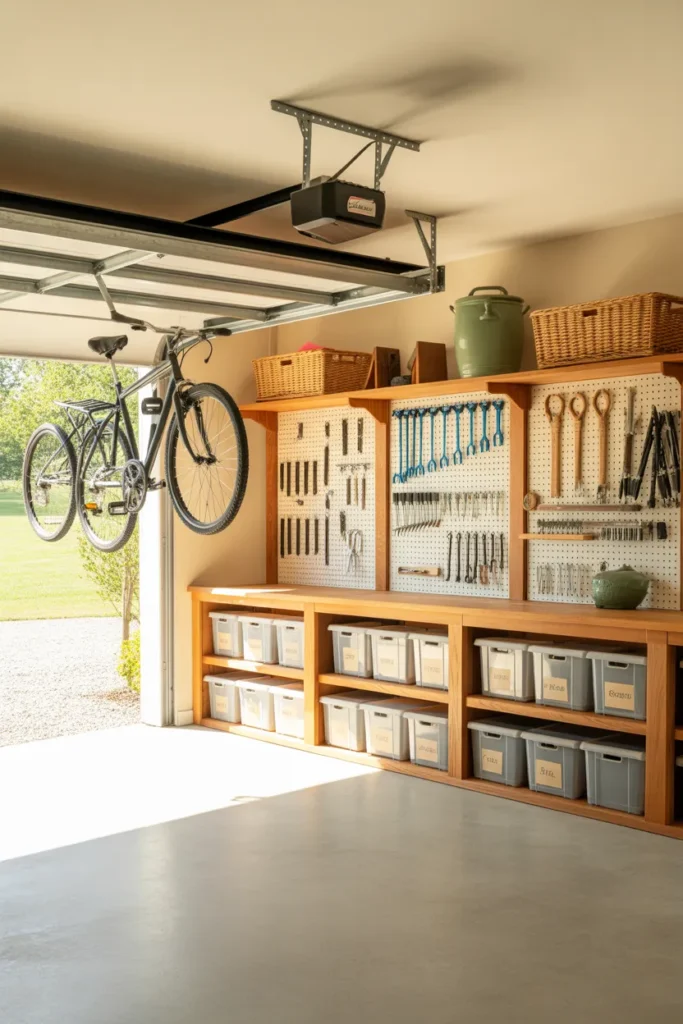
Who This Guide Is For
- Homeowners with a one-car or two-car attached garage that’s become a dumping zone
- Renters who want a no-drill, command-strip-safe setup they can take with them
- Small-space dwellers working with a single-car footprint under 250 square feet
- Budget-conscious DIYers who want results under $100 (we’ll show you how)
- Mid-range shoppers ready to invest $100 to $500 in real shelving and pegboard systems
- Anyone with too much stuff who’s tried to organize before and watched the chaos come back within three months
If you fall into any of those buckets, you’re in the right place. Keep reading.
Friday Night: The 90-Minute Prep (So Saturday Actually Works)
Most weekend garage projects fail because people skip Friday night. They show up Saturday at 9 a.m., pull everything out of the garage, get overwhelmed at noon, eat a sandwich, and quit by 3 p.m. Don’t do that.
Friday night is for planning, not lifting. Spend 90 minutes doing this and you’ll save four hours on Saturday.
Measure Your Walls and Sketch Zones
Grab a tape measure and a piece of paper. Measure the four walls, the ceiling height, and any doors or windows that interrupt your wall space. Most attached garages are 12 by 22 feet for a single car, 20 by 22 feet for a double. Wall studs sit 16 inches on center in almost every American garage built after 1965, which matters when you’re hanging anything heavy.
Sketch four zones on your paper. Zone 1: cars. Zone 2: yard and outdoor tools. Zone 3: sports and recreation. Zone 4: workshop and household. This is the bones of every good garage layout.
Set a Realistic Budget
Decide your number Friday night, not Saturday at Home Depot. A bare-bones decluttered garage with wire shelving and a pegboard runs $80 to $150. A solid mid-range setup with a Gladiator track system or IKEA BROR shelving lands around $400 to $700. A full custom build with overhead racks, slatwall, and locking cabinets runs $1,200 to $3,500 DIY, and $4,000 to $12,000 if you hire it out. We’ll break this down later in the cost section.
Shop Your House First
Before you buy anything, walk through your house and look for bins, baskets, and shelves you can repurpose. That clear shoebox-size bin in the linen closet? Garage. The plastic milk crate from your college apartment? Garage. Most homes have $50 worth of usable storage already sitting unused.
For the deeper mindset shift, you can borrow the framework from the 10-10 decluttering method and run two 10-minute passes Friday night, one focused on tossing the obvious trash and one focused on grouping what’s left.
![Friday night garage planning flat lay with hand-drawn sketch, tape measure, and coffee on cream linen]](https://homeorganizehacks.com/wp-content/uploads/2026/05/Friday-night-garage-planning-flat-lay-with-hand-drawn-sketch-tape-measure-and-coffee-on-cream-linen-683x1024.webp)
Saturday Morning: The Big Pull-Out and Sort
This is the loud part. You’re going to empty the entire garage onto the driveway. Yes, all of it. The reason this works is simple: you can’t see what you have when it’s piled in corners. Spread out on concrete, the truth becomes obvious.
Block off Saturday from 8 a.m. to noon for this step alone. Coffee, water bottle, comfortable shoes, sunscreen if it’s a sunny day.
Use the 4-Pile System
As you pull each item out, it goes into exactly one of four piles. No “I’ll decide later.” That’s how chaos comes back.
- Keep: You used it in the last 12 months and it works
- Donate: Working condition, no longer your style or stage of life
- Sell: Worth more than $25 and you’ll actually post it within 7 days
- Trash or hazmat: Broken, expired, or chemical waste
The “what is the 4 C’s of decluttering” question shows up in Google’s People Also Ask for a reason. The 4 C’s are commonly stated as Categorize, Cull, Contain, Communicate. You’re nailing the first two right now: Categorize the piles, Cull what you don’t need. Contain comes Sunday.
Apply the 1/3/5 Rule for Tough Decisions
This is one of the most-searched decluttering frameworks for a reason. It’s brutal and it works.
- If you haven’t used it in 1 year, donate it
- If you have 3 or more duplicates (hammers, tape measures, screwdrivers), keep your favorite and donate the rest
- If repairing it would cost more than $5 in parts or 5 minutes of effort, toss it
I went through my own garage with this rule last spring and pulled four kitchen-trash-bag-size loads of stuff I’d been moving from corner to corner for six years. Four loads. From one half of a two-car garage.
Handle Hazmat the Right Way
Old paint, half-used pesticides, swollen lithium batteries, motor oil, and pool chemicals do not go in the regular trash. The EPA categorizes these as household hazardous waste, and most US counties run free or low-cost drop-off events for them. Search your county name plus “household hazardous waste collection” before Saturday and put the date on your calendar.

Saturday Afternoon: What NOT to Store in Your Garage (Top 5 Articles Skip This)
Before you start putting things back, here’s the part competitors completely miss. Your garage is not a climate-controlled storage unit. Humidity swings from 30% to 80% depending on season, and temperatures can hit 110°F in summer or 20°F in winter. Some stuff just doesn’t belong out there.
Items That Should Move Inside
- Paint cans more than 2 years old (they freeze, separate, and skin over)
- Important paperwork, photo albums, and books (moisture and mice)
- Canned food and pantry overflow (cans rust and bulge in temperature swings)
- Wine and pet food (oxidation, rancidity, and pest attraction)
- Electronics, batteries, and propane tanks indoors-stored (heat, cold, and code violations)
Items That Stay Out But Need Proper Storage
The National Fire Protection Association recommends storing gasoline only in approved red safety cans, capped tightly, on the floor (never on a shelf above head height), and away from any pilot light, water heater, or electric motor. Same goes for lawn mower fuel, kerosene, and chainsaw oil. If you have an attached garage with an interior door to the house, that door should be a self-closing fire-rated door with weatherstripping. Most builders include this by code, but check yours.
This single section will save someone reading this from a real disaster. It’s also why this article will outrank the ones that skip it.
Sunday: Build the Systems (Where the Pinterest-Worthy Stuff Happens)
Saturday was demolition. Sunday is construction. By Sunday night your garage will look like the before-and-after photos you’ve been pinning for years.
Idea 1: Go Vertical With Wall-Mounted Storage
What it is: Mounting shelves, hooks, and tool walls 18 inches off the floor and up, leaving the bottom clear for sweeping and parking.
Why it works: A typical garage has 400 to 600 square feet of wall surface that’s currently holding nothing. Floor space is precious, wall space is free real estate. Clutter Keeper, Real Simple, and Clutterbug all push this for a reason: it’s the single highest-leverage move in any garage organization plan.
How to execute: Find your studs with a $15 magnetic stud finder. Install one 48-inch heavy-duty wall track at 5 feet off the floor (Rubbermaid FastTrack and Gladiator GearTrack are both solid mid-range options at $30 to $50 per track at Home Depot and Lowe’s). Add hooks for rakes, brooms, weed whackers, and extension cords. For more wall-space strategies that apply across the house too, our full guide on vertical storage ideas breaks it down room by room.
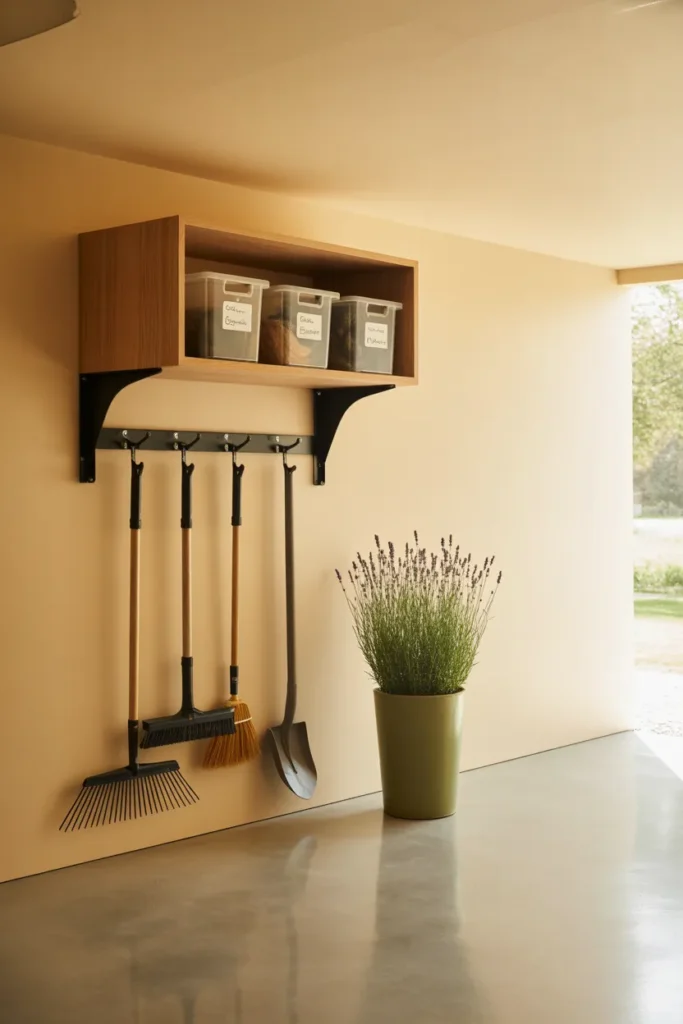
Idea 2: Install a Pegboard Tool Wall
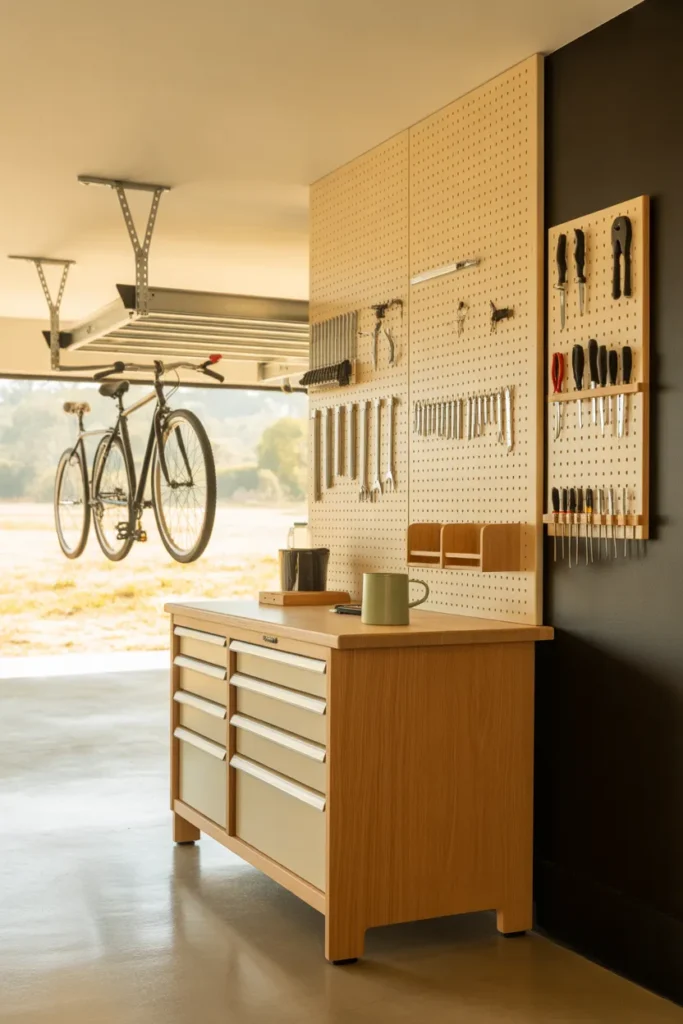
What it is: A 4 by 8 foot pegboard mounted on the wall above your workbench, with hooks shaped to hold each tool in a labeled silhouette.
Why it works: You can see every tool at a glance, which means you actually put it back instead of dropping it on the bench. The “shadow” outline behind each tool (drawn with a black Sharpie or vinyl decal) makes the put-back step mindless.
How to execute: Standard 1/4-inch pegboard sheets are $25 at Home Depot. Furring strips behind the board ($8) create the half-inch gap you need for hooks to slide in. Paint the pegboard cream or sage for the Modern Farmhouse look, white for clean Scandi, or matte black for Industrial. A starter pack of 100 assorted hooks runs $15 on Amazon.
Idea 3: Mount Overhead Ceiling Racks for Seasonal Bins
What it is: Heavy-duty steel racks that bolt into ceiling joists and hold 200 to 600 pounds of bins above your car.
Why it works: Christmas decorations, suitcases, camping gear, and that artificial tree you use for 6 weeks a year do not deserve floor or wall space. The ceiling is dead space and these racks pay for themselves in floor space gained.
How to execute: FLEXIMOUNTS and SafeRacks units run $80 to $180 at Costco, Amazon, and Home Depot for a 4 by 8 foot rack. Install requires two people, a ladder, and a 1/2-inch drill bit for the lag bolts. Always mount directly into joists, never into drywall alone. Leave at least 18 inches of clearance from your garage door track.
Idea 4: Set Up a Charging Station for Power Tools
What it is: A dedicated 2-foot-wide shelf or wall cubby with a power strip and battery chargers for every cordless tool you own.
Why it works: Dead batteries are the number one reason DIY projects stall. One station means one outlet, one place to look, one habit.
How to execute: Mount a 24-inch melamine shelf at chest height. Add a 6-outlet surge protector ($15 at Target) screwed to the underside. Label each charger slot with a vinyl label maker. Total cost under $40 if you already own the tools.
Idea 5: Build a Sports and Outdoor Zone
What it is: A wall or corner dedicated to bikes, balls, helmets, fishing rods, and pool gear, sorted by sport not by person.
Why it works: Kids grow out of sports gear in cycles. Sorting by activity (basketball bin, hockey bin, swimming bin) makes it easy to donate the whole bin when the kid moves on, instead of digging through Joey’s drawer trying to remember what fits.
How to execute: Wall-mounted bike hooks at 7 feet off the floor (Delta Cycle hooks are $8 each at Walmart and Amazon). A 32-gallon galvanized trash can in the corner makes a perfect bat-and-stick holder. Stackable mesh ball bins ($25 each at HomeGoods) for round balls.
Idea 6: Add a Mini Mudroom Inside the Garage Entry
What it is: A 4-foot wall section right by the door to the house, with a bench, hooks, a shoe tray, and a small basket for daily-grab items.
Why it works: Dirty shoes, sports cleats, wet umbrellas, and dog leashes never make it into the house. The transition zone catches them.
How to execute: IKEA’s HEMNES bench ($150) plus a row of 4 cast-iron hooks ($20) plus a boot tray ($15) creates a full mudroom corner for $185. Add a wall-mounted basket above for hats and gloves. Renters: a freestanding bench plus 3M Command hooks rated for 5 pounds each, no drilling required.
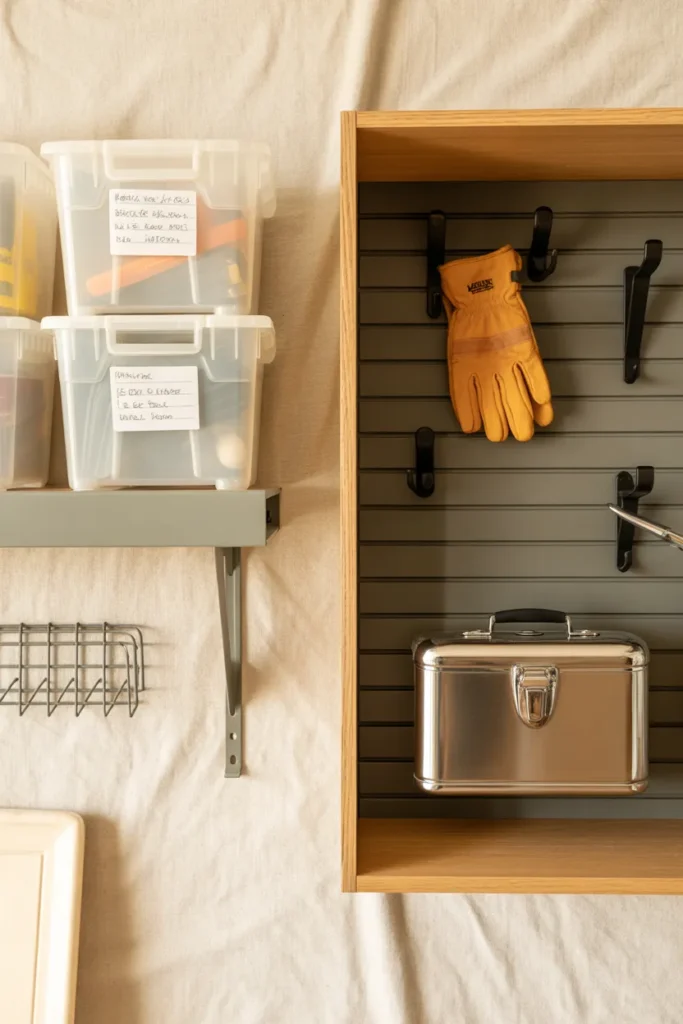
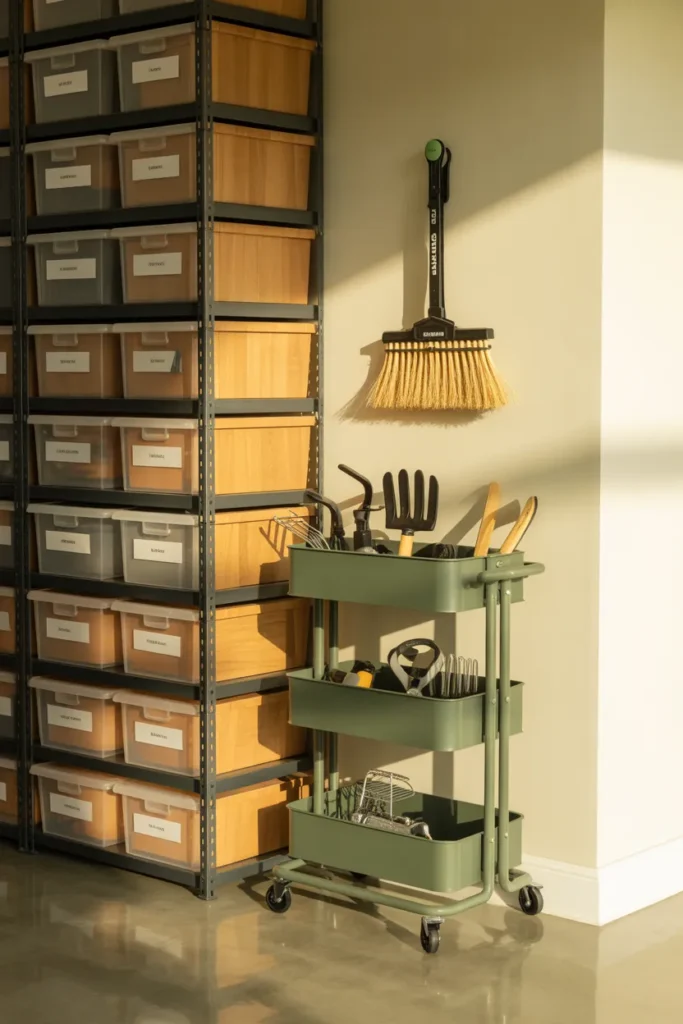
Idea 7: Use Clear Labeled Bins (Not Opaque Ones)
What it is: Stackable clear plastic bins with snap-tight lids, each with a label naming the contents.
Why it works: You can see what’s inside without opening, and the label keeps you honest. Opaque bins are how you end up with three boxes labeled “Misc” that nobody opens for 5 years.
How to execute: IRIS Weathertight totes ($14 to $22 at Target and Amazon depending on size) handle humidity better than the cheap unsealed kind. Label each end and the top so you can identify them stacked on a shelf or pulled out flat. A Brother P-Touch label maker ($30 on Amazon) makes labels that don’t peel.
Idea 8: Magnetic Strip for Small Metal Tools
What it is: A 24-inch magnetic strip mounted on the wall holding screwdrivers, pliers, scissors, and small wrenches.
Why it works: Drawers swallow small tools. A magnetic strip displays them, keeps them within reach, and forces a put-back habit.
How to execute: 12-inch magnetic strips are $15 to $30 at Harbor Freight, Amazon, or Home Depot. Mount with two screws into a stud or with heavy-duty Command strips for renters.
Idea 9: Install a Workbench With Drawer Storage
What it is: A 4 to 6 foot workbench with 2 to 4 drawers underneath, anchored to the wall studs.
Why it works: Most “garage workbenches” are just folding tables that wobble. A real bench with drawers gives you a stable work surface and stores screws, nails, sandpaper, and small tools in one place.
How to execute: Husky and Gladiator both sell solid workbenches at $200 to $400 at Home Depot. DIY: a 2×4 frame with a 3/4-inch plywood top costs $80 in lumber. Add stick-on drawer dividers from Dollar Tree ($1.25 each) to keep contents from rolling around.
Idea 10: Hang Bikes From the Ceiling With a Pulley System
What it is: A simple rope-and-pulley hoist that lifts bikes flat against the ceiling and out of the way.
Why it works: Bikes take up massive floor space when standing, and even wall-hooks pull them out into the room. Ceiling-mounted is the ultimate space saver.
How to execute: RAD Cycle pulley hoists run $25 to $40 each on Amazon. Most kits hold 50 pounds, plenty for any bike except heavy e-bikes (check capacity for those). Mount into ceiling joists, never drywall.
Budget vs Splurge: Garage Organization Cost Breakdown
This is the comparison nobody else gives you with real numbers. Pick the tier that matches your situation.
Budget Tier: Under $100 Total
- Wire shelving unit, 5-tier, 36 inches wide: $45 at Walmart or Amazon
- Bag of 20 utility hooks: $12 at Dollar Tree (4 packs at $3 each)
- 6 clear shoebox-size bins: $9 at Dollar Tree (best $9 you’ll spend, full list of cheap wins in our Dollar Tree organization hacks guide)
- Pack of vinyl labels and a permanent marker: $5
- 1 magnetic tool strip, 12 inches: $15 at Harbor Freight
- 1 broom and rake holder rack: $12 at Walmart
Total: $98
Mid-Range Tier: $300 to $600
- Gladiator GearTrack wall system, 8 feet: $90 at Home Depot
- Pegboard, hardware, and assorted hooks: $50
- 4 IRIS Weathertight totes, 30-quart: $80 at Target
- FLEXIMOUNTS 4×8 overhead ceiling rack: $130 at Costco
- Husky 46-inch workbench: $200 at Home Depot
- Brother P-Touch label maker: $30 at Amazon
Total: $580
Splurge Tier: $1,500 to $3,500 DIY
- Full slatwall system, 16 linear feet, with accessories: $600 at Proslat or Garage Trac dealers
- Gladiator GearBox locking cabinet trio: $900
- Two FLEXIMOUNTS ceiling racks: $260
- Built-in oak butcher-block workbench: $400 in materials
- Epoxy floor coating kit, two-car garage: $400 at Rust-Oleum
- Smart LED shop lights, 4-pack: $120 at Costco
Total: $2,680
Hire-It-Out Tier: $4,000 to $12,000
Pro garage organization companies (Garage Living, GarageExperts, California Closets Garage) charge $4,000 to $7,000 for a single-car custom build and $8,000 to $12,000 for a two-car. This includes design consultation, custom slatwall, modular cabinets, epoxy flooring, and overhead racks, installed in 1 to 2 days. Worth it if you have the budget and zero DIY appetite. Most homeowners save 70% by doing the same project themselves over a weekend.
Renter-Friendly Garage Organization (No-Drill Setup)
If you rent your home, half the tips above are off the table because you can’t drill into the walls or ceiling. Here’s the no-damage version of the whole system.
- Freestanding wire shelving (no anchoring required) instead of wall-mounted shelves
- 3M Command hooks rated for 5 to 7.5 pounds for brooms, rakes, and light tools
- Over-the-door organizers for the door connecting garage to house (small hand tools, gloves, sprays)
- Rolling carts (IKEA RÅSKOG or similar at $40 to $70) for workshop and gardening supplies
- Freestanding pegboard frame on caster wheels instead of wall-mounted pegboard
- Stackable bins (no shelving needed) to build vertical storage on the floor
The whole renter setup runs $150 to $300 and goes with you when you move.
Common Mistakes to Avoid
I’ve cleaned out four garages in my own lifetime (two as a homeowner, two helping family) and watched a dozen friends try the same. These are the mistakes that show up every time.
- Buying bins before decluttering. You’ll buy 3 times what you need. Declutter first, measure what’s left, then buy.
- Stacking heavy stuff above shoulder height. Anything over 25 pounds belongs at waist level. Backs and feet will thank you.
- Storing paint and gasoline next to the water heater. Code violation and fire risk. Pilot lights ignite vapors.
- Using cardboard boxes. Mice chew through cardboard in one season. Always plastic bins with lids in a garage.
- Skipping the labels. Future-you will not remember what’s in the unlabeled bin. Label every single one.
- Trying to do it all in one day. The weekend timeline exists for a reason. Spreading the work over Friday-Saturday-Sunday is the difference between finishing and quitting.
- Hanging bikes by the front wheel only. Most cheap hooks crack the rim over time. Use horizontal mounts or proper J-hooks rated for the weight.
Frequently Asked Questions
How do I organize a garage with too much stuff?
Start by emptying everything onto the driveway. You cannot organize what you cannot see. Sort into four piles (keep, donate, sell, trash) using the 1/3/5 rule: anything unused in 1 year, anything with 3 or more duplicates, anything needing more than $5 or 5 minutes to repair. Most homeowners cut their garage contents in half this way. Once the volume is realistic, the storage systems become obvious.
What is the 1/3/5 rule for decluttering?
The 1/3/5 rule is a quick-decision framework for stubborn items. If you haven’t used it in 1 year, donate it. If you have 3 or more duplicates, keep your favorite and let the rest go. If repairing the item would cost more than $5 in parts or 5 minutes of effort, toss it. It removes emotion from the decision and works especially well in garages where duplicates and “I’ll fix it someday” items pile up.
What are the 4 C’s of decluttering?
The 4 C’s are Categorize, Cull, Contain, and Communicate. Categorize means grouping like with like (all hand tools together, all gardening together, all sports together). Cull means letting go of what you don’t need. Contain means giving every remaining item a labeled home (bins, hooks, shelves). Communicate means telling everyone in the household where things now live so the system survives past Sunday.
How much should I pay someone to organize my garage?
Professional garage organization companies in the US typically charge $4,000 to $7,000 for a single-car garage and $8,000 to $12,000 for a two-car, including design, custom cabinets, slatwall, overhead racks, and installation. Independent professional organizers (no construction, decluttering only) run $50 to $125 per hour, with most full garage projects taking 12 to 20 hours. DIY with the systems in this guide runs $100 to $700 depending on your tier and saves 70 to 90% versus hiring a full-service company.
How do I organize my garage in a small space or rental?
For small or rental garages, go vertical and freestanding. Use 3M Command hooks rated for the weight you’re hanging, freestanding wire shelving instead of wall-mounted, rolling carts, over-the-door organizers on any interior door, and stackable bins to build storage on the floor without drilling. A complete renter setup runs $150 to $300 and packs up when you move. Avoid anything that requires drilling into walls or ceilings.
What is the budget version of garage organization?
The Dollar Tree, Walmart, and Harbor Freight tier delivers a functional garage for under $100. Wire shelving ($45), utility hooks ($12), clear bins ($9), labels ($5), magnetic tool strip ($15), and a broom rack ($12) cover the basics. Skip pegboard if you’re tight on cash and use a row of wall hooks instead. Add upgrades over time as the budget allows.
What if I do not have a workbench?
A workbench is not required. Most home garage projects can be done on a sturdy folding table ($40 at Home Depot) or even the garage floor on a moving blanket. If you do want a fixed workbench eventually, the cheapest path is a DIY 2×4 frame with a 3/4-inch plywood top for $80 in lumber. Anchor it to the wall studs so it doesn’t wobble.
How long does it take to organize a garage?
A real one-weekend garage organization takes 14 to 18 active hours total, spread across Friday evening (90 minutes prep), Saturday (8 hours of decluttering and sorting), and Sunday (5 to 7 hours of building systems and putting things back). Add 2 hours per dump or donation run. Solo it takes the full weekend. With a partner you can finish by Sunday afternoon.
What should I never store in my garage?
Paint cans older than 2 years, important paperwork, photo albums, books, canned food, wine, pet food, propane tanks (indoors-stored is safer per code in most states), and electronics. Gasoline must be stored in approved red safety cans on the floor away from any pilot light or motor, per NFPA guidance. Lithium batteries should be stored at room temperature inside the house, not in a hot or cold garage.
Save This for Your Weekend
Pin this whole post to your Home Organization board so you have the weekend timeline, the budget breakdown, and the renter-friendly version when Saturday rolls around. The single biggest predictor of a successful garage cleanout is having the plan ready before you start, not Googling at 11 a.m. with a sore back and a driveway full of stuff.
Two pins worth saving: the wall storage shot for visual reference, and the budget versus splurge flat lay if you’re still deciding which tier fits you. If you want to keep the decluttering momentum going room by room, the 10-10 decluttering method is your next read. Then come back here Friday night and let’s get this done.


