

Two-Car Garage Organization: Zone It So Both Cars Still Fit
Most two car garage organization advice quietly assumes you have a spare wall. You don’t. You have two vehicles, four doors that swing open, and maybe eighteen inches of honest breathing room on either side. That gap is the entire problem, and almost nobody measures it before buying shelving.
So we’re going to measure it first. With sidewalk chalk.
By the time you finish this post you’ll have four working zones and a floor plan that still fits both cars. You’ll also get a real budget breakdown and a short list of things that should never live out there at all. Grab the chalk.
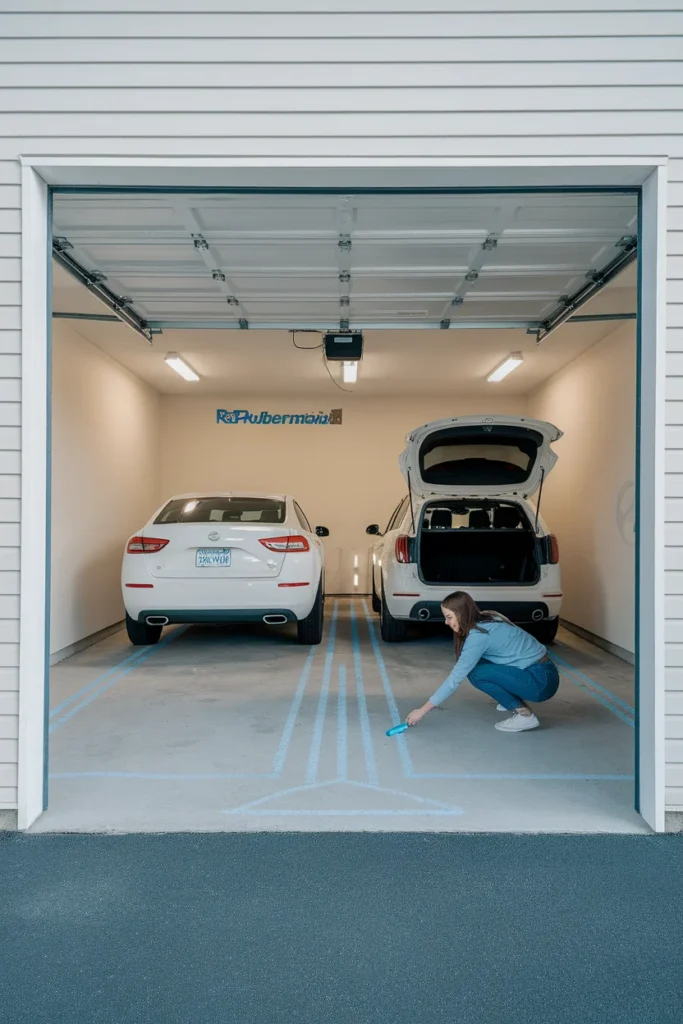
Start With the Chalk Line Test (Before You Buy a Single Bin)
Here is the mistake nearly everyone makes with two car garage organization. They shop first, measure never, and then discover the shelving unit blocks the driver’s door by four inches.
The Chalk Line Test is the fix. It takes twenty minutes and costs about a dollar.
How to run it
- Park both cars exactly where they normally live. Not neatly. Normally.
- Open every car door as wide as it goes. All four. Plus the trunk and the hatch.
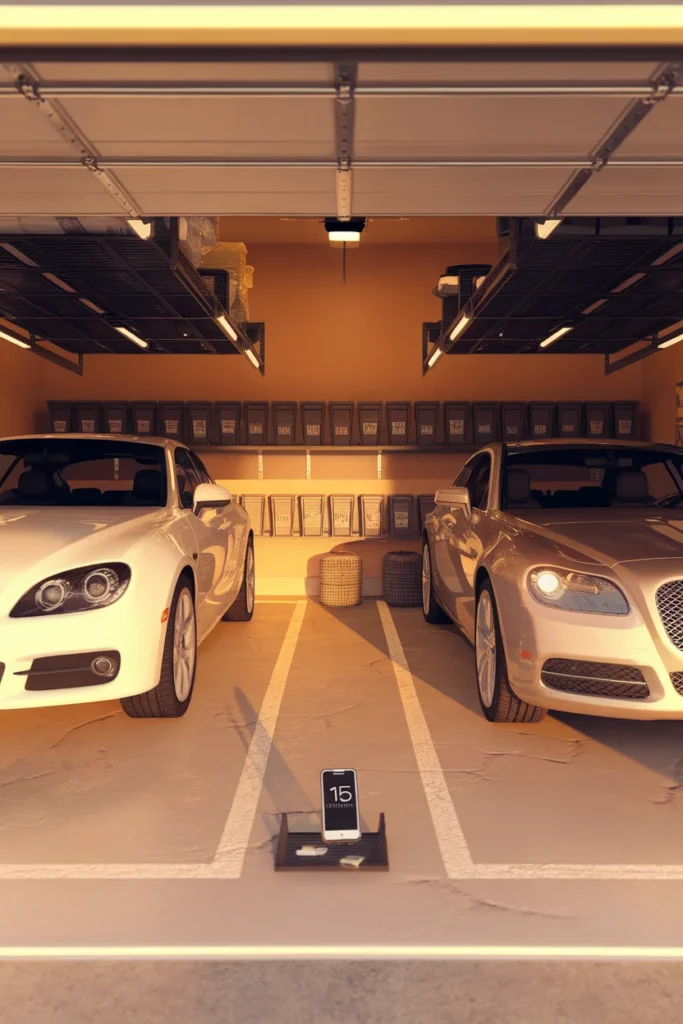
- Draw a chalk line on the floor along the outer edge of each open door, and another two feet out from the trunk.
- Close everything and back both cars out.
- Look at your floor. Everything outside those chalk lines is your real storage footprint. Everything inside them is off limits, permanently.
What the lines usually tell you
The numbers get sobering fast. Angi puts a minimum two-car garage at 20 by 20 feet (about 398 square feet) and an average one at 24 by 24 feet (581 square feet). It also recommends roughly three feet of clearance on each side of a vehicle for doors and walking. Two average sedans plus that clearance eat most of a 20 by 20 box.
Which means your usable depth on the side walls is often 12 to 18 inches. Not 24. Not 36.
That single number changes every purchase you’re about to make.
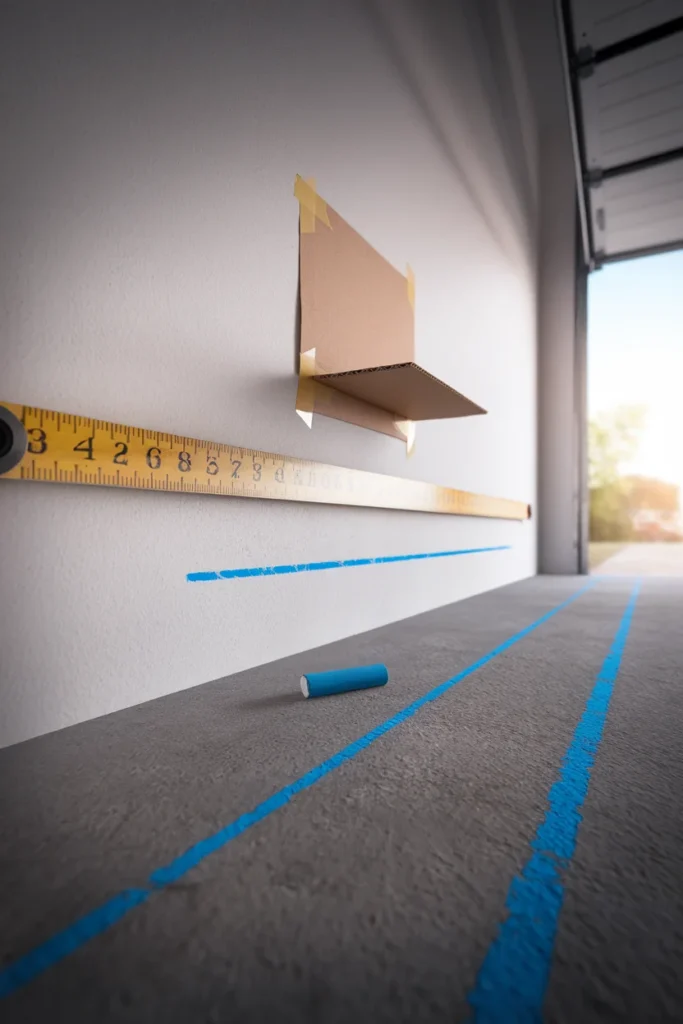
I ran this in my own garage last spring and it was humbling. My chalk line landed 14 inches off the left wall, which meant the 24-inch-deep shelving I’d been eyeing at the home center would have made the driver’s door unusable on that side. Fourteen inches. I taped a scrap of cardboard to the wall at that depth and lived with it for a week before I bought anything.
Empty It Out and Sort in Four Piles
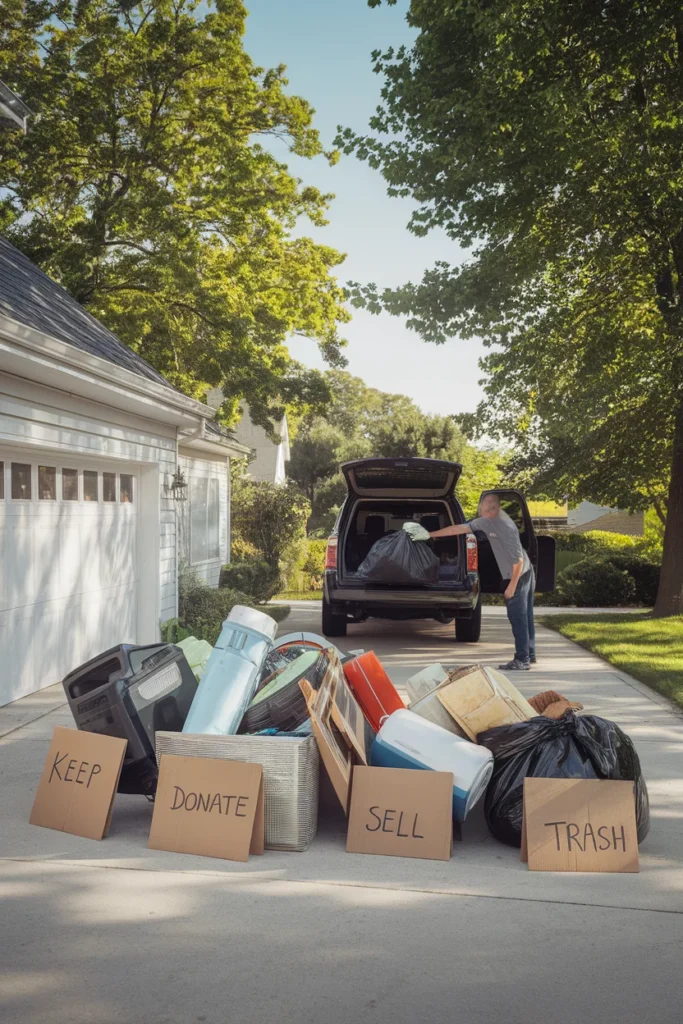
You cannot zone around clutter. Everything comes out onto the driveway, and yes, it will look worse before it looks better.
Four piles only. Keep, donate, sell, trash. Then a fifth staging spot for anything that belongs inside the house and was never garage material to begin with.
If the sight of the full driveway makes you want to quit, start with the easiest category first instead of trying to make decisions in order of importance. Momentum is worth more than logic on day one.
A few sorting rules that speed this up:
- Duplicates go. You do not need four hammers and nine screwdrivers with the same head.
- Broken things get a 30-day deadline or they leave. Write the date on painter’s tape and stick it to the item.
- Anything you have not touched in two full seasons goes in the donate pile. Two full seasons in a garage is a real signal.
- Empty boxes leave immediately. Nobody has ever needed the box the printer came in.
Load the donate pile into a car before you sit down. Not tomorrow. Today, while the pile is still visible.
Zone 1: The Overhead Band Almost Nobody Uses
Look up. That empty air above your car hoods is the single most wasted real estate in the house.
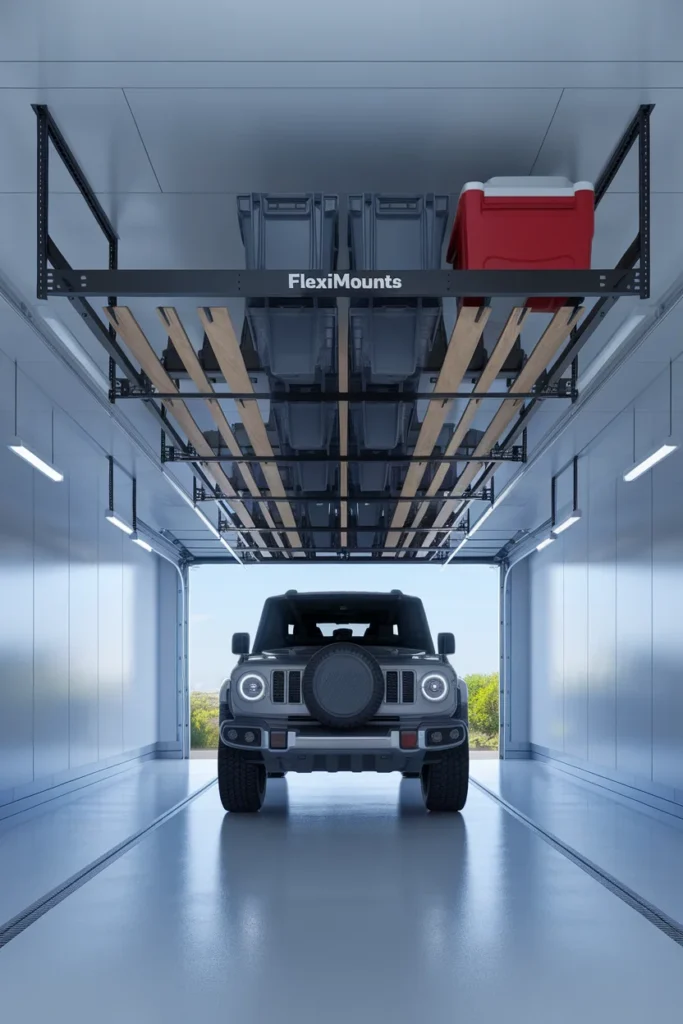
Ceiling racks live entirely outside your chalk lines, which makes them the safest storage in a two-car garage. The FLEXIMOUNTS GR48F Lite is a 4-foot by 8-foot ceiling rack rated to 600 pounds, with an adjustable drop of 22 to 40 inches. The Classic series in the same footprint is rated to 750 pounds. One note the listing buries: the Lite ships without decking, so budget for 3/8-inch plywood or thicker on top of the frame.
Two placement rules matter more than the brand you pick.
Rule one: mount over the hood, not over the whole car. Set your rack in the front third of the bay, above where the engine sits. Nobody stands there. Nobody opens a door there.
Rule two: measure your drop against your tallest vehicle plus six inches. An SUV with a roof box needs different math than a sedan. Do this before you drill, because the drop is adjustable in fixed increments, not infinitely.
Overhead is where holiday bins, camping gear, and the giant cooler belong. Heavy daily-use items do not go up there. Anything you have to reach for on a ladder while holding a toddler is in the wrong zone.
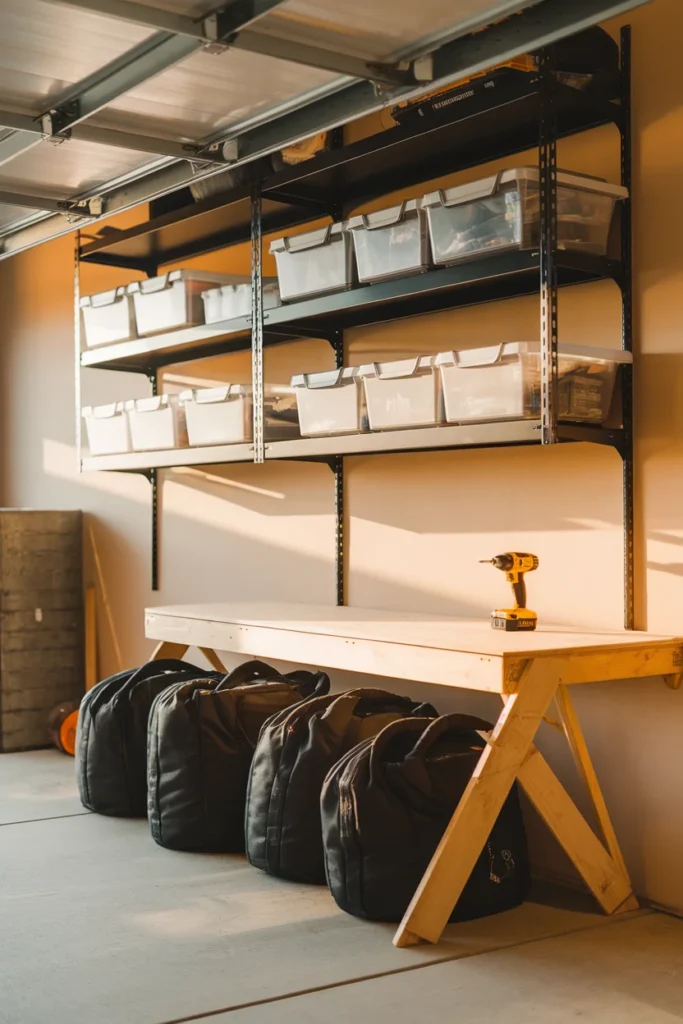
Zone 2: The Back Wall Gets Everything Deep
Your back wall is the only surface with real depth to spare, because cars stop short of it. Give it the bulky things.
Deep cabinets, 24-inch shelving, the workbench, the tall rolling tool chest. All of it belongs here.
Measure your stopping point honestly first. Pull both cars in, mark the front bumpers with chalk, and see what you actually have between bumper and wall. In a 20-foot-deep garage with a mid-size SUV, that is often 24 to 36 inches. In a 24-foot garage it can be five feet, which changes everything.
A workbench that folds flat against the wall is worth the extra cost in a shallow bay. When it’s down, you have a work surface. When it’s up, your bumper clears it. That is a genuinely double-duty piece and one of the few garage upgrades that pays for itself in a small footprint.
Group the back wall by frequency, not by category:
| Shelf height | What goes there | Why |
|---|---|---|
| Floor to 24 in | Heavy, rarely moved (paint-free bulk, sandbags, salt) | Low center of gravity, no lifting |
| 24 to 60 in | Daily and weekly grabs (tools, cleaning supplies, dog food bin) | Eye level, no bending |
| 60 to 84 in | Seasonal and light (empty coolers, beach gear) | Reachable without a ladder |
| Above 84 in | Long-term only (tax boxes in sealed totes) | Ladder territory |
Screenshot that table before you load a single shelf.
Zone 3: The Side Bands Go Vertical, Never Deep
This is where your chalk lines earn their keep. Side walls in a two-car garage get shallow storage or nothing at all.
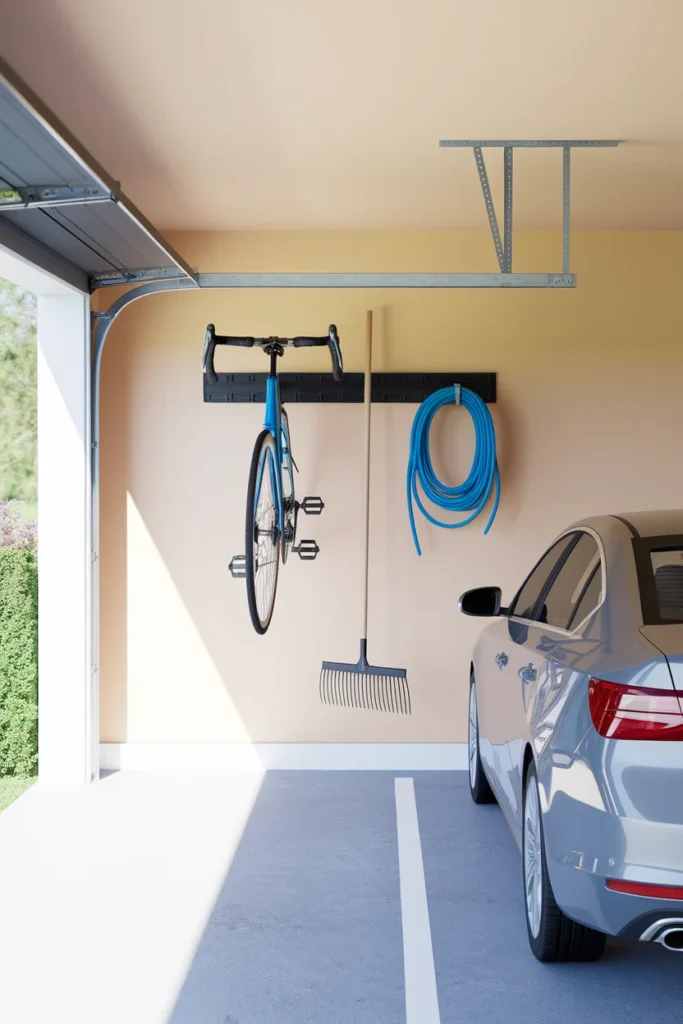
Rail systems solve this better than cabinets. A Rubbermaid FastTrack 48-inch hang rail runs $16.88 at Home Depot and the steel rail is rated to hold up to 1,750 pounds across its length. Hooks slide anywhere along it and reposition in seconds, which matters because your needs change every season. Rakes in spring, bikes in summer, snow shovel in December, all on the same rail.
Mount the rail at 48 inches off the floor as a starting point. High enough that a bike pedal clears the hood, low enough that a 5-foot-4 person can lift a ladder onto it.
Here’s a comparison worth pinning:
| System | Price | Footprint | Material | Best for |
|---|---|---|---|---|
| Rubbermaid FastTrack 48 in. rail | $16.88 per rail | 2 in. wall depth | Powder-coated steel, 1,750 lb rail rating | Renters-adjacent budgets, changing seasonal loads |
| FLEXIMOUNTS GR48F Lite ceiling rack | Mid-range | 4 ft x 8 ft overhead, 22 to 40 in. drop | Steel frame, decking sold separately | Bulk seasonal bins, zero floor cost |
| Gladiator GearTrack channels | Higher | ~1.5 in. wall depth | Heavy-gauge steel with proprietary hooks | Long-term homeowners wanting a matched wall system |
| Dollar Tree small bins | $1.25 each | Shelf-top only | Lightweight plastic | Sorting small hardware, screws, tape, zip ties |
The pegboard question comes up constantly. Pegboard is excellent for hand tools under two pounds and genuinely poor for anything heavier, because the hooks pop out of the holes the moment you tug at an angle. Use it above a workbench. Do not use it to hold a leaf blower.
Zone 4: The Threshold by the House Door
Every garage has one spot that gets used forty times a week, and it is the four feet next to the door into the house.
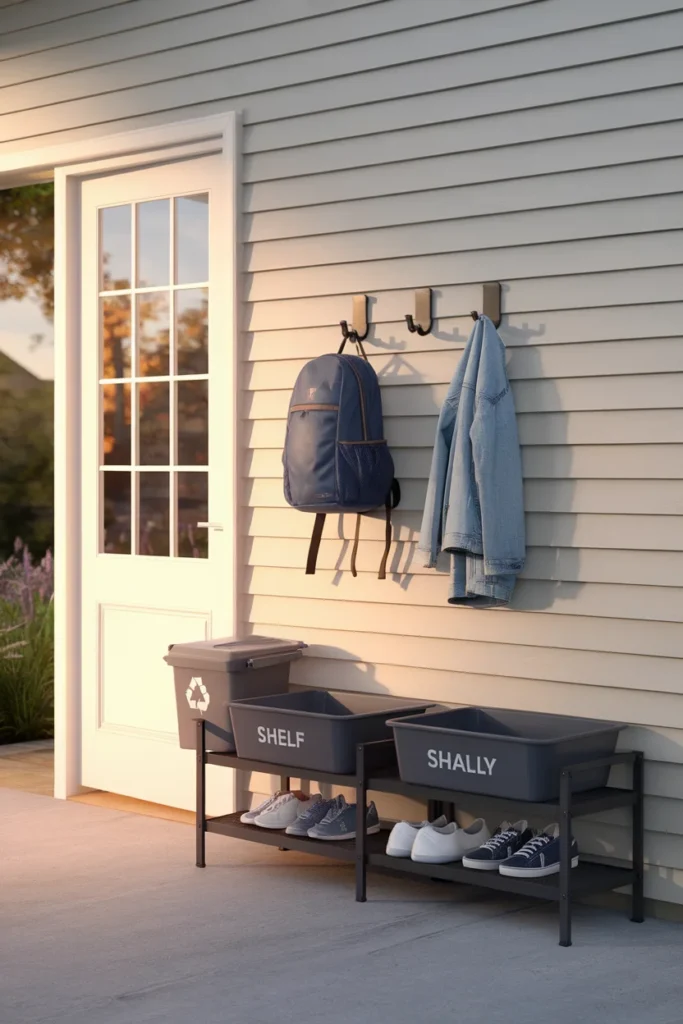
Treat it as its own zone with its own rules. Shoes come off here. Backpacks land here. Recycling stages here. Nothing that lives here is allowed to be seasonal.
What earns a spot on the threshold wall:
- Three hooks per person, no more, at each person’s own height
- One shallow bin per person for shoes, labeled
- A small covered can for recycling
- A hook for reusable grocery bags, right at eye level
- Dog leash and one towel for muddy paws
That’s it. The threshold zone fails when it starts absorbing overflow from the rest of the garage.
If your garage door opens into a laundry area, the same logic applies to that handoff space. It’s worth setting up a proper mudroom and laundry combo setup so the two zones stop fighting each other. The garage side stages, the interior side sorts.
One honest note about two-driver households: the threshold zone is where most garage systems break down, because two people have different definitions of “put it away.” Split the wall physically. Your hooks, their hooks. Draw an actual line with tape if you have to. A shared zone with no ownership becomes a pile within a month, and I say that as someone who tried the shared-basket approach twice before giving up on it.
The Dead Strip Between the Cars
Roughly three feet of concrete runs down the middle of your garage and holds nothing. It is also the strip both drivers walk through every single day, which is why most two car garage organization plans get it wrong.
Resist the urge to fill it. A tall shelf here becomes a door-ding machine within a week.
What actually works in the center strip:
- A slim rolling cart, 12 inches deep or less, that parks against the back wall and rolls out when you need it
- A wall-mounted retractable hose reel, if your center strip ends at a wall
- Nothing else
If your two cars are narrow enough that the center gap runs four feet or more, one narrow freestanding shelf can work, but measure the gap with both doors open before you commit. That’s your chalk line again.
What Should Never Live in a Two-Car Garage
Here’s the section every competitor skips, and it’s the one that saves you the most money. Organizing something that the garage is going to ruin is wasted work.
An attached garage is unconditioned space. It swings from below freezing to well over 100°F, it holds humidity, and it has a door to the outdoors that pests treat as an invitation.
Things heat and cold destroy
Latex paint freezes at roughly the same temperature as water, so a garage shelf in a Northern winter is the fastest way to ruin a $50 gallon. Canned food spoils faster in temperature extremes. Electronics, vinyl records, and candles warp. Propane tanks belong outdoors, never in an attached garage.
Things pests find first
Pet food in its original bag is a rodent beacon. Decant into a sealed container or keep it inside. Paper items invite silverfish, so photo boxes and important files stay in the house. Firewood brings termites and spiders directly to your foundation. Upholstered furniture, sleeping bags, and off-season clothing absorb fumes and dust and get chewed.
Things that are a genuine fire risk
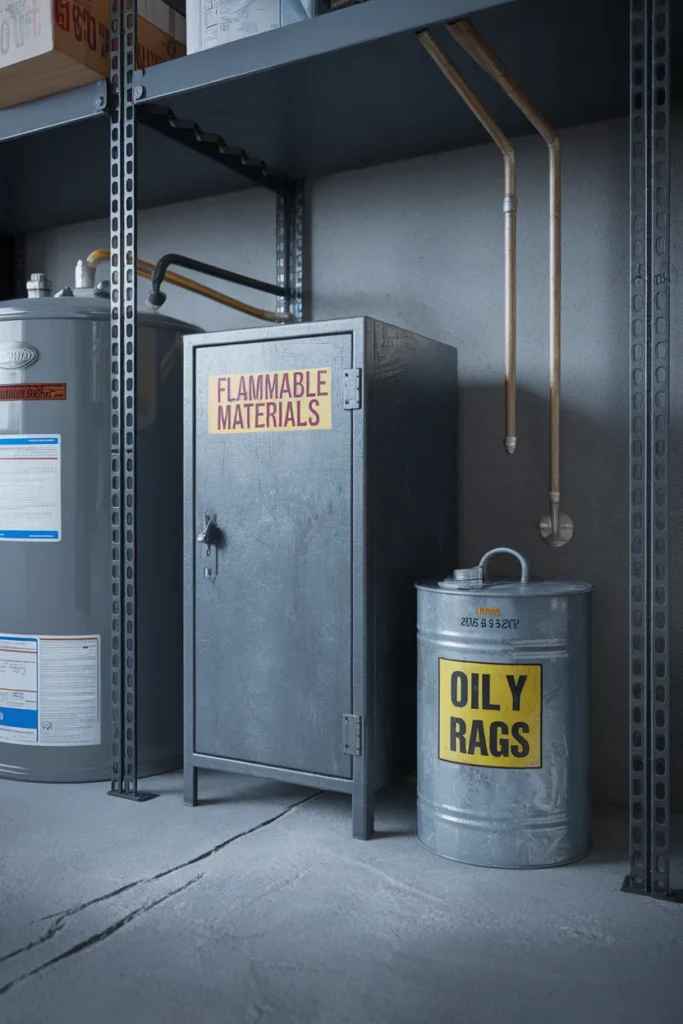
The U.S. Fire Administration is direct about this. Its basement and garage fire safety guidance says to store oil, gasoline, paints, propane, and varnishes in a shed away from your home. Keep anything that can burn at least three feet from a furnace or water heater. Oily rags go in airtight containers, away from heat. The agency also recommends a heat alarm rather than a smoke alarm in the garage, since a smoke alarm out there will nuisance-trip constantly.
For the chemicals you keep, the EPA’s household hazardous waste guidance is worth two minutes of your time. The short version: leave products in their original labeled containers, never move them into food containers, and never mix them, since incompatible products can react, ignite, or explode. When you’re purging expired products during your sort, look up a local collection program rather than pouring anything down a drain.
Please note: this is general home-organization information, not professional advice. Local fire and building codes vary by city and state. For anything involving fuel storage, gas appliances, or electrical work in your garage, consult a qualified US professional or your local fire department.
Renter-Friendly Two-Car Garage Organization With Zero Drilling
Every article in the top five assumes you own the place and can lag-bolt into studs. Plenty of you can’t.
Shallow storage without a single hole:
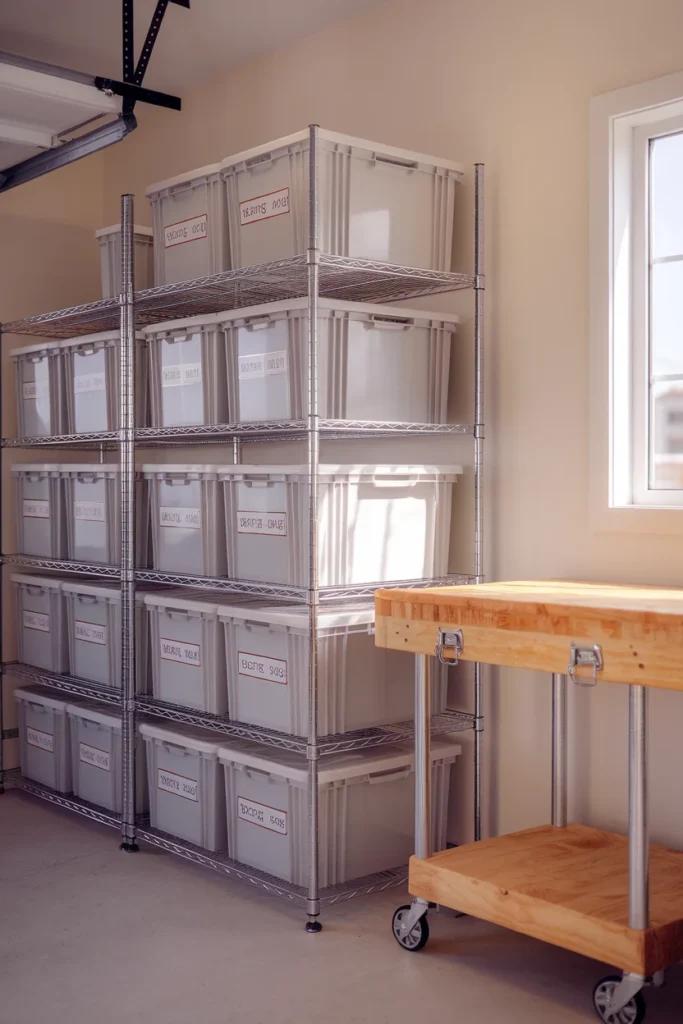
- Freestanding steel wire shelving on the back wall only. Look for 18-inch depth or less, and strap the top shelf to a stud with a single removable adhesive anchor if your landlord allows one small point of contact. If not, load the bottom shelves heavy and leave the top mostly empty.
- A tension rod set high across a shallow alcove holds hanging garden tools by their handles. Works in any recessed nook wider than three feet.
- Heavy-duty adhesive hooks rated by weight, mounted on the smooth painted section of drywall, not on bare concrete block. Check the rating on the package and then use one size up from what you think you need. They fail from overload, not from age.
- Rolling tool chests and stacking totes do the entire job with zero attachment. Stack Sterilite totes three high maximum, heaviest on the bottom, and label the short end so you can read it from the car.
- Over-the-door organizers on the interior house door grab gloves, sunscreen, and small hardware without touching a garage wall.
One double-duty pick for renters: a rolling workbench with a butcher-block top and locking casters. It’s your work surface, your extra shelf, and it rolls out of the way when both cars come in. Nothing gets mounted, and it moves with you.
Your Two-Car Garage Organization Budget, Broken Down
Costs vary by market, so treat these as planning brackets rather than quotes. What matters is the order you spend in.
| Phase | What you buy | Rough spend | Do this when |
|---|---|---|---|
| Phase 1 | Chalk, painter’s tape, a tape measure, trash bags | Under $25 | Weekend one, before anything else |
| Phase 2 | One 48 in. wall rail plus 6 to 8 hooks | Around $50 to $90 | Weekend two, after the purge |
| Phase 3 | Back wall shelving unit, 18 to 24 in. deep | $120 to $300 | Once you know your bumper clearance |
| Phase 4 | One overhead ceiling rack, 4 ft x 8 ft | $150 to $300 with decking | After seasonal bins are consolidated |
| Phase 5 | Matched labeled totes, threshold hooks and bins | $60 to $150 | Last, once every zone is defined |
Phase 1 costs less than lunch and prevents the most expensive mistake on the list, which is buying depth you can’t use.
If your total budget is $200, spend it on Phase 1, Phase 2, and totes. Skip the cabinets entirely. Rails and bins solve about 70 percent of a two-car garage problem for a fraction of the cabinet price.
The 15-Minute Monthly Reset That Makes It Stick
Two car garage organization fails on maintenance far more often than it fails on setup. Put a recurring 15-minute block on the calendar for the first Saturday of the month and run the same four steps.
- Walk the chalk lines. Anything sitting inside them goes back to its zone or leaves.
- Clear the threshold bins. Shoes to the house, recycling out, dead batteries to a collection bin.
- Check one overhead bin. Rotate one seasonal tote per month rather than doing a giant swap twice a year.
- Empty the catch-all. Every garage grows one shelf that collects everything. Empty it monthly and the problem never compounds.
The same monthly rhythm works well on the small supply zones inside the house, and it’s exactly how you organize a utility closet without letting it slide back into chaos. Same fifteen minutes, different door.
Set a timer. When it goes off, you stop, even if you aren’t finished. Fifteen honest minutes monthly beats four hours twice a year, and it’s the reason my garage has stayed parked-in for two summers running (to be fair, month three was rough).
Frequently Asked Questions
How do I organize a two-car garage on a budget? Spend your first $25 on chalk, tape, and trash bags, then purge hard before buying anything. After that, one 48-inch wall rail with hooks (around $17 for the rail at Home Depot) plus a set of stackable totes handles the majority of a two-car garage. Skip cabinets until the zones are proven. Rails and bins give you the most storage per dollar, and they adapt when your needs change.
How much space do you need to park two cars and still store things? A minimum two-car garage runs about 20 by 20 feet, or roughly 398 square feet, and an average one is closer to 24 by 24 feet at 581 square feet. Plan on roughly three feet of clearance on each side of a vehicle for doors and walking. In a 20 by 20 garage that usually leaves 12 to 18 inches of usable side-wall depth, which is why shallow rail systems beat deep cabinets there.
Where should I start with two car garage organization? Start with the Chalk Line Test, not with shopping. Park both cars, open all four doors, chalk the swing path on the floor, then back the cars out. Everything outside those lines is your real storage footprint. Purge second, zone third, buy fourth. Doing it in that order prevents the most common and most expensive mistake, which is buying shelving that blocks a car door.
What is the best wall storage for a small two-car garage? Shallow rail systems win in tight bays because they use two inches of wall depth instead of eighteen. A Rubbermaid FastTrack 48-inch rail is rated to 1,750 pounds and hooks reposition in seconds, which suits changing seasonal loads. Gladiator GearTrack is the pricier long-term option with a matched look. Pegboard is fine above a workbench for hand tools under two pounds and unreliable for anything heavier.
What should not be stored in the garage? Latex paint (it freezes at about the same temperature as water), canned and pet food, paper files and photos, upholstered furniture, sleeping bags and off-season clothing, firewood, propane tanks, and spare fuel. The garage swings between freezing and over 100°F, holds humidity, and attracts pests. The U.S. Fire Administration also advises keeping anything burnable at least three feet from a furnace or water heater.
Can I organize a two-car garage if I rent? Yes, and without a single hole. Freestanding wire shelving on the back wall, weight-rated adhesive hooks on painted drywall, a tension rod across a shallow alcove, stacking totes, and a rolling workbench cover almost everything a mounted system does. Check your lease before adding any permanent anchor, and photograph the garage on move-in day.
How do I keep two drivers from wrecking the system? Split the threshold wall physically and give each person their own hooks and their own bin at their own height. Shared baskets fail because nobody owns them. A strip of painter’s tape down the middle of the drop zone sounds silly and works remarkably well.
Putting It All Together
Two car garage organization comes down to one honest measurement and four zones that respect it. Overhead for bulk. Back wall for depth. Side bands for shallow and vertical. Threshold for daily traffic. Everything else stays outside the chalk.
Run the Chalk Line Test this weekend. It costs a dollar and twenty minutes, and it will tell you more about your garage than any product review.
Then come back and tell me what your number was. I’m collecting them, and I have a theory that almost nobody has the 24 inches they think they do.


