

Small Garage Organization: Maximize a Tight One-Car Garage
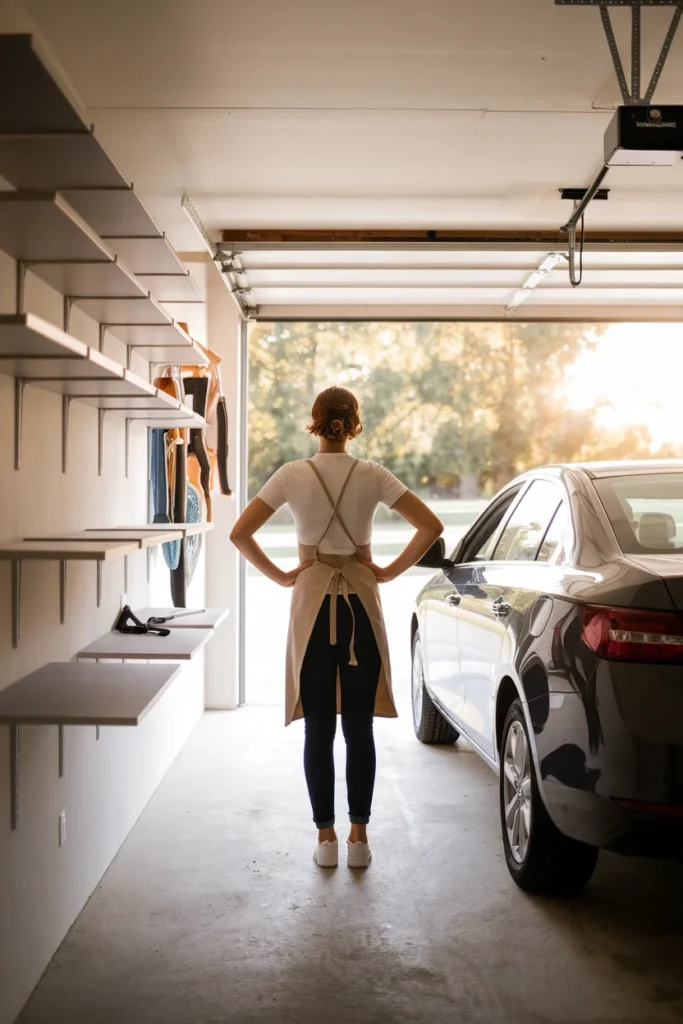
Small garage organization has almost nothing to do with buying better bins. It’s a depth problem. A standard one-car garage runs about 12 feet wide, your car eats roughly 6 feet of that, and the doors need to open. Do the math and you’re left with about 32 inches of usable wall on each side. That’s it.
Most garage advice on the internet was written for a two-car bay with room to spare, which is why it quietly fails in a space this tight. Below is the system we use instead: a measured depth budget, a car-first setup order, and a weekend plan that ends with the car actually parked inside. No demolition, no custom cabinetry, no pretending you have square footage you don’t.
Why Small Garage Organization Fails in a One-Car Bay
Here’s the part nobody tells you. Standard garage shelving is 18 to 24 inches deep. Home Depot’s popular HDX five-tier steel units come in 18 inch and 24 inch depths, and both are excellent products. In a 12 foot garage, one 24 inch unit on each side leaves you 96 inches of clear width. A midsize sedan is about 73 inches wide at the mirrors. You now have 11 inches per side. You cannot open a car door in 11 inches.
So the shelving goes in, the car goes out, and the garage slowly becomes a shed with a very expensive door.
Small garage organization only works when you stop thinking in shelves and start thinking in inches of depth per height band. The floor level is precious. Everything above your shoulder is nearly free. Once you budget depth that way, the whole room reorganizes itself.
Step One: Park the Car Inside Before You Touch Anything
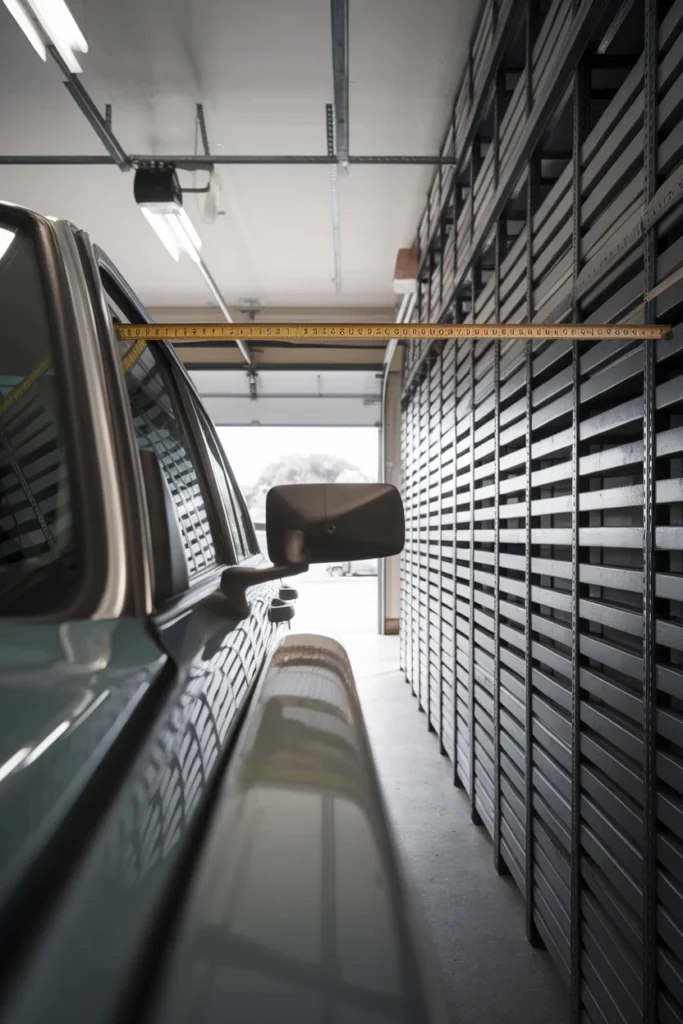
Every guide on the first page of Google says to empty the garage completely first. We’d push back on that, at least for a small bay. Empty the garage and you lose the single most important reference point in the room.
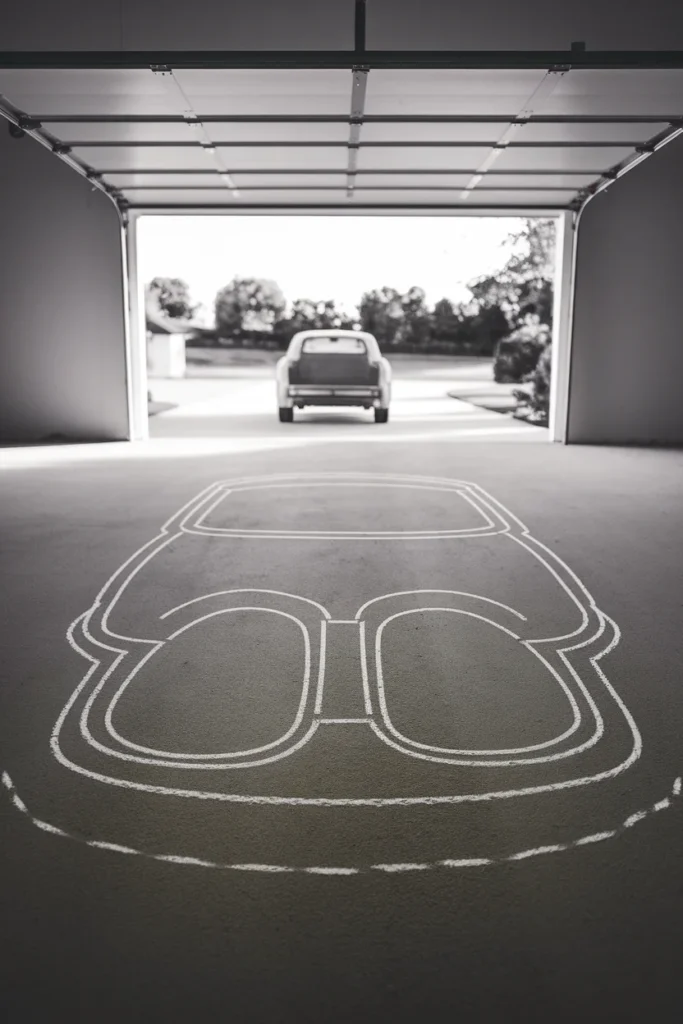
Pull the car in. Park it where you actually park it, not centered for the photo. Open both doors all the way. Now grab sidewalk chalk and trace the outline: tires, mirrors, and the full arc of both open doors. Add the trunk lid at full lift if you drive a hatchback or SUV.
Then back the car out and look at the floor.
That chalk outline is your no-build zone. Nothing permanent goes inside it, ever. In most one-car garages the leftover shape is a narrow U: two shallow bands down the sides and one deeper bank across the front wall. Everything in this article lives in that U. If you’re working with more room and want the same logic scaled up, we walk through how to zone a two-car garage so both cars still fit using a similar measure-first approach.
The 12-24-36 Rule: Our Depth Budget for Tight Garages
This is the framework we come back to on every small garage. Instead of picking storage by product, you pick it by how high off the floor it sits. Three height bands, three maximum depths.
| Height band | Max depth | What belongs here |
|---|---|---|
| Floor to 5 feet | 12 inches | Daily and weekly grabs: hand tools, cleaning supplies, dog leash, sports gear in use |
| 5 to 7 feet | 24 inches | Monthly items: labeled bins, spare parts, car care, bulk paper goods |
| 7 feet and up | 36 inches | Seasonal only: holiday decor, luggage, camping gear, off-season sports |
Why those numbers hold up. Below 5 feet you’re inside the car door swing, so 12 inches is the most you can give up without trapping yourself. Between 5 and 7 feet you clear the roofline of most sedans (a typical sedan roof sits around 57 to 60 inches), so you can double the depth. Above 7 feet you’re above the vehicle entirely, which is where the deep gear finally has somewhere to go.
Print it, screenshot it, tape it to the wall. Every time you’re about to buy a garage product, check the depth against the band it will hang in. If it doesn’t fit the band, it doesn’t come home.
Clear the Floor With a Four-Pile Sort (Not a Full Empty-Out)
You don’t need to drag everything onto the driveway. In a space this size that takes six hours and usually ends with half of it going back in.
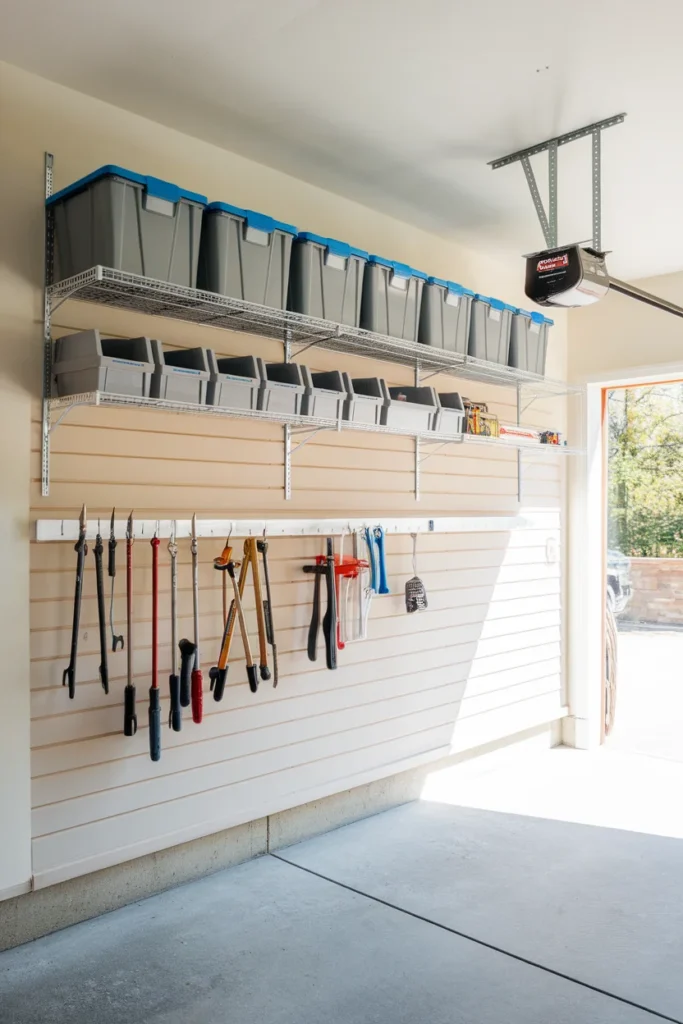
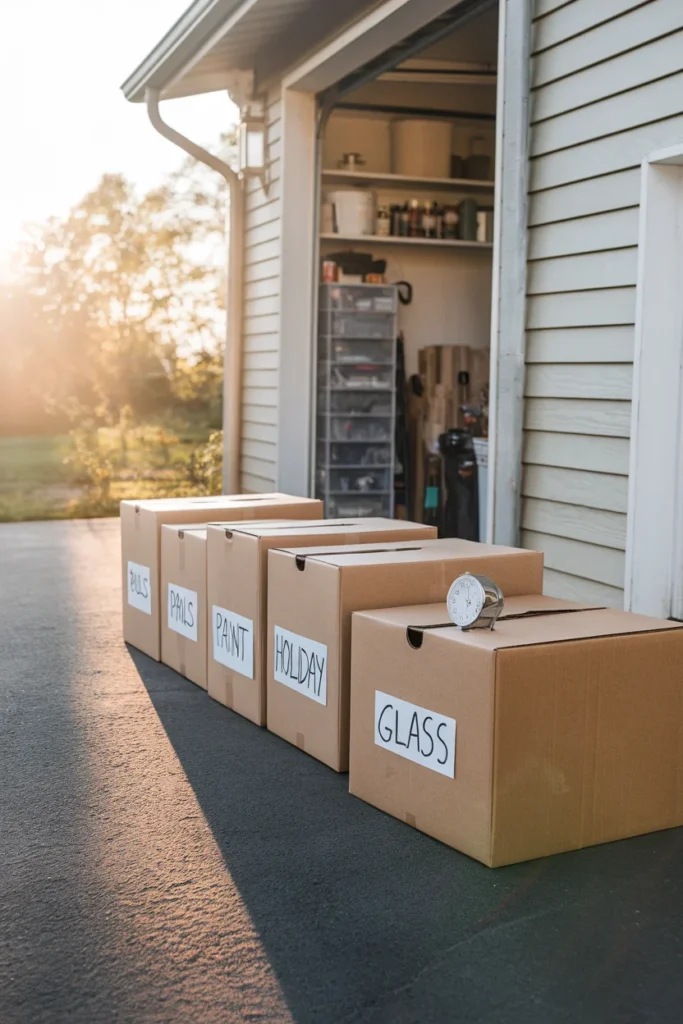
Work the perimeter instead, one 4 foot section at a time, and sort into four spots on the driveway: Keep in Garage, Belongs Elsewhere in the House, Donate or Sell, and Recycle or Dispose. Set a timer for 25 minutes per section. Move on when it rings even if you’re not finished, then loop back.
Two rules make this go faster. First, anything you haven’t touched in two full seasons is a Donate candidate by default, and you have to argue it back in. Second, duplicates get capped: one shovel, two brooms, three rolls of tape. The rest leaves.
Local Buy Nothing groups and Facebook Marketplace clear bulky sports gear and lawn equipment surprisingly fast. Goodwill and Salvation Army will take almost everything else that’s clean and functional.
Build the Side Bands: Shallow Wall Storage Under 5 Feet
The side walls are where small garage organization gets won or lost. Twelve inches, remember. That number rules out almost every freestanding garage shelf on the market, which is fine, because the side bands want wall-mounted systems anyway.
Rails Beat Shelves Here
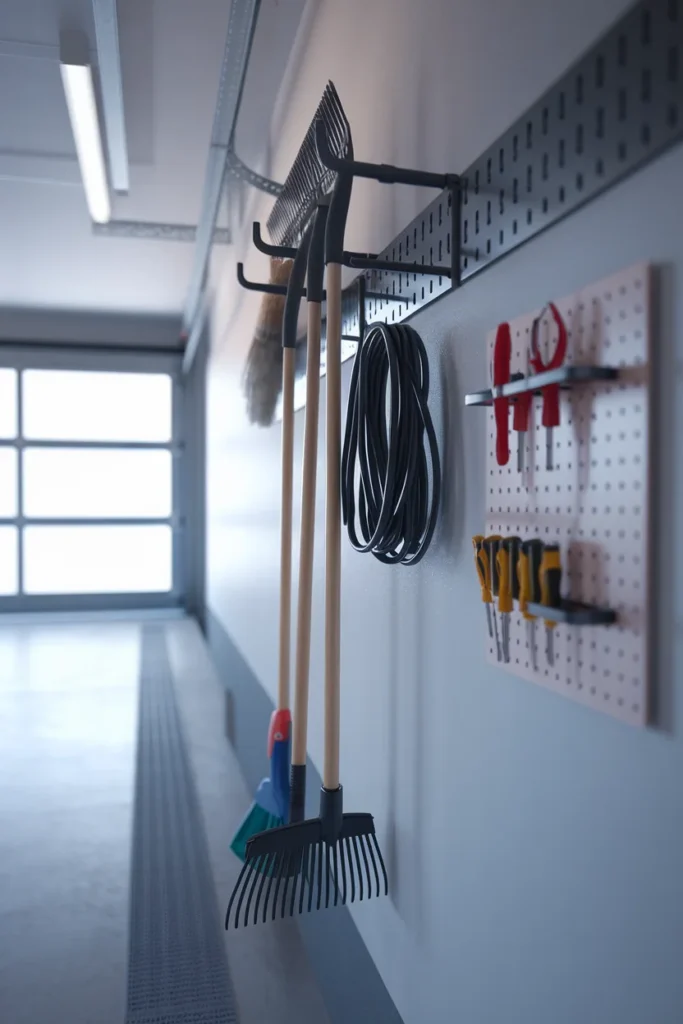
A rail system mounts one horizontal track into the studs, then accepts hooks, baskets, and bike hangers that slide anywhere along it. Rubbermaid FastTrack and Gladiator GearTrack are the two you’ll see at Home Depot and Lowe’s. Most hooks project 4 to 8 inches from the wall. You’re spending a third of your depth budget and keeping the rest as air.
Hang the long-handled items first: rake, broom, snow shovel, leaf blower. They’re the worst floor offenders and the easiest wins.
Pegboard for the Small Stuff
Above or beside the rail, a pegboard panel holds everything under a pound. IKEA’s SKÅDIS boards work beautifully here and take clip-on cups and small shelves. If your tools have started multiplying past what one board can hold, our guide to wall systems that keep tools findable breaks down pegboard versus slatwall versus French cleats in more detail.
One Slim Cabinet, Maximum
Want a closed cabinet for anything ugly? Cap it at 12 inches deep and put it on the side with the least door swing. That’s usually the passenger side, since nobody rides shotgun in the garage. A slim broom cabinet or a 12 inch utility cabinet holds a shocking amount when the shelves are adjustable.
The Front Bank: Your One and Only Deep Wall
The wall your car noses up to is the exception to everything above. Most one-car garages measure 20 to 24 feet deep, and a midsize car takes about 16 feet of that, which leaves you a 4 to 6 foot bank across the front. This is where deep storage is allowed to live.
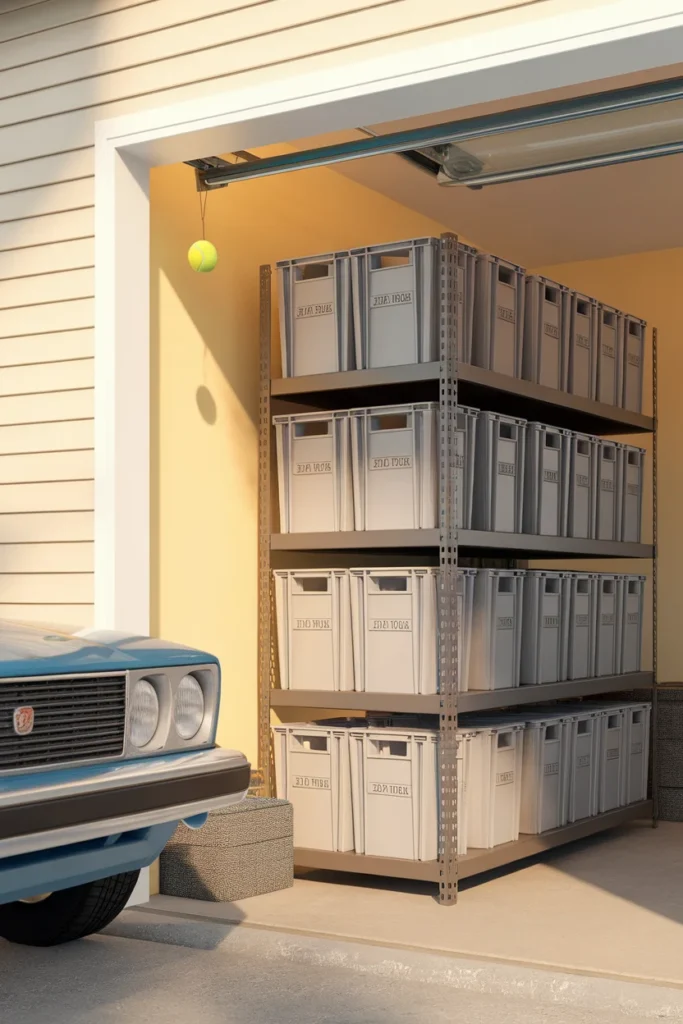
Put your one real shelving unit here. A 24 inch deep, 48 inch wide, five-tier steel unit fits most front walls with room to spare on either side. It carries the heavy bins that have no business hanging on a wall. Two units side by side work if your garage runs 24 feet deep and you drive something short.
Leave a 6 inch buffer between the shelf face and your front bumper at full park. Tennis ball on a string is the classic trick and it still works. So does a strip of pool noodle glued to the shelf edge if your garage is genuinely that tight.
Bottom shelf gets the heaviest items. Top shelf gets the lightest. This sounds obvious and gets violated in roughly every garage we’ve seen.
Bikes, Sports Gear, and Lawn Equipment: The Three Floor Hogs
Three categories eat more floor in a small garage than everything else combined. Handle them first and the room opens up before you’ve bought a single bin.
Bikes go up, not against the wall. A bike leaned on a wall claims about 6 square feet of floor. Hung vertically from a wall hook by its front wheel, it claims roughly 1. Vertical hooks are the better call in a narrow bay because the bike sits flush instead of sticking out 5 feet. Two bikes can share one wall section if you stagger the hook heights by about 12 inches, alternating handlebars high and low so they nest.
Sports gear needs one container, not a corner. Balls migrate. That’s just what they do. A single open-top ball bin or a tall mesh hamper on casters stops the migration cold, and it can roll into the chalk zone while the car is out. Bats, sticks, and rackets clip onto the same rail as the yard tools.
Lawn equipment is a measuring problem. Mowers, trimmers, and blowers are usually the last things people place, which is backwards. Place them first. A push mower needs about 2 by 4 feet of floor. In a one-car garage there’s exactly one spot where that footprint blocks nothing: the front corner on the passenger side, tucked past the bumper line. Put it there before you commit any other floor space.
One more habit worth keeping. Anything with wheels gets stored with the wheels toward the aisle. Sounds trivial. It saves you dragging a mower sideways every Saturday.
Overhead Storage That Doesn’t Cost You Headroom
Ceiling racks are the biggest single win in a tight garage, and also the easiest thing to get wrong.
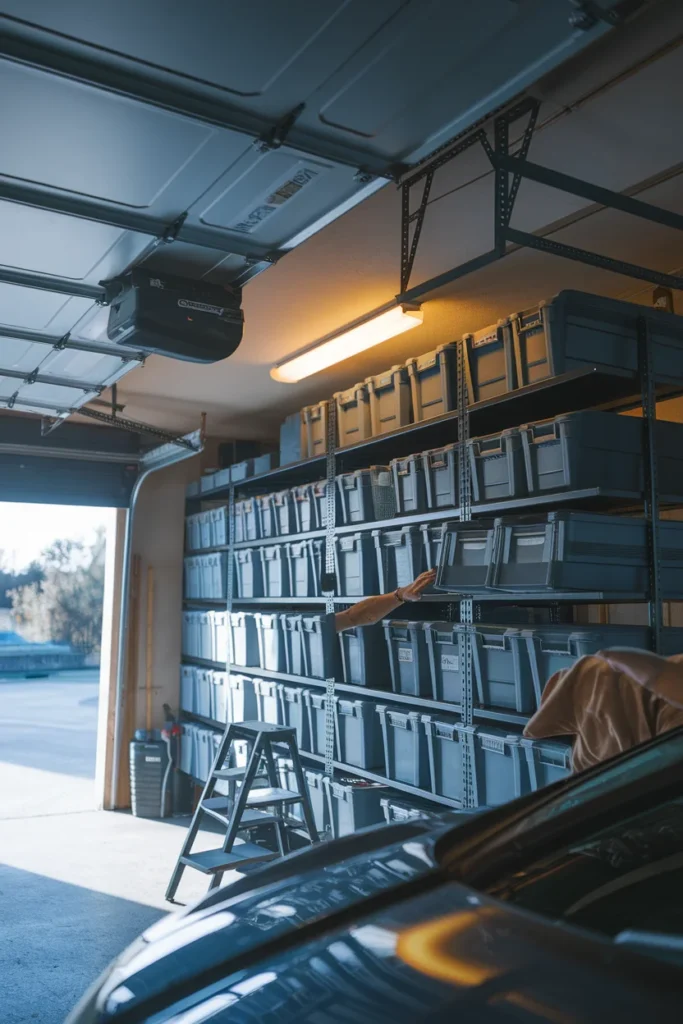
The specs worth knowing. Most overhead garage racks are rated between 400 and 600 pounds when they’re lag-bolted into ceiling joists with the load spread evenly. You want at least 8 feet of ceiling height to keep safe clearance over a parked car. That rating assumes correct installation into structure. Anchored into drywall alone, the real capacity is a fraction of the number on the box.
Mount the rack over the hood, not over the middle of the car. You’ll be lifting bins overhead, and standing in front of the bumper is a lot easier than leaning across a roof.
What goes up there: holiday decor, luggage, camping gear, off-season sports equipment. What doesn’t: anything heavy, anything fragile, anything liquid, and anything you need more than once a month. If you’re reaching for it weekly, it belongs in the 5 to 7 foot band instead.
One more thing renters and cautious DIYers should know. If you can’t or won’t drill into joists, a freestanding 7 foot shelving unit placed against the front wall gives you the same top-band storage without touching the ceiling.
No-Drill Small Garage Organization for Renters
Renting a house with a garage puts you in an awkward spot: all the good garage storage bolts into something. Here’s what works when you can’t leave holes.
Freestanding is your friend. A 12 inch deep, 5 foot tall utility shelf along one side band and one 24 inch unit on the front wall covers most of a small garage without a single anchor. Walmart’s Mainstays and Home Depot’s HDX plastic units both land under $60 and assemble tool-free.
Tension rods do real work. A heavy-duty tension rod mounted between two studs (no drilling, just pressure) holds hanging garment bags, folded camp chairs, or a row of S-hooks for extension cords. Run one across a shallow alcove and you’ve created a closet rod for garage gear.
Command hooks, with a caveat. 3M Command hooks are genuinely useful for lightweight items like cords, hats, and leashes, and the outdoor line is built for temperature swings. Ordinary indoor strips are not. An unheated garage in Chicago in January or Phoenix in July will pop them off the wall, so buy the outdoor version and follow the weight rating rather than eyeballing it.
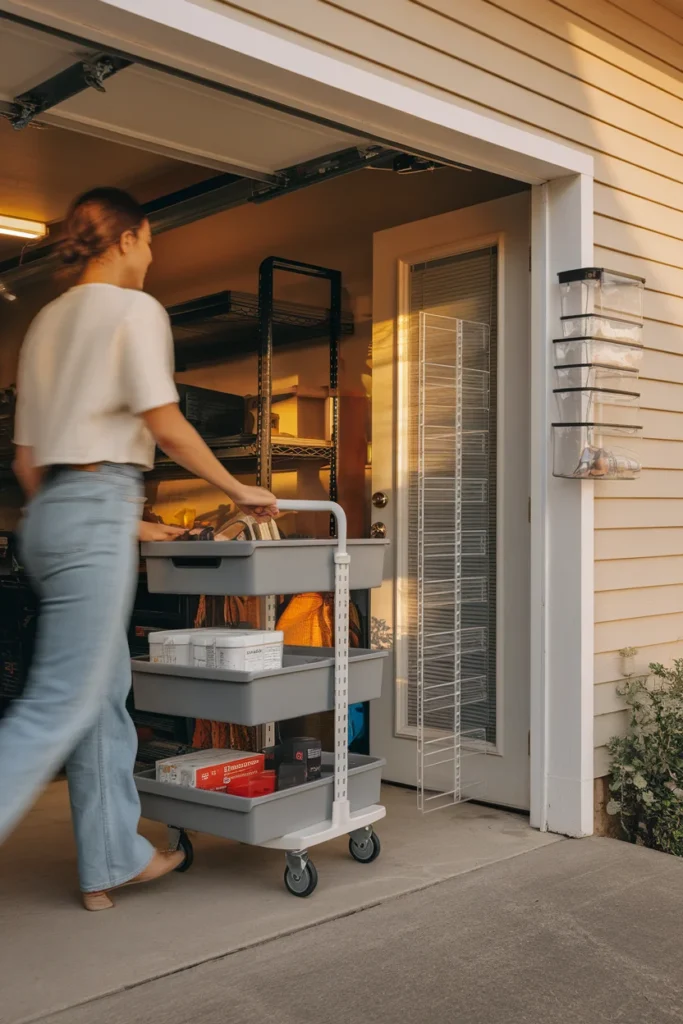
Rolling everything. Casters turn a shelf into a movable wall. A rolling utility cart or a wheeled tool chest can live in the chalk zone while the car is out and tuck against the front wall when it’s in. That double duty is worth more in a small garage than any fixed cabinet.
Over-the-door organizers on the entry door. The door from the garage into the house is usually the most wasted 20 square feet in the room. A clear pocket organizer holds gloves, sunscreen, spray bottles, and small hardware.
What Should Never Live in a Small Garage
A small garage is unheated, unconditioned, and humid. It swings 60 degrees between a January morning and a July afternoon, and it destroys things quietly. When space is this limited, the fastest way to gain room is to stop storing what the garage was going to ruin anyway.
Safety guidance is consistent on the flammables. The U.S. Fire Administration’s basement and garage fire safety guidance recommends storing gasoline, oil, paint, propane, and varnish in a shed away from the house. It also advises keeping combustible items on shelves away from appliances, and installing a heat alarm rather than a smoke alarm in the garage. That last one surprises most people. Smoke alarms nuisance-trip constantly in a space with car exhaust and dust.
For the products you’re clearing out, don’t put them in the household trash. The EPA’s household hazardous waste guidance covers what qualifies (paints, cleaners, oils, batteries, pesticides) and points you toward local collection programs and drop-off events. Most counties run at least one a year and many run permanent sites.
The other category is the quiet ruin list: cardboard boxes (roaches and mites love corrugated), stored clothing (moths, plus it absorbs fumes), wood furniture (warps with the humidity swings), electronics, and photos or artwork. Move those inside and you’ll be amazed how much shelf space appears.
Bins, Labels, and the Five-Minute Weekly Reset
Buy bins last. This is the step everyone does first and regrets.
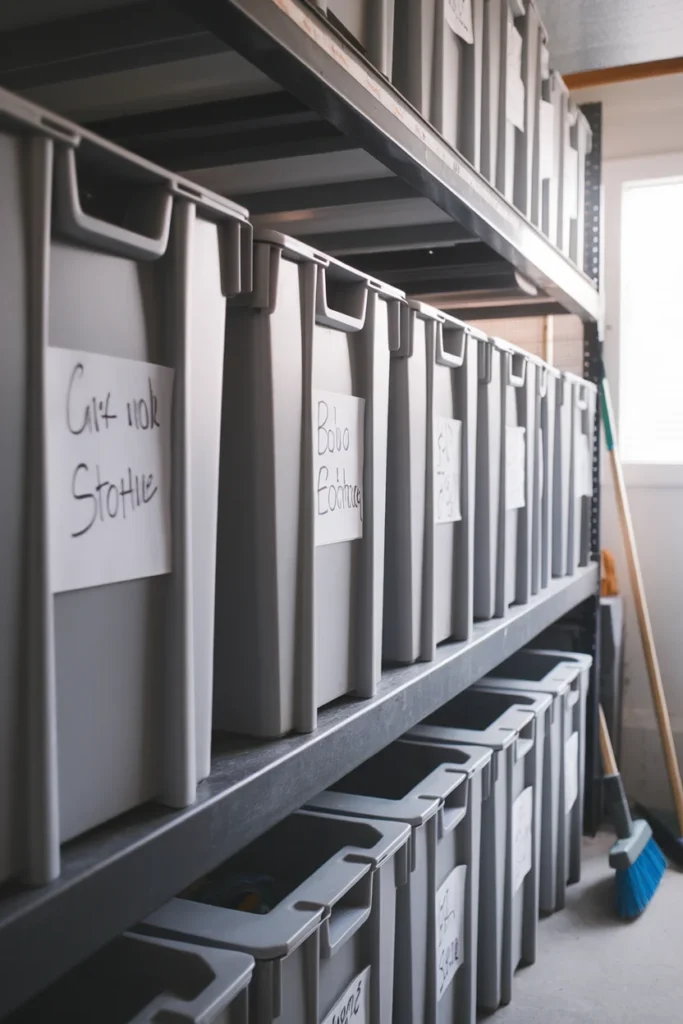
Once you know your depth bands and what’s actually staying, match the bin to the band. For the overhead deck, opaque heavy-duty totes with latching lids are right (Sterilite’s 27 gallon industrial totes are the workhorse here and they stack square). For the 5 to 7 foot band, clear bins win because you’re reading them from below. For the shallow side bands, open-front bins or baskets beat lidded containers, because a lid you have to remove one-handed while holding a wet dog leash is a lid you’ll stop using.
Label two faces of every bin: the front and the short end. In a garage you approach bins from odd angles, and a single front label is invisible half the time.
Then protect it with a reset. Ours is five minutes, once a week, on the same day. Walk the perimeter, put back anything on the floor, and break down any cardboard that appeared. That’s the whole ritual. Five minutes weekly beats four hours quarterly, every single time.
A Realistic Two-Day Small Garage Organization Plan
Most guides suggest a weekend. Most weekends do not go as planned. Here’s the version that survives contact with real life.
| Block | Time | What you do |
|---|---|---|
| Saturday AM | 90 min | Park the car, chalk the outline, back it out. Section-sort the perimeter in 25 minute rounds. |
| Saturday PM | 60 min | Haul the donate and dispose piles out. Schedule a hazardous waste drop-off. Sweep the floor. |
| Saturday eve | 20 min | Measure your three height bands. Write your shopping list against the 12-24-36 depth caps. |
| Sunday AM | 2 hours | Mount the rail and pegboard. Assemble the front-wall shelf. Install overhead rack if you’re drilling. |
| Sunday PM | 60 min | Load bins by band, label two faces, park the car back in, adjust anything that’s tight. |
Total: about six hours across two days, plus one shopping trip. Finish early? A proper bench is the natural next project, and we cover how to set up a garage workshop that works without giving up your parking spot.
Small Garage Organization FAQ
How do I organize a small garage full of stuff without spending money? Sort before you shop. Do the four-pile perimeter sort, get the donate and dispose piles physically out of the room, and then look at what’s left. Most people find they already own enough shelving once the volume drops. Free wins that need zero budget: hang long-handled tools on nails already in the studs, move cardboard and clothing indoors, and use vertical space you’re currently ignoring above the 5 foot line.
How can I make a small garage feel bigger? Clear the floor and paint the walls a light neutral. Visible floor is what your eye reads as room size. A garage with clean concrete and shallow wall storage feels dramatically larger than one with the same volume stacked in corners. Lighting helps more than people expect. Swap a single dim bulb for two 4 foot LED shop lights and the whole space reads bigger.
Is it cheaper to buy or build garage shelves? Building is usually cheaper per linear foot for deep, heavy-duty shelving, especially at 24 inches deep or more. For a small garage it’s often a wash, because you only need one or two units and prefabricated steel or plastic shelving under $60 arrives already sized. Build if you want a custom depth that nobody sells. Buy if you want it done Sunday afternoon.
What are good tool storage ideas for a small garage? Vertical and shallow. Three pieces cover most home setups in under 12 inches of depth. A wall rail with hooks for long-handled tools, a pegboard panel for hand tools, and one rolling tool chest that tucks against the front wall. Magnetic strips are the sleeper pick. They hold wrenches and screwdrivers and take up almost no room at all.
How do I organize a garage when I have to park in it? Chalk the car’s footprint including both door arcs, treat that outline as unbuildable, and confine all storage to the resulting U-shape: shallow side bands, one deeper front bank, and the ceiling. That constraint is the entire method. Everything else follows from it.
How long does small garage organization actually take? Plan on six working hours split across two days for a one-car garage, plus one shopping trip and one hazardous waste drop-off. Trying to do it in a single marathon day is where most projects stall around hour four.
Can I do this if I rent? Yes. Freestanding shelving, tension rods, outdoor-rated Command hooks, rolling carts, and over-the-door organizers give you a complete system without drilling a single hole. You lose the ceiling rack and the mounted rail, which costs you some capacity, and you gain the ability to pack it all up and take it with you.
Start With the Chalk
The reason small garage organization keeps failing isn’t discipline and it isn’t the amount of gear you own. It’s that the storage you bought was too deep for the room. Fix the depth budget and the room quietly cooperates.
So go park the car. Trace the outline. Look at what’s left, and let that shape make the decisions for you.
If you try the 12-24-36 Rule this weekend, we’d love to hear which band gave you the most trouble. Most people are shocked by how much lives in the 5 to 7 foot range once they start looking up.