

Under Stairs Storage Ideas You Haven’t Tried
That little triangle of dead space under your stairs is basically free square footage you already paid for. Most of us walk past it for years. We shove a vacuum in there, maybe a stack of shoes nobody claims, and call it done.
Here’s the promise. By the end of this post you’ll have a dozen under stairs storage ideas that go way past the usual “add a basket” advice, including a few no one on the first page of Google is talking about. Some take a weekend. Some take fifteen minutes and zero tools.
We’ll cover renter-safe setups, budget picks, the one safety rule almost everyone skips, and a simple framework to decide what actually belongs under there. Let’s put that corner to work.
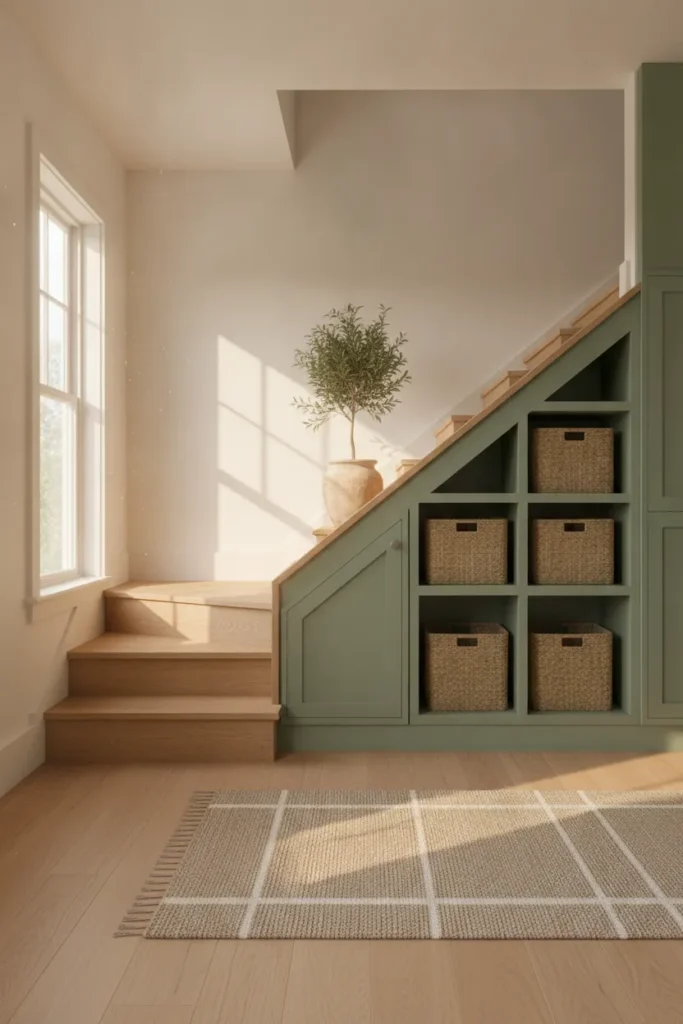
First, What Is Storage Under Stairs Even Called?
Quick vocabulary, because it helps when you shop. That closed-off closet is an under-stair or “understair” closet. The angled dead zone itself is often called the “spandrel.” Search Pinterest and you’ll see people call the whole thing a staircase storage nook.
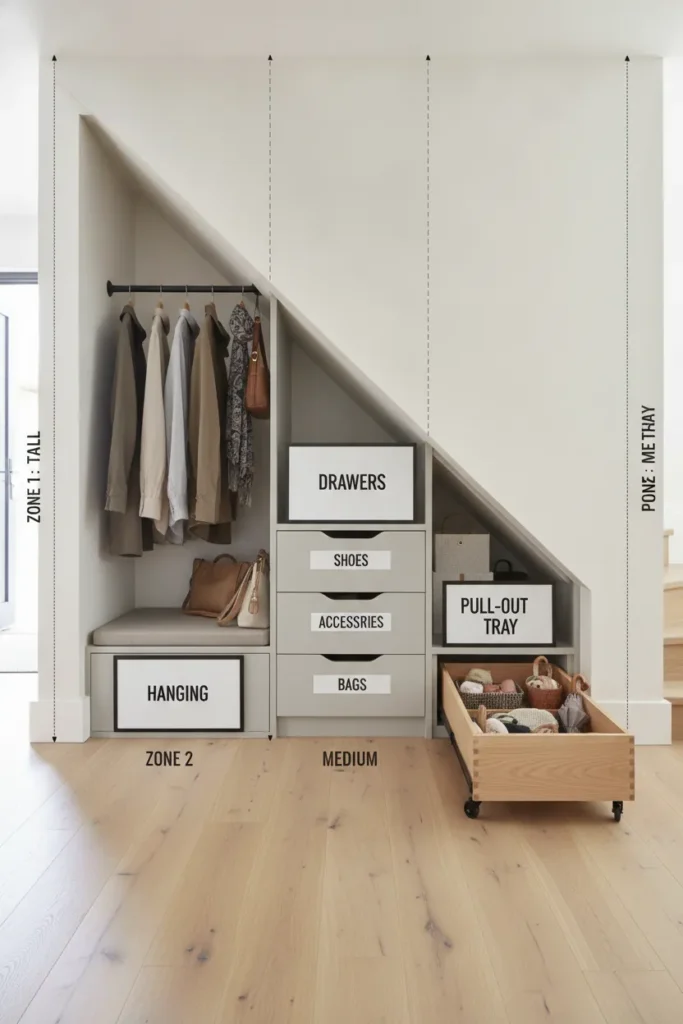
Names aside, every staircase gives you three rough zones: a tall end where you can stand, a middle where you can crouch, and a low end barely a foot high. The trick is matching the right storage to the right height. More on that in a second.
The 3-Zone Understair Rule (Steal This Framework)
Before you buy a single bin, use this. I call it the 3-Zone Understair Rule, and it saves you from the classic mistake of buying tall shelves that only fit one corner.
Zone 1 is the tall end (roughly 5 to 7 feet). Put things you use daily and need to see: coats, backpacks, a slim shoe cabinet. Zone 2 is the middle (about 2 to 4 feet). This is drawer and basket territory. Zone 3 is the low end (under 18 inches). Reserve it for flat, seasonal, or rarely-touched items on pull-out trays, because reaching back there is a pain otherwise.
Sketch your three zones on your phone before shopping. Match each item to a zone. That’s the whole system.
No-Drill Under Stairs Storage for Renters
Here’s the gap nobody fills. Almost every under-stairs article assumes you own the place and can hire a contractor. If you rent, you need setups that leave no marks and pack up on moving day.
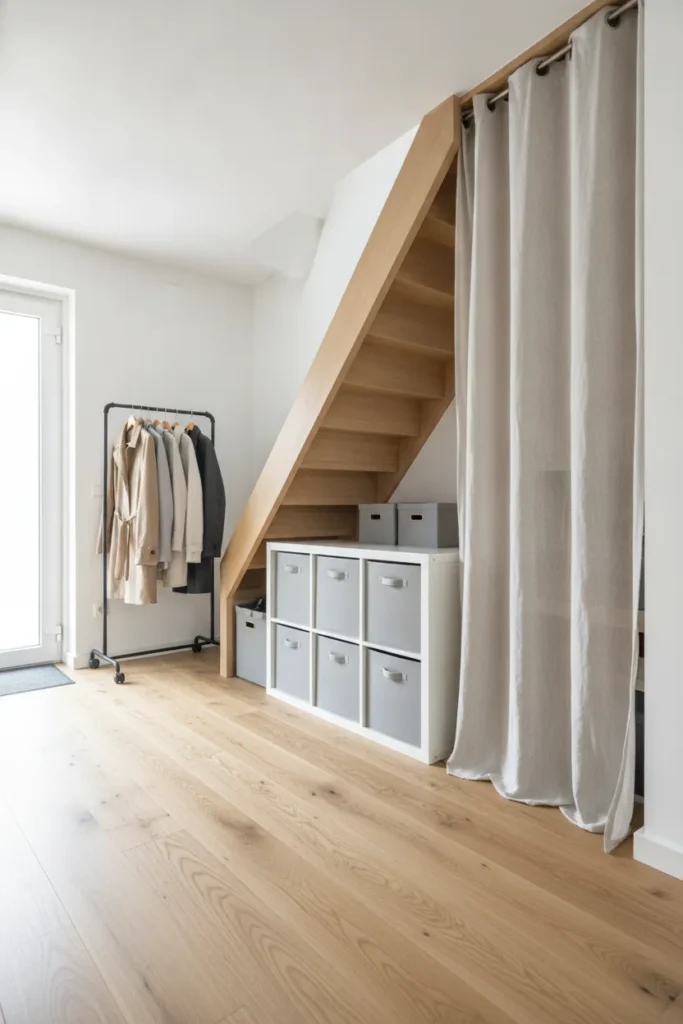
Start with freestanding units. An IKEA Kallax on its side slides neatly under the mid zone and gives you cube storage without a single screw in the wall. Add IKEA Drona fabric boxes to hide clutter. For the tall end, a slim rolling garment rack turns the spot into a mini coat closet.
Command hooks (the 3M kind rated for the weight you need) handle bags, hats, and a dog leash on the vertical wall. A tension rod wedged across two side walls gives you a hanging bar with zero hardware. And if you want a pretty “door” without building one, a linen curtain on a tension rod hides everything in one swipe.
In our old apartment I ran a $12 tension rod across the opening and hung a drop-cloth curtain, and our landlord never knew there was a whole shoe pile behind it.
A Smarter Shoe Drop
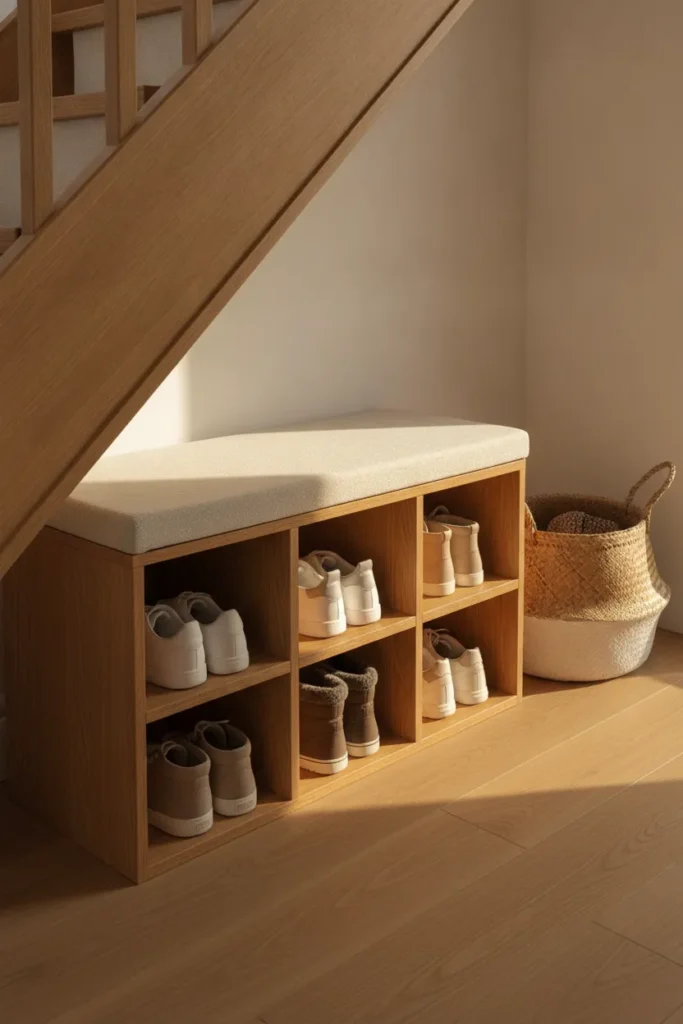
Shoes are the number one thing people pile under stairs, and the number one thing that turns the spot into a mess. The fix is giving each pair a defined slot instead of a free-for-all heap.
A low, wide shoe bench with cubbies fits the mid zone beautifully and doubles as a place to sit and pull off boots. Angled shoe shelves make use of the slope. For deep spots, clear stackable shoe boxes let you see every pair without digging.
If footwear is your main under-stairs problem, we go deeper on slot-by-slot systems in our guide to a smarter shoe drop. Pair it with this space and your entryway floor stays clear.
Build In Pull-Out Drawers (The Space Saver Everyone Wants)
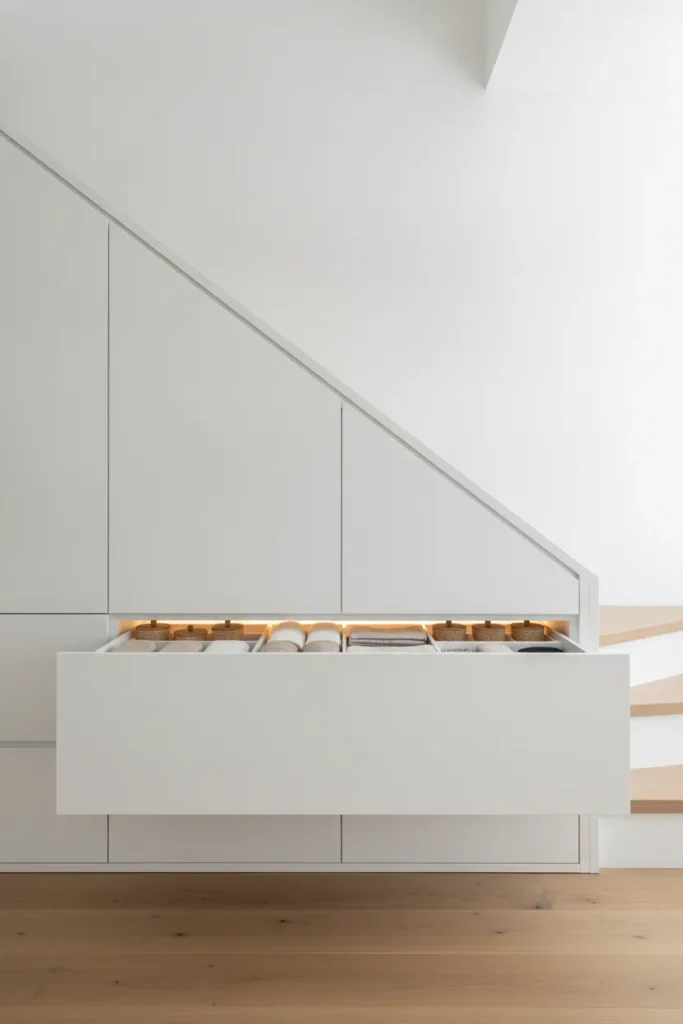
If you can access the hollow behind the staircase wall, pull-out drawers are the highest-value upgrade. Deep drawers on heavy-duty slides reach all the way to the back low zone, so nothing gets lost in the dark triangle.
Store off-season clothing, extra linens, wrapping paper, or bulky sports gear. Add a strip of battery LED lights inside so you can see the contents. Pre-made under-stair drawer kits exist if you don’t want to build from scratch, and they cut the project down to a weekend.
Not a builder? A freestanding chest of drawers in the tall zone gives you a similar hidden-storage payoff with none of the carpentry.
Turn It Into a Cozy Reading Nook
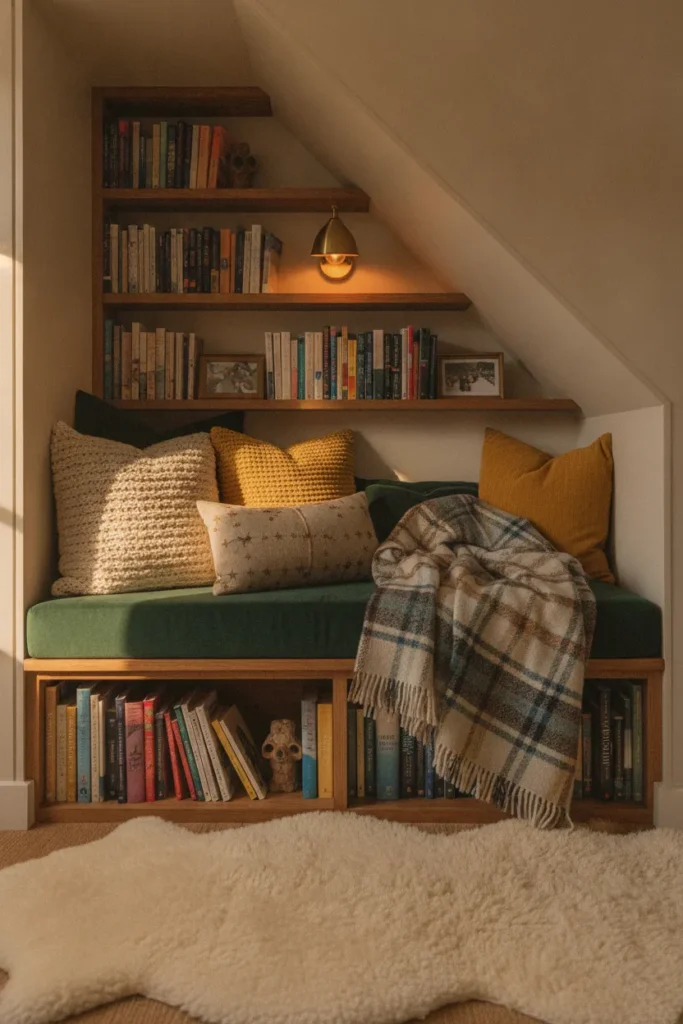
This is the idea that blows up on Pinterest, and for good reason. The tall-to-mid zone is the perfect size for a small padded bench, a few cushions, and a warm reading light.
Add a slim wall sconce or a rechargeable puck light so nobody’s reading in the dark. Line the back with a couple of low shelves for books, and suddenly the most wasted corner in the house becomes everyone’s favorite seat.
Kids especially love it. If you want the full cozy-corner treatment, borrow the layout ideas from our post on building a reading nook in a small bedroom, then shrink it to fit.
Add a Pantry Overflow Station
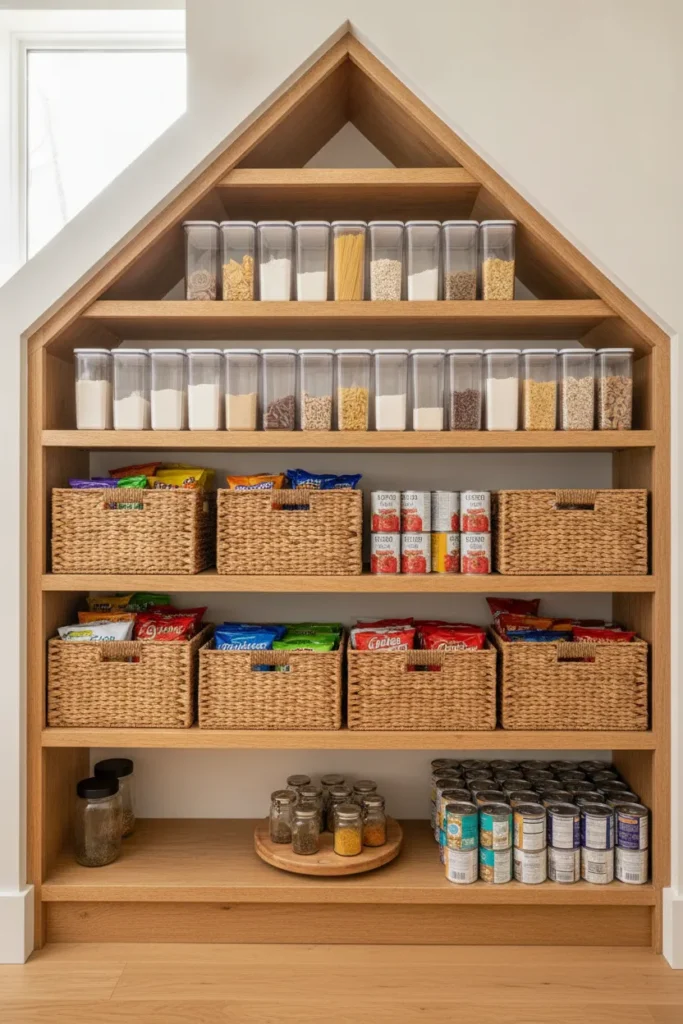
Short on kitchen storage? If your stairs sit near the kitchen, the under-stair space makes a brilliant pantry overflow. Open shelves in the tall zone hold canned goods, small appliances, and clear OXO Good Grips POP containers of decanted flour, pasta, and snacks.
A 2.7-quart OXO POP container is a good workhorse size for flour or cereal, and the square shape stacks without wasting an inch. Group like with like, add labels, and keep a lazy Susan on the deepest shelf so nothing hides in the back corner.
Snacks on the low shelves, heavy stuff at waist height, rarely-used platters up top. Simple.
Make a Drop Zone for the Whole Family
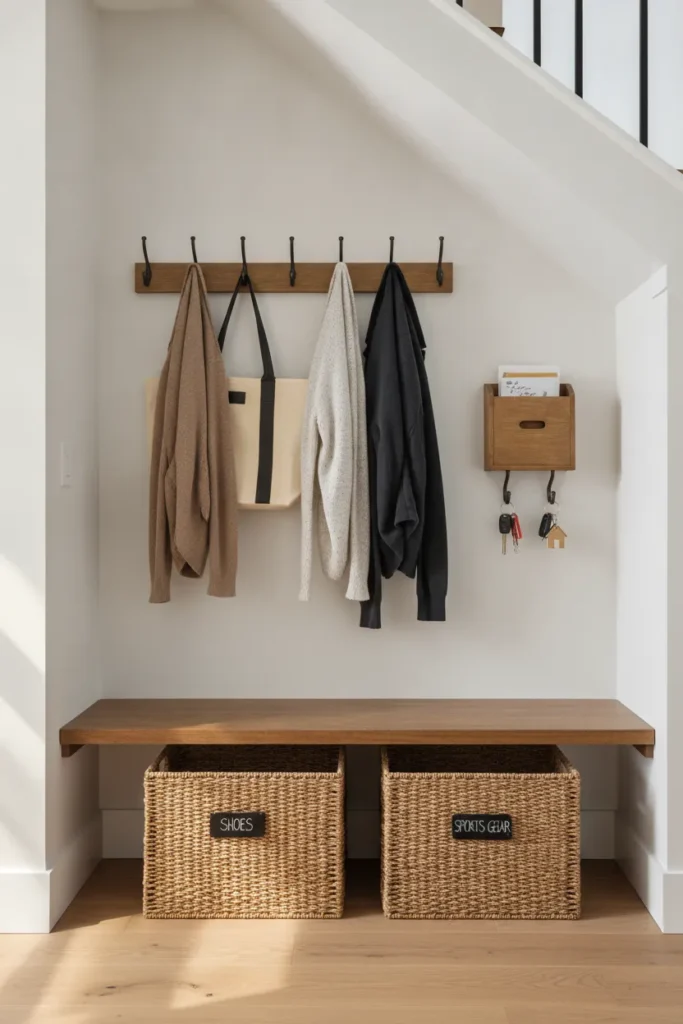
If your staircase greets you at the front door, treat the wall under it as a command center. Think hooks, a small bench, a mail tray, and a basket per person. This keeps the daily avalanche of keys, bags, and jackets from landing on the floor.
Try to think in vertical zones here, because the sloped wall gives you staggered hook heights that actually suit a family. Tall hooks up high for adults, low hooks near the short end for little ones.
Tie the look into the rest of your entryway so it reads as intentional, not tacked on. A matching paint color between the stairs and the drop-zone wall does most of the heavy lifting.
Under Stairs Storage on a Budget
You do not need a contractor to make this space work. Some of the best-looking setups cost under $50 total.
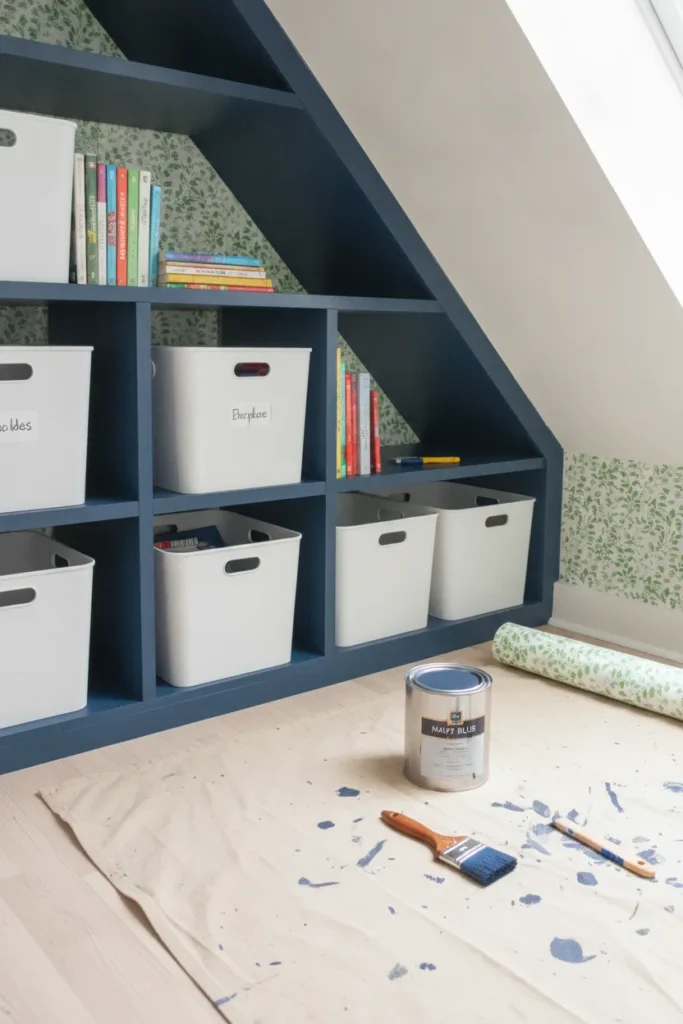
Dollar Tree and Walmart Mainstays bins bring instant tidiness. A can of paint in a moody color makes cheap shelves look custom. Peel-and-stick wallpaper on the back wall adds a designer touch that peels right off later (renters, this one’s for you).
To put the DIY route in perspective, a professional built-in bookshelf installation runs about $1,400 to $4,830 according to Angi’s 2026 cost data, and their guide even calls out “under the stairs” as a prime built-in spot. A weekend of paint, brackets, and bins can get you 80 percent of that look for a tiny fraction.
The Safety Rule Almost Everyone Skips
Here’s the angle the pretty Pinterest posts leave out, and it matters. The space under the stairs is not the place for flammable clutter. The U.S. Fire Administration advises keeping stairs clear for quick escape and storing oil, gasoline, paints, and propane away from living spaces, per their home fire prevention guidance.
So skip the paint cans, propane camp stoves, and stacks of old newspapers down there, especially in a basement stairwell. Keep the zone tidy enough that it never blocks an exit path. If you ever enclose the space into a closet, check your local building code, since usable enclosed space under stairs often has fire-resistance requirements.
Store the everyday stuff. Keep the hazardous stuff elsewhere. Easy rule, big payoff.
Quick-Glance Under Stairs Storage Cheat Sheet
Screenshot this before you start:
| Zone | Height | Best For | Budget Pick |
|---|---|---|---|
| Tall end | 5 to 7 ft | Coats, garment rack, tall shelving | Rolling rack + Command hooks |
| Middle | 2 to 4 ft | Drawers, baskets, shoe bench | Kallax on its side + fabric bins |
| Low end | Under 18 in | Flat, seasonal, pull-out trays | Clear underbed boxes |
I swore my low end was useless until I slid two flat wrapping-paper boxes in and reclaimed a whole closet shelf upstairs.
Frequently Asked Questions
How do you turn under stairs into storage?
Measure the three height zones first, then match storage to each: hanging or tall shelving at the tall end, drawers and baskets in the middle, flat pull-out trays at the low end. Renters can do it all with freestanding units and no drilling.
How much does understairs storage cost?
It ranges widely. A DIY setup with bins, paint, and freestanding units can stay under $50 to a few hundred dollars. Custom built-ins are far more: professional built-in bookshelf work runs roughly $1,400 to $4,830 based on Angi’s 2026 data, and full storage-staircase builds can climb higher.
What can you store under stairs?
Shoes, coats, backpacks, off-season clothing, linens, cleaning supplies, pantry overflow, holiday decor, books, and sports gear all work well. Keep flammables like paint and propane out of the space for safety.
What is storage under stairs called?
It is usually called an understair closet or understair storage, and the angled dead space itself is sometimes called the spandrel. On Pinterest you’ll also see it tagged as a staircase storage nook.
What is the cheapest way to add under stairs storage?
Start with freestanding bins and baskets you already own, add a coat of paint, and hang a curtain on a tension rod as a no-cost “door.” Dollar Tree and Walmart Mainstays bins keep the whole project well under $50.
Is it safe to store things under the stairs?
Yes, for everyday household items, as long as you keep the path clear and never block an escape route. Avoid flammable liquids and follow local building code if you fully enclose the space, since the U.S. Fire Administration flags stairwell clutter and improperly stored flammables as fire risks.
Can renters do under stairs storage without damage?
Absolutely. Freestanding cube shelves, rolling racks, tension rods, removable Command hooks, and peel-and-stick wallpaper give you a finished look with zero permanent changes.
Your Dead Corner’s About to Become the Hardest-Working Spot in the House
The space under your stairs was never really wasted. It was just waiting for a plan. Pick one idea that fits your zone map, grab a couple of bins this weekend, and start small.
Which zone are you tackling first, the tall coat corner or that tricky low triangle? Measure it tonight, save this post, and come back when you’re ready for the next room.


