
Linen Closet Organization: How to Fold and Store Sheets and Towels (Without Losing Your Mind)
Picture your linen closet right now. The fitted sheet that looks like a balled-up parachute. A tower of bath towels leaning at a 12-degree angle. Three pillowcases that have absolutely nothing to do with the sheet sets they belong to. We’ve all been there, and the good news is that fixing it takes one focused afternoon, not a weekend renovation.
Here’s the promise. By the end of this guide, you’ll have a linen closet you actually want to open, every sheet folded so flat it looks store-bought, and a freshness system that keeps the whole space smelling like a cozy hotel. We’re organizing this article by Linen Closet Organization zone (top shelf, middle, bottom, and door), with budget and splurge picks layered into each zone so it works whether you’re shopping Dollar Tree or West Elm.
Who This Guide Is For
You’ll get the most out of this guide if you fall into any of these buckets:
- Renters who can’t drill, paint, or modify built-ins (we have an entire door-back section for you)
- Homeowners with a hallway closet that hasn’t been reorganized since you moved in
- Small-space dwellers working with closets as narrow as 20 inches wide
- Budget-conscious folks who want a Pinterest-worthy result for under $50 total
- Style lovers who want the closet to match a Modern Farmhouse or Japandi aesthetic
Skip ahead to whichever section fits your situation. Or read top to bottom, because the fold tutorials are worth the trip.
Start With the 90-Day Linen Audit (The Step Everyone Skips)
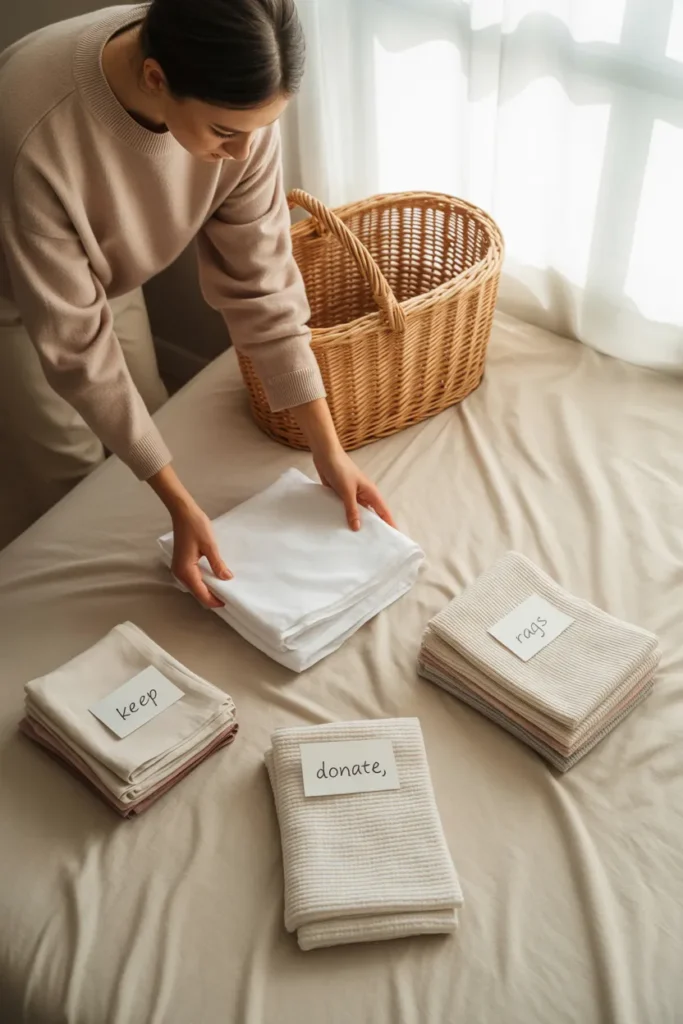
Before you buy a single bin, you need to know what’s actually in your closet. This is the step that separates a Pinterest pin from a Pinterest fail. Pull every single item out. Pile it on your bed. Then sort using this decision rule.
The 90-Day Linen Audit Framework:
| Item | Keep | Donate | Repurpose as Rags |
|---|---|---|---|
| Bath towels | Used in last 90 days, no fraying | Unused 90 plus days, still soft | Frayed edges, bleach stains |
| Fitted sheets | Elastic still snaps back, no pilling | Fits a bed size you no longer own | Holes, permanent stains |
| Flat sheets | Matches a fitted sheet you kept | Orphan sheets, no matching set | Rips longer than 2 inches |
| Pillowcases | Has a matching partner | Set is incomplete and faded | Stained beyond stain-stick help |
| Blankets | Used in last 12 months | Duplicate of one you prefer | Pet hair past saving |
This single framework eliminates 30 to 40 percent of what’s clogging the average linen closet. I tested this in my own hallway closet last spring and walked away with two donation bags and a clear shelf I didn’t know I had.
How to Fold Sheets Like You Actually Know What You’re Doing
Folded sheets save space, look organized, and stop the dreaded sheet avalanche. Here are the three folds you need.
The Fitted Sheet Fold (a 60-Second Method)
This is the trick Martha Stewart made famous, and it genuinely works once you do it twice. For a video walkthrough that shows the hand position from the right angle, Martha Stewart’s own fitted sheet tutorial is the gold standard.
- Hold the sheet lengthwise with the elastic side facing you
- Tuck your hands into the two top corners
- Bring those corners together, then flip the right corner over the left so they nest like cups
- Repeat with the bottom two corners until all four corners stack into one
- Lay flat, fold into a long rectangle, then fold into thirds
Why it works: The nested-corner trick is what flattens the curved elastic into a straight edge. Without it, you’re folding a parachute.
The Flat Sheet Fold
Fold lengthwise in half, then in half again. Now fold widthwise into thirds. You’re aiming for a rectangle roughly 12 inches wide and 16 inches tall, which is the magic dimension for most linen closet shelves.
The “Sheet Set in a Pillowcase” Trick
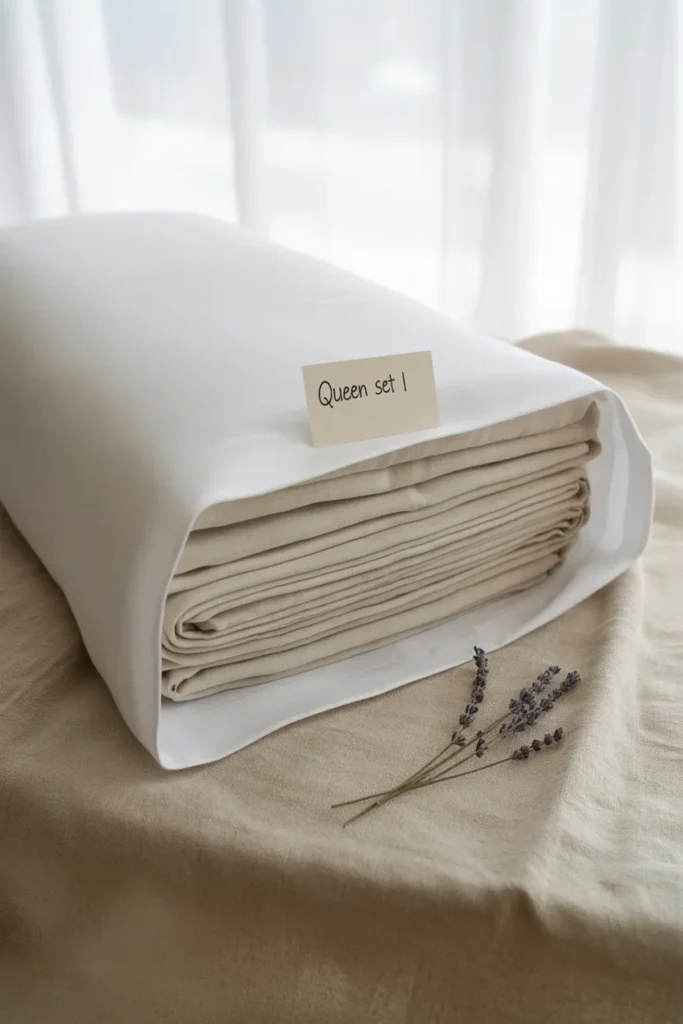
This is the single best linen closet organization idea ever invented. After you fold the fitted sheet, flat sheet, and one pillowcase together, slide the entire stack inside the second matching pillowcase. Now you grab one bundle and have the complete set, every time. No more orphan pillowcases lurking in the back like sock-drawer goblins.
Towel Storage Ideas That Actually Save Space
Towels are the bulkiest thing in most linen closets and the most likely to topple. Two methods work, and the right one depends on your shelf depth.
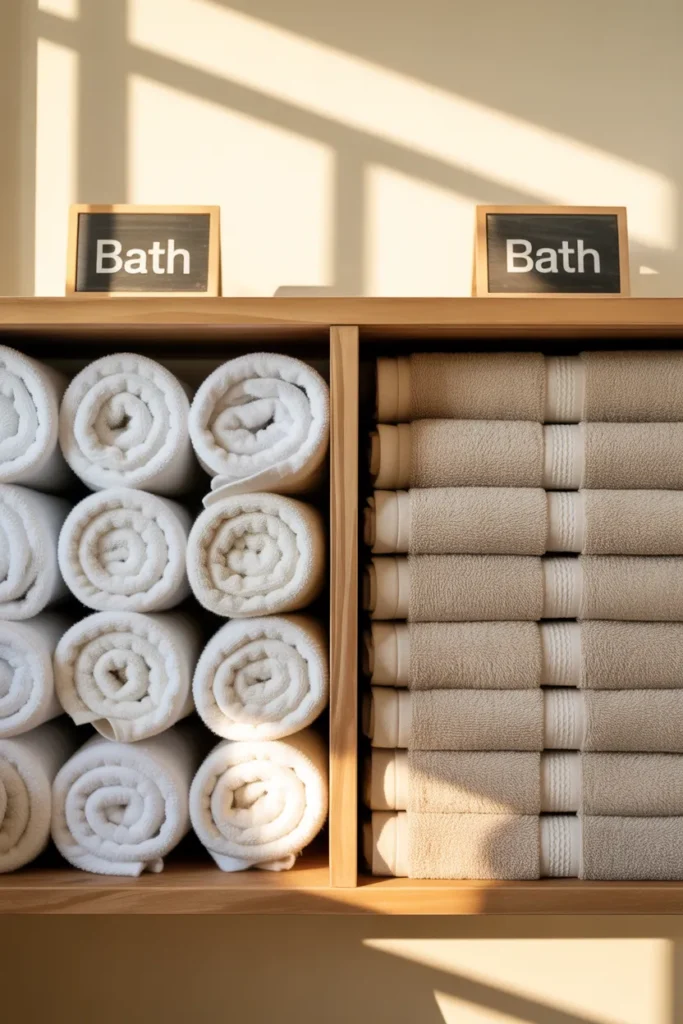
The Hotel Roll (For Shelves 14 Inches Deep or Less)
Fold the towel in thirds lengthwise, then roll tightly from the short end. Stack rolls on their sides like wine bottles. You’ll fit roughly 30 percent more towels per shelf with this method, and it’s the only towel storage idea that works in pantries or hallway closets as narrow as 20 inches wide.
The Library Stack (For Shelves 14 Inches Deep or More)
Fold towels in thirds lengthwise, then in half, then in half again. Stack vertically (yes, vertically, like books on a shelf). You’ll see the edge of every towel at a glance, and pulling one doesn’t collapse the rest.
Sort by Use, Not by Size
Here’s the angle no competitor article covers well. Group towels by who uses them and for what, not by their size. So your hand towel pile lives next to the bath towel pile that goes in the same bathroom. Beach towels live separately. Guest towels stay roped off so they’re actually clean when guests arrive. This is how hotels do it and the reason their closets stay sane.
Top Shelf: Seasonal and Rarely Used (Zone 1)
The top shelf is where you stash the things you reach for once a season. Think extra blankets, holiday linens, guest sheets for the bed nobody uses except in December.
What goes here: Down comforters in summer, lightweight quilts in winter, holiday-themed table linens, the duvet cover your mother-in-law gifted you that you swap in when she visits.
How to store it: Use vacuum-seal bags for bulky comforters (they shrink to roughly one-third their original size). For everything else, soft-sided fabric storage cubes with labels. Cubes corral the contents and hide the chaos behind a clean front, which matters because the top shelf is the most visible part of the closet when the door swings open.
Budget pick (under $25): Dollar Tree’s flat collapsible storage cubes, two for $3, and a 6-pack of vacuum bags from Amazon for $19.
Splurge pick ($100 plus): West Elm’s rope-handle storage bins in natural seagrass at around $39 each. They look like a styled magazine spread when stacked three across.
For a deeper dive into seasonal rotation across the whole house, our room-by-room spring cleaning checklist walks through exactly when to swap your linen closet contents twice a year.
Middle Shelves: Daily Drivers (Zone 2)
This is the prime real estate. Eye level. Easy reach. The shelves you open every single day. Reserve them for the things you actually use.
What goes here: Bath towels for the bathroom this closet serves, current-season sheet sets, hand towels, washcloths.
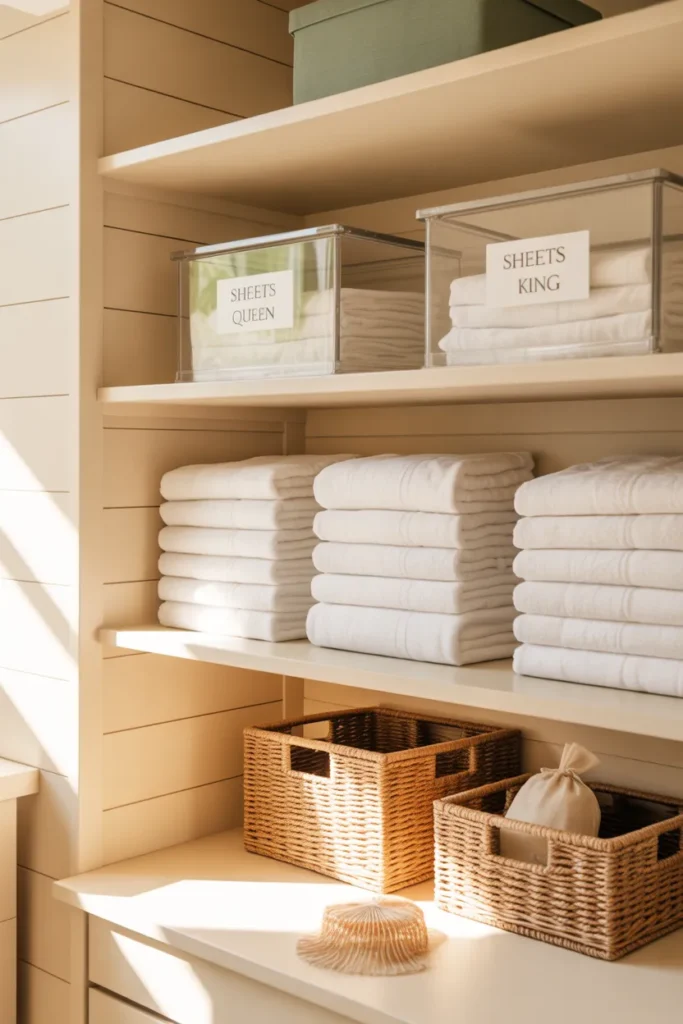
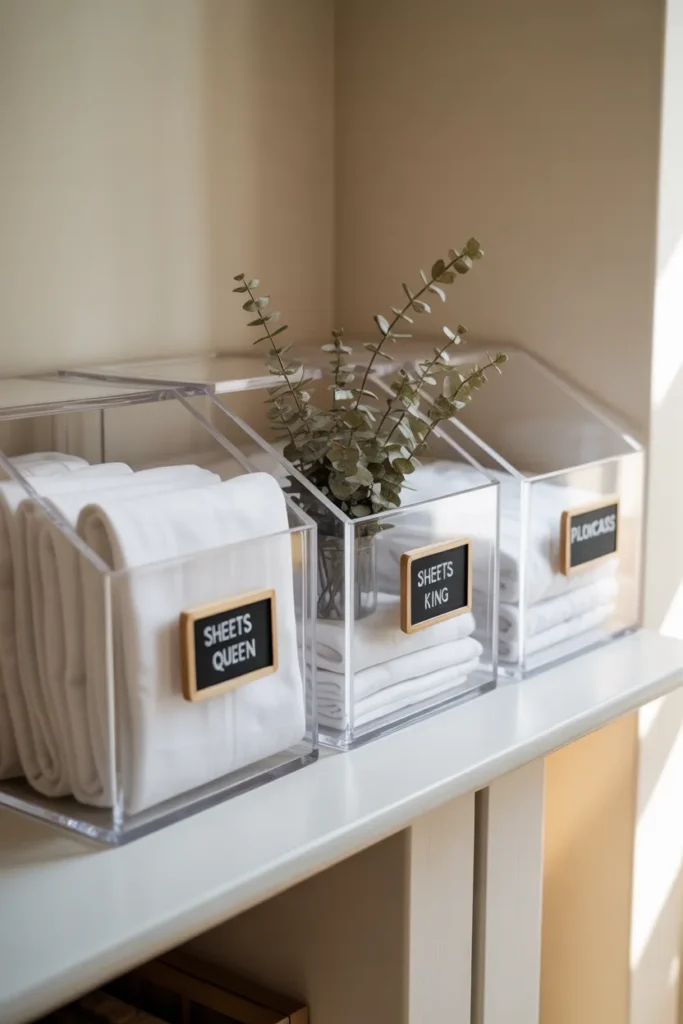
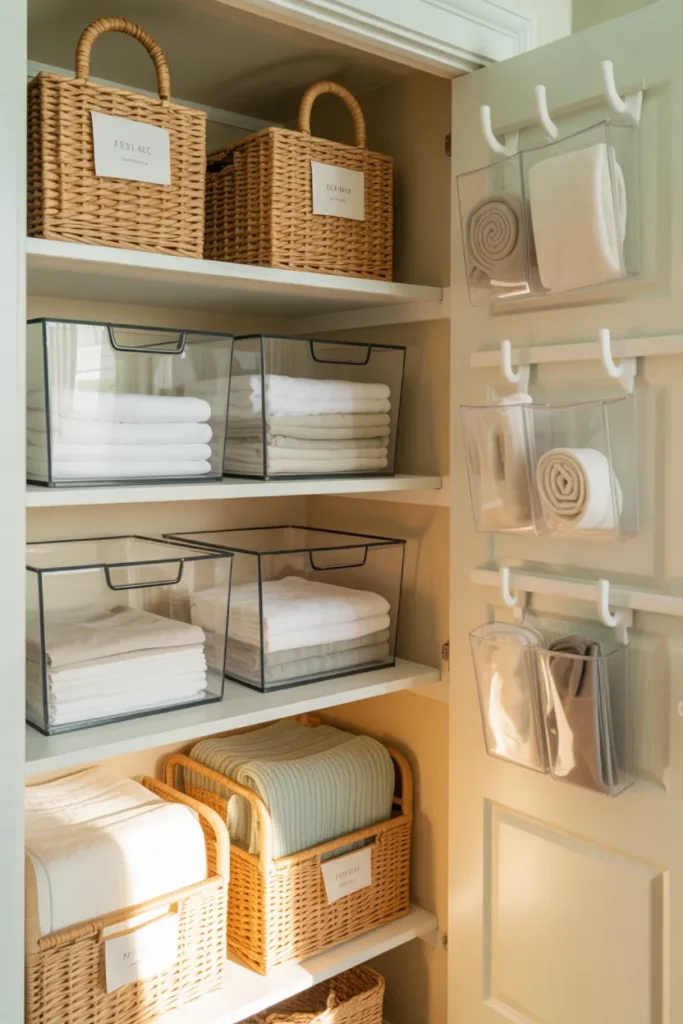
How to store it: Clear acrylic bins are your best friend on the middle shelves because you can see what’s inside without pulling them down. Group by category, label every bin, and leave roughly two inches of breathing room on top of each bin so you’re not jamming things in.
Budget pick (under $25): Stackable clear bins from Dollar Tree at $1.25 each, plus a pack of chalkboard labels for $3.
Splurge pick ($100 plus): The Container Store’s clear shoe boxes (yes, shoe boxes, they’re the perfect dimensions for sheet sets) at around $4 each, plus an iDesign Linus stackable drawer at $39 for medicine and small items.
The trick is consistent sizing. When every bin is the same width and depth, the closet reads as organized even before you do another thing. Mismatched bins make even a clean closet look chaotic.
Bottom Shelves: Heavy and Bulky (Zone 3)
The bottom shelves take the items that are too heavy or too oddly shaped for higher up. Lifting weight at knee level is way safer than lifting it overhead, which matters if you have a packed closet full of guest blankets.
What goes here: Spare blankets, throw pillows, mattress pads, beach towels, pool floats.
How to store it: Woven baskets are the right answer here for two reasons. First, they hide the bulky-bin look. Second, the texture adds the warm, layered visual that Pinterest pins love. Use one basket per category. Label with leather tags or a simple twine-and-paper tag.
Budget pick (under $25): HomeGoods woven seagrass baskets at $14.99 each. Walmart’s Better Homes and Gardens collapsible storage bins at $9.
Splurge pick ($100 plus): Crate & Barrel’s Maui rectangular baskets at $79.95 each. They’re the prop you see in every styled-home Instagram post for a reason.
For renters working with apartment-sized closets where the bottom shelf doubles as overflow storage, our guide to budget-friendly apartment organization has more solutions for tight spaces.
The Closet Door: The Most Wasted Square Footage in Your Home
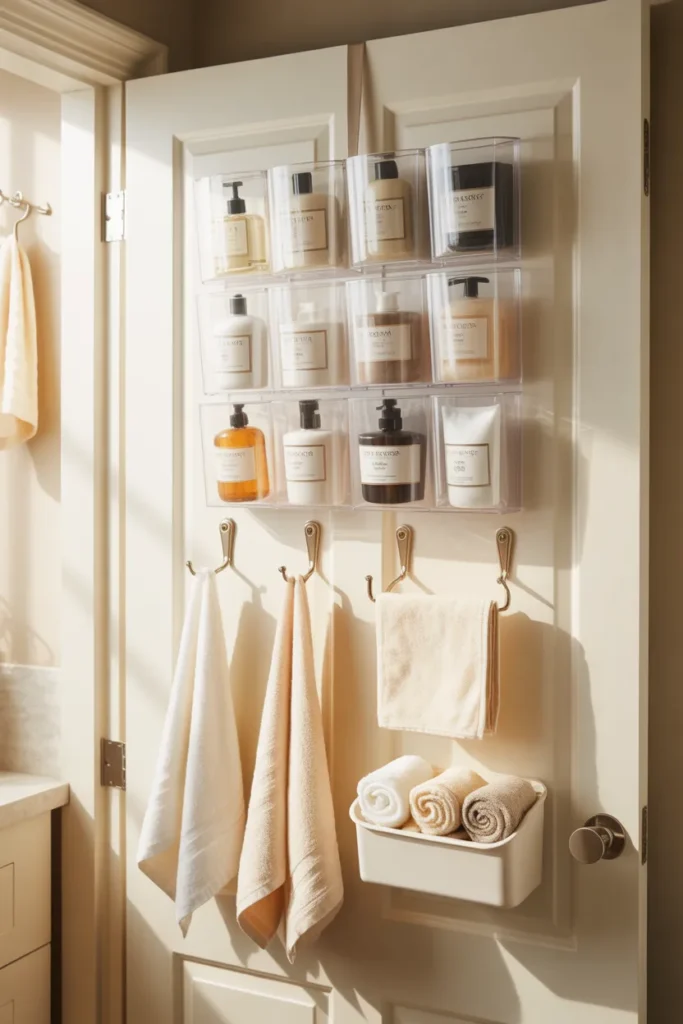
Every linen closet door has roughly 12 square feet of unused vertical space on the inside. Here’s how to claim it without drilling a single hole.
Over-the-door pocket organizer: Holds first aid, sunscreen, travel-size toiletries, hair tools, batteries. The clear-pocket version from Amazon runs around $18 and rental-friendly because it hooks over the top of the door (no hardware required).
Adhesive hooks for hand towels: Command Strip hooks rated for 7.5 pounds hold a damp hand towel with no problem. Use them for the towels you grab and throw in the laundry quickly.
Adhesive shelf bins: Stick-on plastic bins (the brand mDesign makes a great one for around $24 a 2-pack) attach to the back of the door without hardware. Perfect for stashing extra rolls of toilet paper, lotion bottles, or hair brushes.
Renter-friendly flag: Every solution above uses adhesive, hooks, or over-the-door hangers. Zero drilling. Removable. Command-strip safe. Your security deposit stays intact.
The Scent and Freshness System (The Angle Nobody Talks About)
Your linen closet should smell like fresh laundry every time you open it, not like the slightly musty wood scent that builds up over time. Here’s the rotation system I use.
Sachets (replace every 90 days): Lavender or cedar sachets, two per shelf. Tuck them between folded stacks. Lavender for soft and floral. Cedar for clean and slightly woodsy.
Cedar blocks (replace every 12 months, sand the surface every 90 days): Cedar’s natural oils repel moths and absorb humidity. One small block per shelf is enough. When the scent fades, sand the surface with fine-grit sandpaper to refresh the oils.
Linen spray (use weekly): A light mist of linen spray on stacked towels and sheets keeps them smelling fresh between washes. Caldrea makes a beautiful one for $12 if you want something splurgy, or you can DIY with distilled water, vodka, and a few drops of essential oil for under $5.
The 90-day refresh cadence: Set a phone reminder. Every quarter, refresh sachets, sand cedar, and rotate stored items so the bottom of every stack actually gets used. This single habit is what keeps the closet from regressing.
While we’re on the topic of freshness, the Cleveland Clinic recommends washing sheets at least once a week for hygiene reasons (more often if you have allergies or pets). Build that cadence into your linen system and you’ll always have a fresh set ready to go.

Budget vs Splurge: A Side-by-Side Comparison
Same closet, two budgets, both work. Here’s exactly what each version looks like.
| Category | Budget Build (under $50 total) | Splurge Build ($300 plus) |
|---|---|---|
| Bins (middle shelf) | Dollar Tree clear stackables, $1.25 each | Container Store clear shoe boxes, $4 each |
| Baskets (bottom shelf) | Walmart fabric cubes, $9 each | Crate & Barrel Maui baskets, $79.95 each |
| Door organizer | Amazon clear pocket organizer, $18 | West Elm leather pocket organizer, $69 |
| Labels | Dollar Tree chalkboard stickers, $3 | Rifle Paper Co printed labels, $14 |
| Sachets | Amazon basics 6-pack, $9 | Caldrea sea salt neroli sachets, $24 |
| Sheet bands | DIY ribbon and tag, $4 | Container Store labeled sheet bands, $19.99 |
Both versions deliver the same functional result. The splurge version photographs slightly better and has a longer aesthetic lifespan. The budget version genuinely looks just as good once everything is folded uniformly and labeled consistently.
Common Mistakes to Avoid
After reorganizing my own linen closet three times before I got it right, here are the mistakes I see most often.
Buying bins before purging. You end up with the wrong sizes for the items you actually keep. Always audit first. Always shop second.
Using mismatched containers. Even the most beautifully labeled closet looks chaotic if the bins are five different colors and four different sizes. Pick one bin style and commit.
Stacking towels too tall. Anything over 8 towels in a single stack will topple within a week. Cap each stack at 6 to 8 towels and start a new column.
Skipping labels because “you’ll remember.” You will not remember. Your spouse will not remember. Your kids will absolutely not remember. Label everything.
Storing toiletries in the original packaging. Different shapes, different colors, different heights. Decant or contain. Use a single clear bin for backup toiletries and keep the daily-use ones in the bathroom itself.
Ignoring the door. Twelve square feet of free real estate, wasted on most closets. Even a single over-the-door pocket organizer doubles your storage.
Forgetting the rotation. A perfectly organized closet regresses to chaos in 90 days if nobody refreshes it. Set the reminder.
A Quick Word on Style: Modern Farmhouse vs Japandi
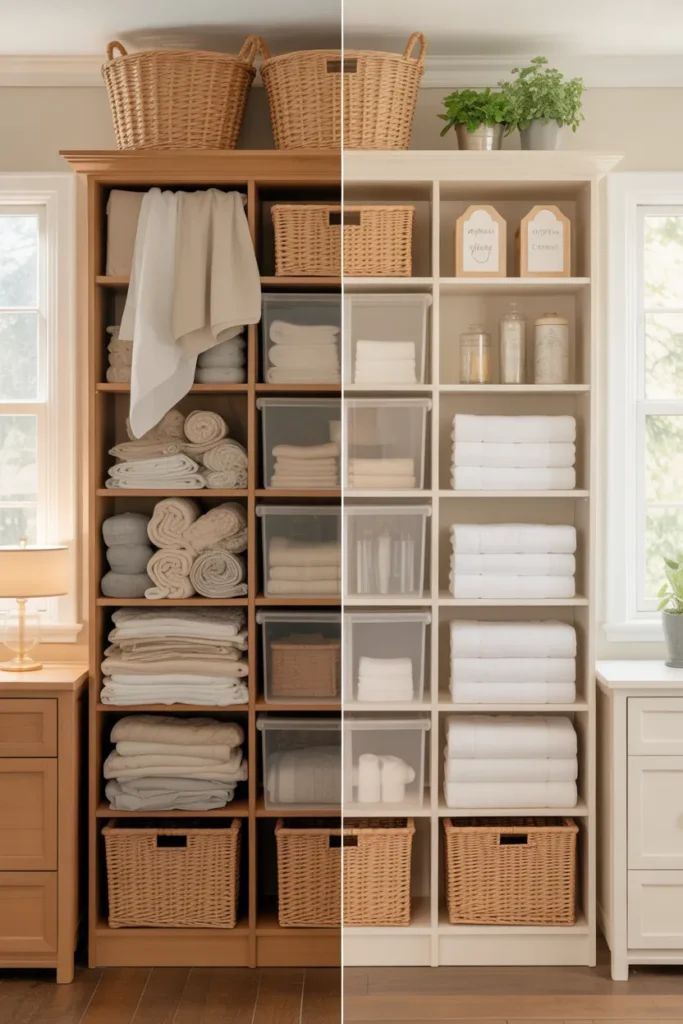
Two of the most-pinned linen closet aesthetics on Pinterest right now are Modern Farmhouse and Japandi. They’re not interchangeable, and your bin and basket choices should match the one you’re going for.
Modern Farmhouse: Cream and white palette, woven seagrass baskets, chalkboard labels, distressed wood accents, dried eucalyptus or lavender as styling props. Cozy, warm, slightly rustic.
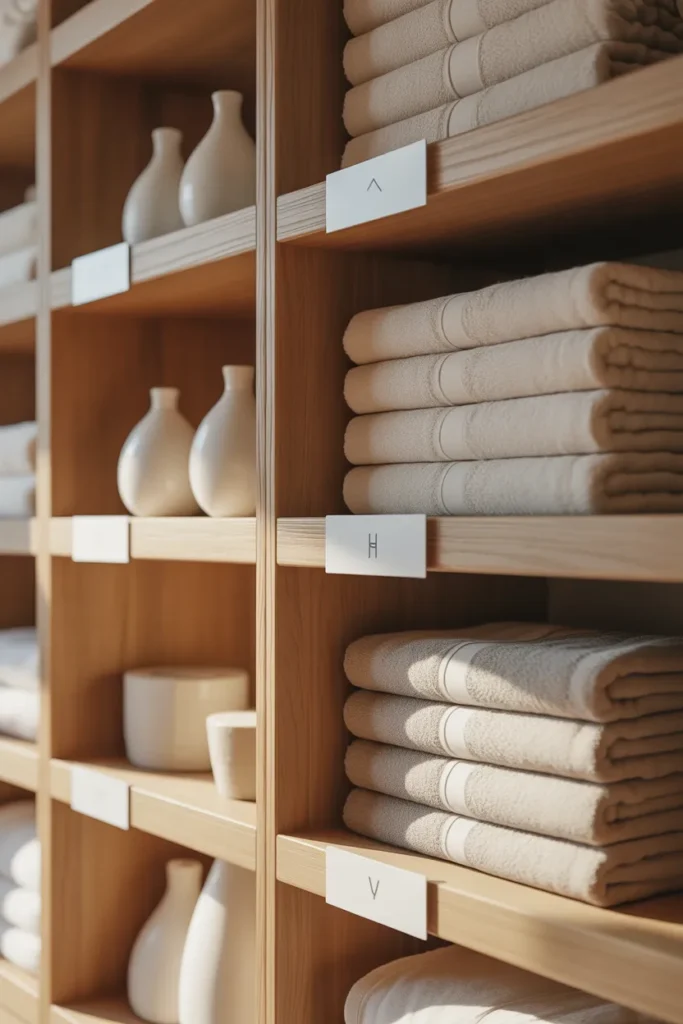
Japandi: Stripped-back beige and white palette, light oak or bamboo accents, ceramic vessels, linen pouches, minimal labeling (single-character or symbol-only labels). Calm, clean, almost monastic.
Pick one and commit. Mixing the two is what makes a Pinterest pin look like a Pinterest fail.
Linen Closet Organization for Bathrooms vs Hallways
Quick distinction, because the two situations call for different priorities.
Bathroom linen closet: Smaller, often only 18 to 24 inches wide, prone to humidity. Prioritize moisture-resistant bins (acrylic over fabric), keep medications on a higher shelf away from steam, and use a small cedar block to handle the humidity.
Hallway linen closet: Usually deeper, often 24 to 30 inches deep, but vulnerable to deep-shelf “back-of-the-shelf graveyard” syndrome. Use pull-out drawers or label-fronted bins so the back of the shelf stays accessible. A turntable on a deep shelf is the secret weapon for first aid and toiletries.
Pulling It All Together: Your Action Plan
Block out 3 to 4 hours on a Saturday morning. Coffee. Comfortable clothes. Donation bag ready. Here’s the order.
- Empty the entire closet onto your bed (45 minutes)
- Run the 90-Day Linen Audit (30 minutes)
- Wipe shelves clean and add liner if needed (15 minutes)
- Fold everything using the methods above (60 to 90 minutes)
- Place items by zone (top, middle, bottom, door) (30 minutes)
- Add bins, baskets, sachets, and labels (30 minutes)
Your closet, fully reset, in one focused session. For more closet and bedding projects to tackle next, our guide to bedroom organization for calmer mornings is the natural next step.
Frequently Asked Questions
How do I organize a small linen closet or rental?
Use vertical storage. Hotel-roll your towels to fit shelves as narrow as 20 inches deep. Add an over-the-door pocket organizer (no drilling required, command-strip safe) to claim 12 extra square feet. Pick one bin style across the entire closet for visual consistency, even if you only have three of them.
What is the budget version of this whole project?
Under $50 total. Dollar Tree clear stackable bins ($1.25 each), Walmart fabric cubes ($9 each), Amazon over-the-door pocket organizer ($18), DIY ribbon-and-paper sheet bands ($4), and a 6-pack of basic lavender sachets ($9). The functional result is identical to the splurge build.
What if I do not have shelf dividers and the towels keep toppling?
Stack vertically (library style) instead of horizontally. Standing folded towels on their edge, like books, prevents the toppling problem entirely. If you must stack horizontally, cap each stack at 6 to 8 towels and start a new column rather than building taller.
How long does this project take from start to finish?
3 to 4 hours for a standard hallway closet if you do it in one focused session. Add an extra hour if you need to paint or add wallpaper to the back wall. The single biggest time-saver is doing the audit and the bin shopping before the organizing day, so you’re not running back to Target mid-project.
How often should I wash sheets that are stored in the linen closet?
Even unused stored sheets benefit from a fresh wash every 3 months to clear out dust and any settling fibers. For sheets in regular rotation, the Cleveland Clinic recommends weekly washing (more often if you have pets, allergies, or sweat heavily at night).
How do you fold a fitted sheet so it actually stays flat?
The Martha Stewart nested-corner method. Tuck your hands into adjacent corners, flip one over the other so they cup, and repeat until all four corners stack. Lay flat, fold into a long rectangle, then fold into thirds. The nested corners are what flatten the elastic into a clean edge.
Where should I store medicine in a linen closet?
A higher shelf, away from bathroom steam and out of reach if children are in the home. Use a clear acrylic stackable drawer (the iDesign Linus drawer at around $39 is the gold standard). Keep first aid in a separate, clearly labeled bin so anyone in the family can find a bandage in an emergency without digging.
Save This Post for Your Next Closet Reset
If your linen closet has been on your to-do list for longer than you’d like to admit, save this guide to your Pinterest organizing board so you can pull it up the next time you have a free Saturday. Then pick the one zone (top, middle, bottom, or door) that bothers you most and start there. You don’t have to do it all at once. You just have to start.
For your next project, head over to our bedroom organization hacks for a calmer morning routine and keep the momentum going.