
The Realistic Cleaning Schedule for Working Moms Who Are Already Doing Too Much
You get home. Backpacks hit the floor, somebody needs a snack right now, and the kitchen still looks like breakfast happened three hours ago (because it did). The idea of a spotless house feels like a joke somebody plays on Pinterest.
Here’s the honest promise of this post. You don’t need more hours. You need a cleaning schedule for working moms that fits into the pockets of time you already have, ten minutes here, fifteen there, one calm reset on the weekend. That’s it.
Below you’ll find a daily plan, a Monday-through-Sunday weekly rotation, a monthly deep-clean list, and a fallback for the weeks when everything falls apart. There’s a free printable too, so you’re not trying to hold all of this in your head. Let’s set you up.

Why Most Cleaning Schedules Fail Working Moms
Most schedules online were built for someone with a quiet Tuesday afternoon and no meetings. That’s not your life. When a plan assumes three free hours, you feel like the failure, when really the plan was wrong.
A realistic cleaning schedule for working moms does three things differently. It works in short bursts, it shares the load instead of dumping it all on you, and it bends on hard weeks without breaking. Keep those three rules and almost any system will hold.
One more mindset shift. Clean enough beats perfect. A tidy main floor and a fresh bathroom carry your whole house. Nobody is inspecting your grout.
The 15-Minute Anchor Rule
Here’s the core framework this whole plan runs on. I call it the 15-Minute Anchor Rule: attach one 15-minute cleaning burst to something you already do every single day, so it never depends on motivation.
You already start coffee. You already pack lunches. You already sit down after bedtime. Anchor a quick task to one of those, and it happens on autopilot. Motivation is unreliable. Habits stapled to existing routines are not.
[VERIFY: your real anchor here, for example “I anchor mine to the kettle. While the water heats, I wipe the counters and load the dishwasher.” Swap in the true habit you personally use.]

Your Daily Cleaning Schedule (Working Mom Edition)
Daily tasks are the non-negotiables, the small handful that keep chaos from compounding. Keep this list short on purpose. If your daily list is long, you won’t do it.
Morning, before you leave: make the beds, wipe the bathroom sink, and start a load of laundry if the basket is full. Fifteen minutes, tops.
Evening, after dinner: run the dishwasher, do a 10-minute tidy of the main living space, and set out anything you need for tomorrow. That last one saves your morning.
The daily cleaning schedule for a working mom isn’t about deep cleaning. It’s about resetting surfaces so you wake up to calm instead of clutter. That’s the whole game.
The 5-Touch Kitchen Close
Try this tiny routine tonight. The 5-Touch Kitchen Close is five quick moves that “close” the kitchen so it greets you clean in the morning: load the dishwasher, wipe the counters, wipe the sink, shake out the mat, and set the coffee.
It takes about seven minutes. Honestly, the wiped sink is the one that tricks your brain into thinking the whole kitchen is clean. Start there if you only do one.
The Weekly Cleaning Schedule: One Zone a Day
This is the heart of your plan. Instead of one exhausting cleaning day, you spread the house across the week, one zone per day, 20 to 30 minutes each. The top-ranking schedules all use a version of this because it works.
Here’s a simple Monday-through-Sunday rotation you can adjust to your home:
Monday: Bathrooms. Toilets, sinks, mirrors, a quick tub wipe.
Tuesday: Dusting. Surfaces, shelves, baseboards you can reach standing up.
Wednesday: Floors. Vacuum high-traffic areas, spot-mop the kitchen.
Thursday: Kitchen deep-ish. Fridge wipe-down, microwave, stovetop, toss expired food.
Friday: Bedrooms. Fresh sheets on the primary bed, clear surfaces.
Saturday: Catch-up and laundry. Whatever slipped, plus finishing laundry.
Sunday: Reset. Light tidy and prep for the week ahead.
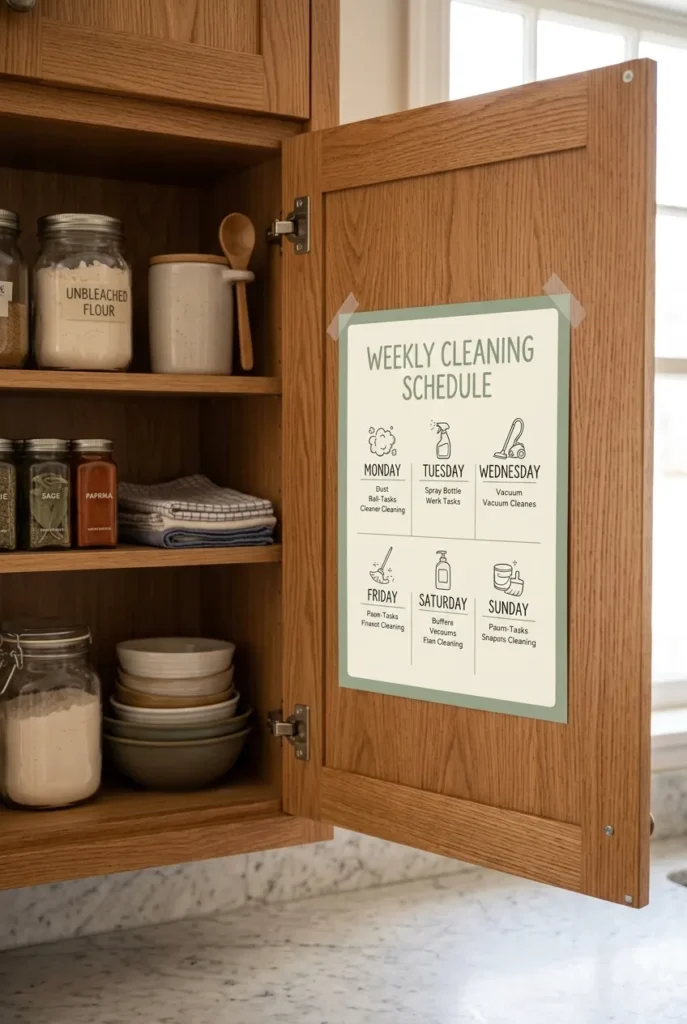
Pin this rotation to your fridge so it stops living in your head. If you want the grid version to print, grab the free weekly cleaning schedule printable and tape it inside a cabinet door.
How to Adjust the Rotation for Your Real Week
Your days off drive this, not mine. If Wednesday is your busiest day, put your lightest task there. If you’re a single working mom, cut the list to bathrooms, floors, and one reset, and let the rest ride. Fewer tasks you actually finish beats a full list you abandon.
Working full time with a long commute? Move the two heaviest zones (bathrooms and floors) to your days off and keep weekdays to 10-minute tidies only. The schedule serves you, never the other way around.
The Monthly Deep-Clean Rotation
Some jobs don’t need weekly attention, so we spread them across the month, one per week. This keeps deep cleaning from piling into a dreaded all-day marathon.
Week 1: Baseboards and door frames. Week 2: Windows, mirrors, and glass. Week 3: Kitchen appliances inside and out. Week 4: One “forgotten” zone (think the entryway closet, under the beds, or the laundry area).
Twenty minutes a week keeps the deep stuff handled. To be fair, some months you’ll skip a week, and the house will survive. Just pick back up where you left off.

Share the Load: The Mental Load Handoff
Here’s an angle most cleaning schedules skip entirely, and it’s the one that actually saves working moms. A schedule you run alone is still a schedule you carry alone. The goal is to get tasks out of your brain and onto other people’s plates.
Introducing the framework I lean on hardest: the Mental Load Handoff. You assign owners to recurring tasks so you stop being the only person who notices the trash is full. Ownership, not reminders.
Sit down once and split the list. A partner can own trash, floors, and the weekend bathroom. Older kids can own their own laundry folding and the family room tidy. The point isn’t fairness down to the minute. The point is that you’re not the sole manager of the entire house.
Age-by-Age Kid Tasks
Kids can do more than we think, and the systems stick when they start young. Here’s a rough ladder:
Ages 2 to 4: put toys in a bin, carry their plate to the counter. Ages 5 to 7: make their bed (loosely), feed a pet, wipe a low table. Ages 8 to 11: load or unload the dishwasher, take out trash, vacuum a room. Ages 12 and up: own their laundry start to finish, plus one shared chore.
Post these on a simple chore chart so nobody argues about whose turn it is. The chart is the boss, not you. That reframe alone lowers the daily friction.

Speed-Cleaning Tricks That Buy You Time
When you only have ten minutes before someone arrives, work in this order: clear surfaces first, then wipe, then floors last. Visible clutter reads as “messy” faster than dust does, so clearing wins you the biggest visual payoff.
Keep supplies where you use them. A small caddy under each bathroom sink means no walking back and forth for spray. Set up a grab-and-go cleaning caddy once and your whole routine speeds up.
Set a timer and race it. Ten minutes with music on gets more done than an unfocused hour. (I’m always a little shocked how much lands in one song.)
The Two-Basket System
Carry two baskets as you move through the house: one for things that belong in another room, one for donate-or-toss. You put things away as you go instead of making twelve trips. Empty the “belongs elsewhere” basket at the end, room by room.
[VERIFY: your real basket detail here, for example “I use two [brand] fabric bins I already had in the closet.” Add the true containers you use so this reads as your genuine tip.]

The Products You Actually Need (and How to Use Them Safely)
You need fewer products than the store wants you to buy. A good all-purpose spray, a glass cleaner, a bathroom cleaner, microfiber cloths, and a disinfectant for high-touch spots will handle the vast majority of your home. That’s genuinely it.
One safety note worth the extra sentence. Cleaning and disinfecting are two different steps. According to the CDC’s guidance on cleaning and disinfecting your home, you should clean a surface first, because dirt makes it harder for disinfectants to reach and kill germs.
And when you do disinfect, read the label. The EPA’s steps for safe and effective disinfectant use recommend checking for the EPA registration number and following the product’s directions, including how long the surface needs to stay wet. Skipping the dwell time is why disinfecting often doesn’t work.
[VERIFY: your real product here, for example “The [brand] all-purpose spray is the one I keep buying.” Name the product you actually use and trust.]

The Bad-Week Fallback Plan
This is the section that keeps your schedule alive. Real life includes sick kids, work deadlines, travel, and weeks where nothing goes to plan. A schedule that can’t survive those weeks isn’t realistic.
Here’s the fallback framework: the Bare-Minimum Three. On a bad week, you only maintain three things: dishes, one load of laundry a day, and a clear kitchen counter. Everything else waits, guilt-free.
Those three keep your home functional and stop the mess from snowballing into an overwhelming pile. When the storm passes, you return to the full rotation without a mountain of catch-up. You didn’t fall off the wagon. You just downshifted.

Make It Stick with a Sunday Reset
The secret to keeping any cleaning schedule going is one small weekly checkpoint. Sunday works for most families because it sits right before the week resets. Twenty to thirty minutes of light tidying and prep sets your Monday up to feel calm instead of frantic.
Reset the main spaces, prep lunches or outfits, and glance at the week ahead. If you want a full walk-through, here’s a simple Sunday reset routine you can copy step by step. Pair it with your schedule and the whole system runs on rails.

Frequently Asked Questions
How do you schedule cleaning the house as a working mom?
Break the house into zones and assign one zone per day, 20 to 30 minutes each, plus a few daily non-negotiables like dishes and a quick evening tidy. Anchor each burst to a habit you already have, and use a Sunday reset as your weekly checkpoint. Short and consistent beats long and occasional.
How do you keep a house clean when you work full time?
Focus on the surfaces that carry the whole house: a wiped kitchen, a fresh bathroom, and cleared main-room clutter. Share tasks with your partner and kids by age, keep supplies where you use them, and lean on a bad-week fallback so one hard stretch doesn’t undo everything.
How can I get my family to help clean the house?
Assign ownership rather than handing out one-off reminders. Give each person recurring tasks that match their age, post them on a chore chart so the chart is the boss, and resist redoing their work. Consistency and clear ownership matter more than perfection.
What does a realistic Clean Mama style routine look like?
It’s a rotating system where each weekday has a focus (bathrooms one day, dusting another, floors another), paired with small daily habits and a monthly deep-clean list. The appeal is that no single day is overwhelming, because the work is spread out.
How long should a cleaning schedule take each day?
Aim for 15 to 30 minutes on a normal day, split between a morning and evening burst. On bad weeks, drop to the Bare-Minimum Three (dishes, one load of laundry, clear counters) and pick the full plan back up when life calms down.
Is there a free printable cleaning schedule for working moms?
Yes. A printable grid you can tape inside a cabinet or stick on the fridge makes the whole system easier to follow because you’re not holding it in your head. Print it, fill in your zones, and start with just the daily tasks this week.
You Don’t Have to Do It All Today
Here’s the thing to hold onto. You are not behind, and you don’t need a perfect house. You need a rhythm that survives real weeks, shares the work, and forgives the hard days.
Start with one piece this week. Maybe it’s the 5-Touch Kitchen Close tonight, or taping up the weekly rotation tomorrow. Small and repeatable is what wins.
Grab the free printable, pick your zones, and give yourself the same grace you’d give a friend. Which day are you claiming as your reset? Print the plan, stick it on the fridge, and start there.