
How to Organize Skincare in Your Bathroom So It Lasts (and Looks Good)
Your bathroom skincare organization sets the tone for the whole morning. Open a tidy vanity and your routine feels calm. Open a crowded one and every serum feels like a tiny argument before coffee. We’ve reset dozens of these spaces, and the fix is almost never “buy more bins.” It’s a smarter system. In this guide you’ll get a simple approach to bathroom skincare organization that keeps products easy to reach, keeps your actives fresh, and still looks pretty enough to photograph. No renovation required. Let’s set it up.
Start by Editing, Not by Buying
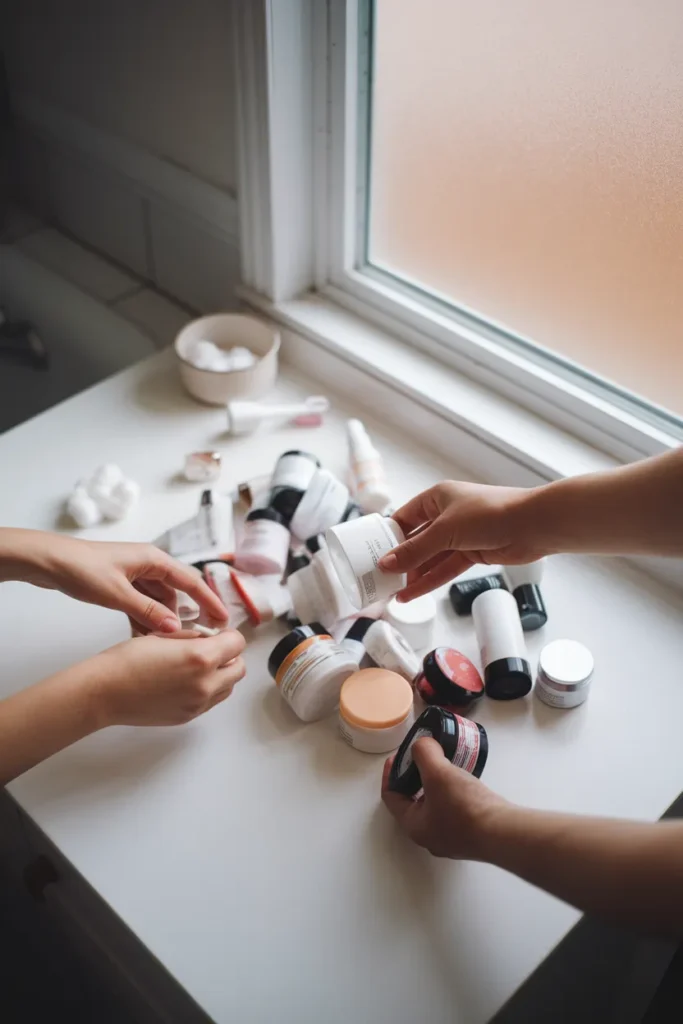
Here’s the highest-value move, and it costs nothing. Before you buy a single organizer, take everything out. Every product. Every sample, every travel size, every half-used sheet mask (yes, even that one). Line it all up on a towel so you can actually see what you own.
Now sort fast. Keep, toss, relocate. Toss anything separated, off-smelling, or clearly past its prime. Relocate the backups and bulk items you don’t reach for daily. What’s left is your real routine, and it’s usually smaller than you’d guess.
One quick filter helps here. If you haven’t reached for it in a year, it’s probably not part of your routine. Samples are the worst offenders, so keep the three or four you’ll truly test this month and pass the rest along. Recycle the empties. A shorter lineup makes every step after this one easier.
Why does this matter so much? Because most crowded bathrooms aren’t short on space. They’re full of products nobody uses. Good bathroom skincare organization starts with less, not more.
The Reach, Rotate, Retire Method
Once you’ve edited, you need a system that survives busy mornings. Ours is simple enough to remember at 6 a.m. We call it the Reach, Rotate, Retire Method, and it sorts your skincare by how often you touch it and how fragile it is. Reach items are your daily AM and PM drivers, kept front and center. Rotate items are your weekly treatments, grouped so you actually remember to use them. Retire items are backups and light-sensitive actives that live tucked away, cool and dark, plus anything past its date that gets pulled from the lineup for good.
The beauty of three buckets is that your bathroom skincare organization stays fast to keep up. You’re never guessing where a product goes, because it belongs to one of three homes. Here’s how each one works.
Reach: your daily front row
These earn prime real estate. Cleanser, moisturizer, sunscreen, your one everyday serum. Keep them on a small tray or in the front of the top drawer, no more than one grab away.
Rotate: your weekly treatments
Exfoliants, masks, retinol nights, targeted treatments. Group them together in a labeled bin so “treatment night” is a five-second decision, not a scavenger hunt.
Retire: backups and fragile actives
Refills, unopened stock, and anything sensitive to light and heat go here, in a cool dark spot. This is also where you catch expired products before they reach your face. More on the toss rules below.
Store Skincare Where It Actually Lasts
This is the part almost every bathroom guide skips, and it matters more than any bin. Where you store skincare changes how long it works. A steamy bathroom is tough on active ingredients. L’Oréal Paris points out that shower heat and humidity spikes can decrease a product’s shelf life, and it flags vitamin C and retinoids as the most vulnerable. The FDA also notes that most cosmetics carry no required expiration date, so how you store them is often the only thing standing between fresh and flat.
So bathroom skincare organization isn’t only about looks, it’s about protecting what you paid for, because a serum that slowly cooks on a warm shelf can lose its punch long before the bottle is anywhere near empty. A few rules we live by:
- Keep pricey actives (vitamin C, retinol) in a closed drawer or vanity, away from the window and the shower steam.
- Store bottles upright and capped tight so air and moisture stay out.
- If your bathroom runs hot and humid, move your most delicate serums to a cool bedroom drawer, or a small skincare fridge.
- Give sunscreen a spot you’ll see, since the one you can reach is the one you’ll actually wear.
Not everything needs babying, to be clear. Cleansers, body lotion, and most gel formulas handle a normal bathroom just fine. It’s the pricey actives that reward a cooler home. If you like the idea of a skincare fridge, keep it small and save it for vitamin C and eye cream, since a cool product feels lovely on tired skin anyway. Room temperature suits the rest.
Clear amber or opaque containers help too. Light is the quiet enemy of a good serum.
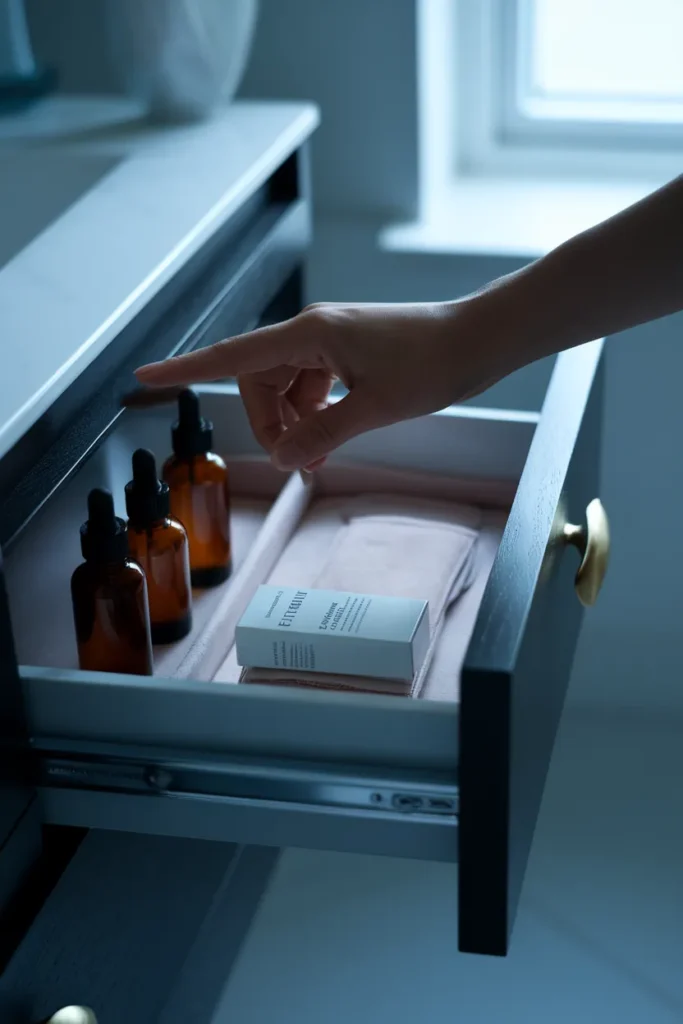
Organize the Vanity Drawer
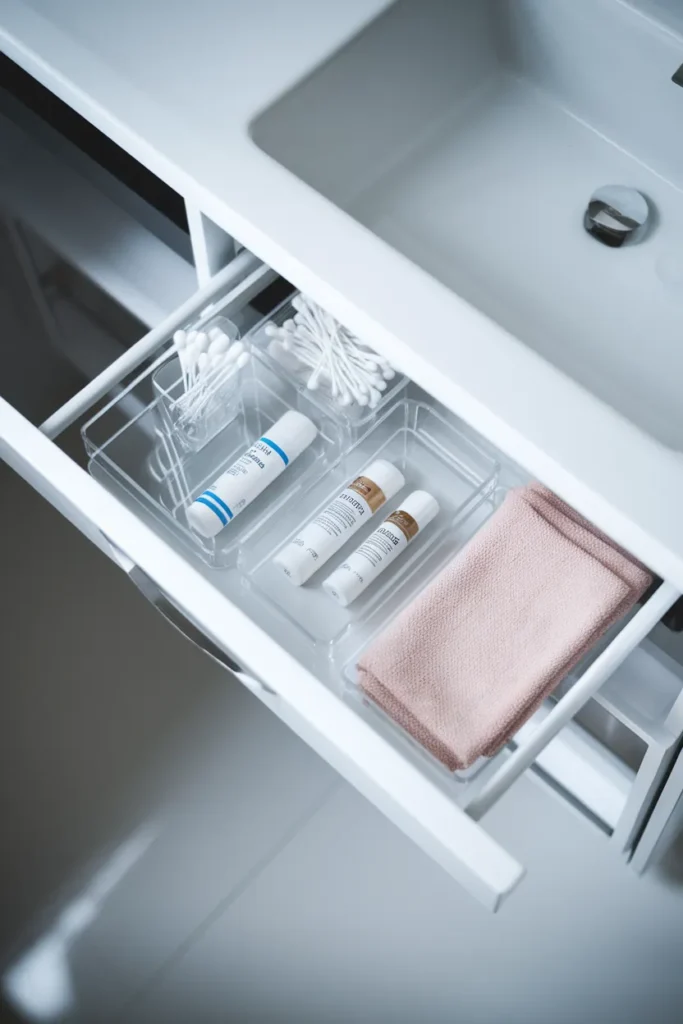
Drawers are where skincare goes to pile up. The trick is matching the organizer to the drawer’s depth, not to whatever’s on sale. Shallow drawers love flat acrylic dividers that keep tubes from rolling. Deeper drawers do better with small bins you can lift out and refill.
Stand tubes and bottles upright, like files, so you read labels at a glance instead of digging. Corral tiny items (cotton swabs, hair ties, spare caps) in one little cup so they stop scattering. A set of clear acrylic drawer trays does most of the heavy lifting here, and it wipes clean in seconds.
A couple of picks make this simple. Target’s Brightroom stackable clear drawers stand about eight inches tall, so they slot into most vanity cabinets and grow with your collection. A three-tier clear organizer like Vtopmart’s works on the counter or inside a deep drawer, with a pull-out tray for the tiny stuff. Add a washable liner so nothing slides every time you tug the drawer open. Matching the tool to the drawer is what keeps your bathroom skincare organization from unraveling by Friday.
If the drawers themselves are your real headache, we broke the whole thing down by depth in Bathroom Drawer Organization: Stop the Bottle Avalanche. For renters, our renter-friendly toiletry drawer system uses zero adhesive and no drilling, so you get your deposit back and your sanity too.
Smart Under-Sink Storage for Backups
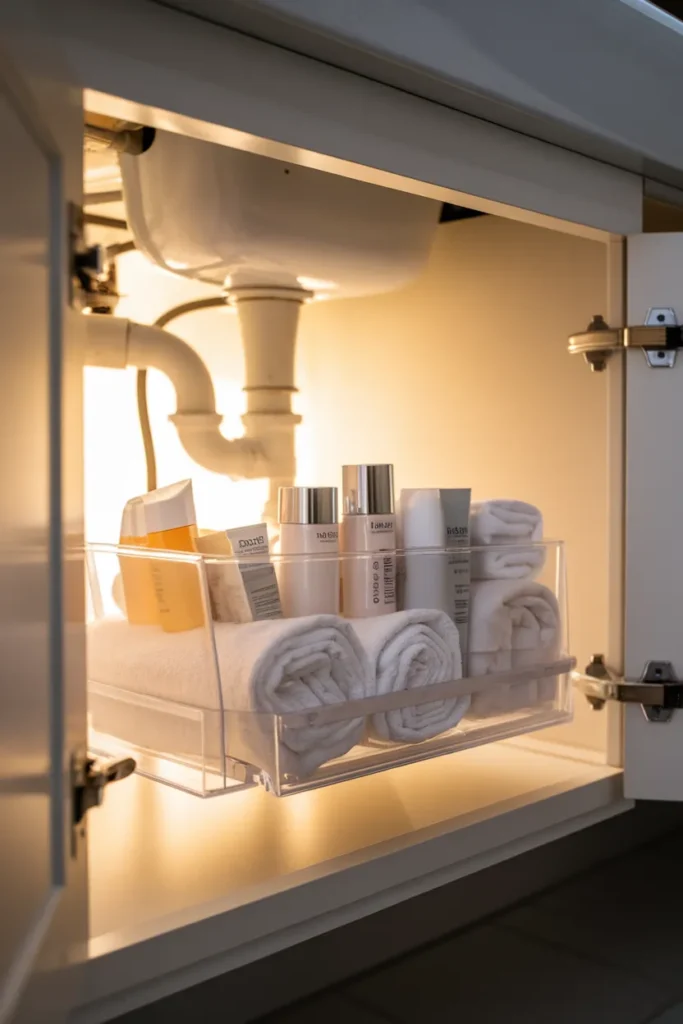
The cabinet under your sink is prime backup territory, and with a little planning around the pipes it can hold a surprising amount without turning into a dark hole you’re afraid to open. This is where Retire-zone stock belongs: the second cleanser, the bulk cotton rounds, the refill you caught on sale.
Pull-out bins change everything down there. Slide one out, grab the backup, slide it back. No kneeling and reaching into a dark corner. Stack a two-tier riser beside the pipe to double your usable height, and keep a small caddy for anything you’d want to grab in a hurry.
Measure before you buy. Note the height to the P-trap (that curved pipe under the basin) and the width of the door opening, then shop to those numbers so nothing gets stuck. A small lazy Susan in the corner spins your backups forward with one finger. It’s a cheap fix that ends the daily dig.
One rule for renters: skip the drilled shelves. Freestanding bins and a tension rod (to hang spray bottles by the trigger) give you the same lift with zero damage. mDesign clear bins are a reliable pick here because you can see what’s inside without labeling every single one.
Make the Medicine Cabinet Work Harder
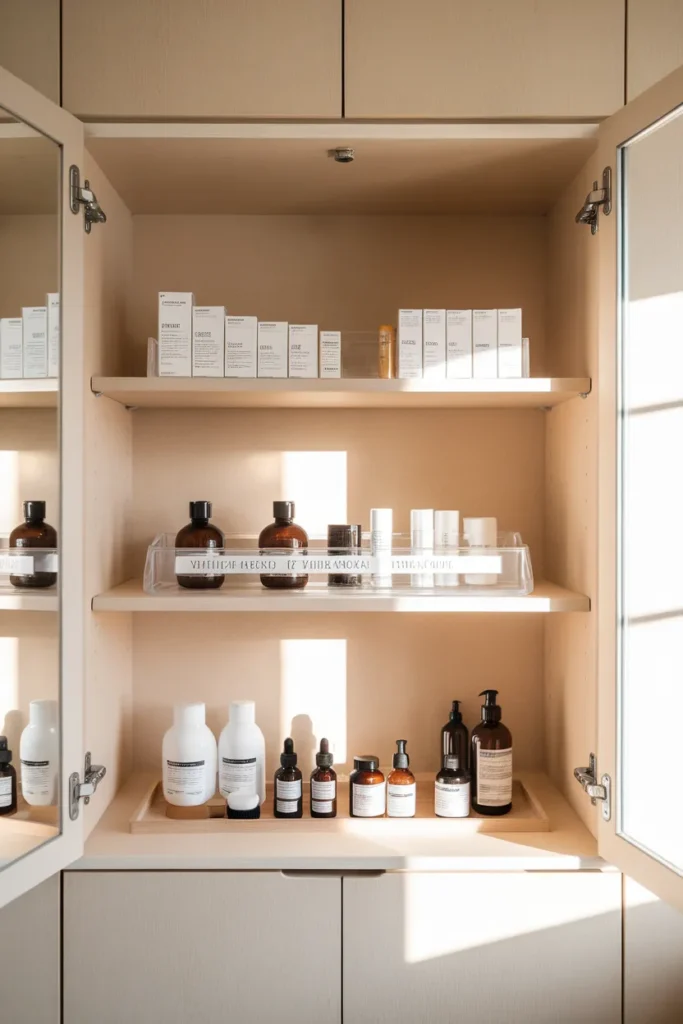
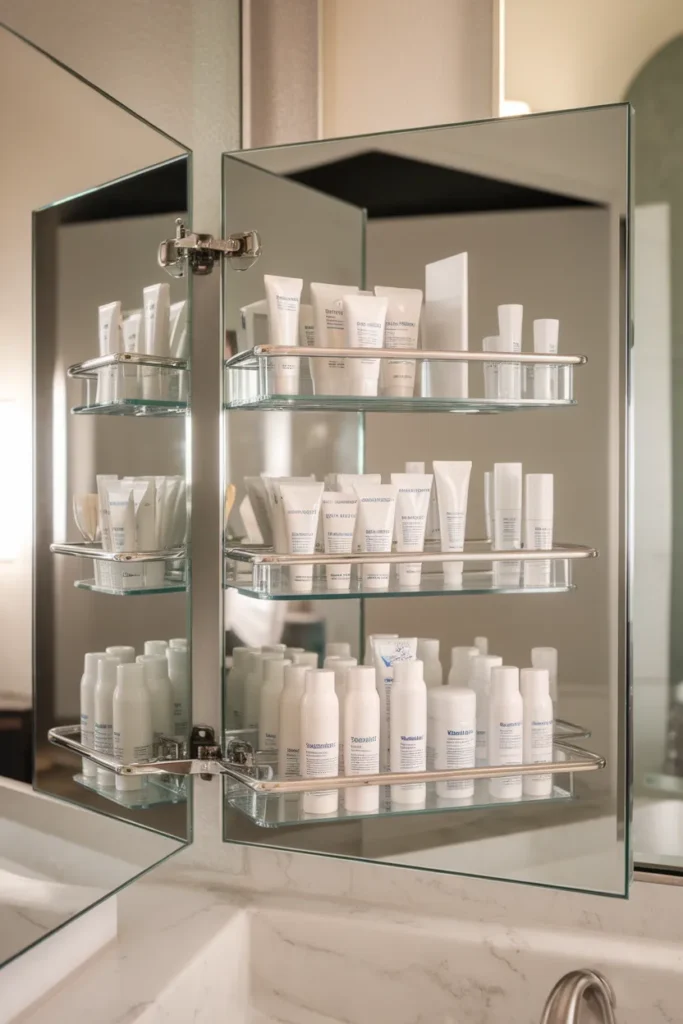
That little cabinet behind the mirror is pure gold for a small bathroom, because it’s vertical space you already own. The shallow shelves are perfect for short bottles and daily-reach items from your Reach zone.
Zone it top to bottom. Daily skincare at eye level. Backups and taller bottles up high. Anything you’d grab fast, like a spot treatment, on the shelf your hand finds without looking. Magnetic strips inside the door can hold tweezers and metal tools flat, freeing up a whole shelf.
Keep the actives out of here if your mirror sits right over the shower, though, since that’s a steam zone. If your cabinet has turned into chaos, you can reset a medicine cabinet in about 15 minutes with a simple five-zone pass.
A Countertop Display That Still Feels Calm
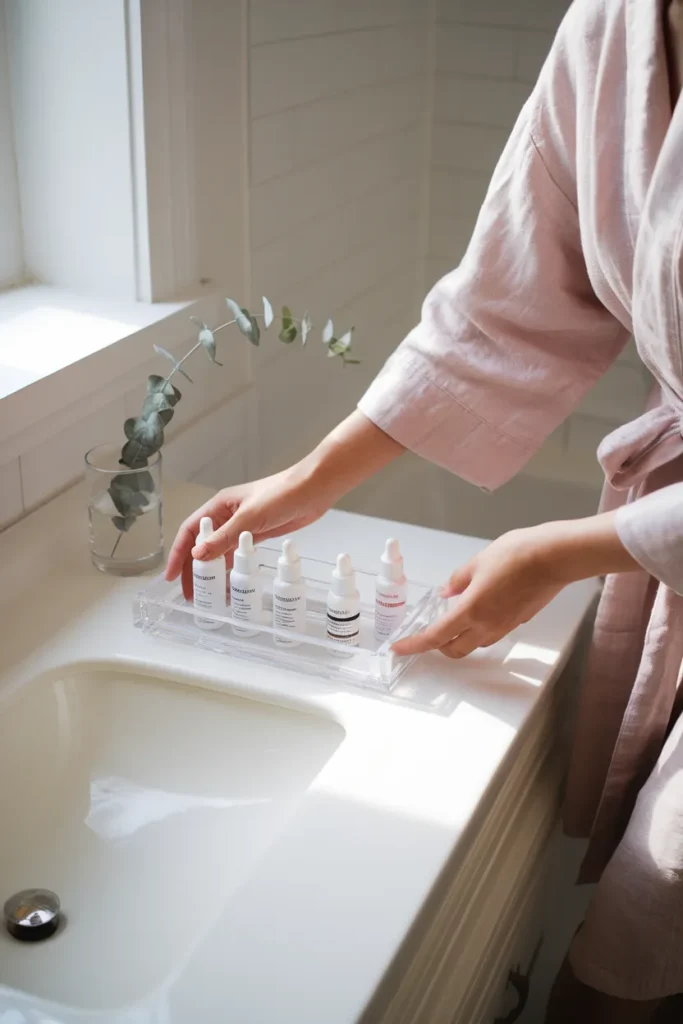
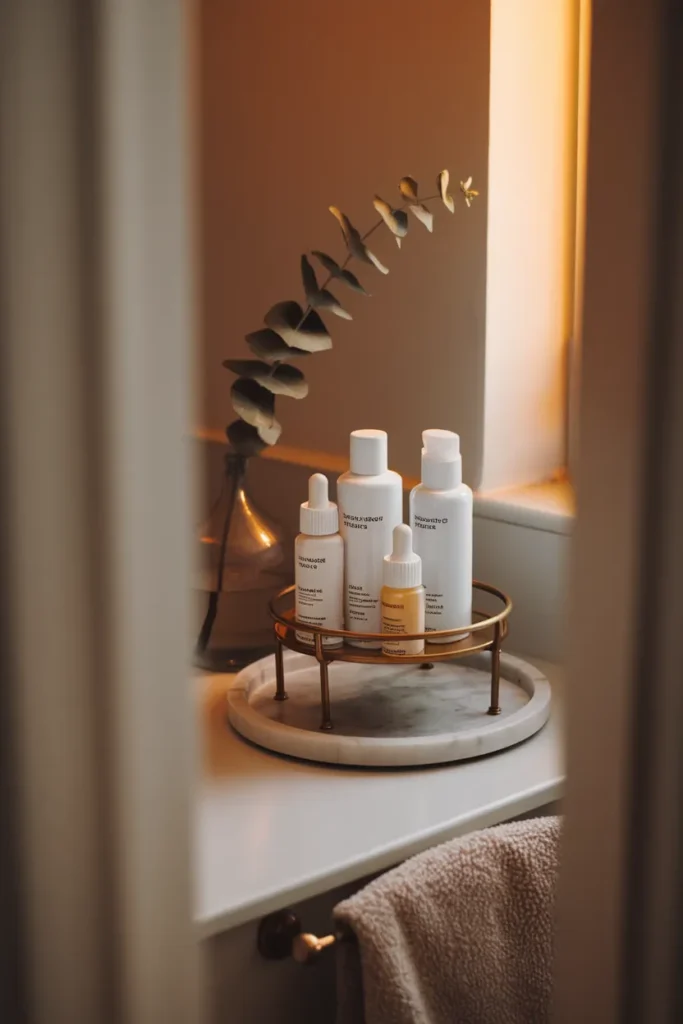
Some products deserve to be seen. The display side of bathroom skincare organization is where your routine turns into that soft, put-together shelfie look, without becoming clutter. The secret is a tray. A single tray gives your daily bottles one defined home, so the whole counter reads as styled rather than scattered, even on a busy morning when the caps are off and the routine is mid-flow.
Add a small tiered riser or a slow-spinning turntable so back bottles peek over the front row. Corral them by height, tallest at the back. Toss in one living thing, a tiny plant or a eucalyptus stem, and the whole vignette softens. To be fair, a display only stays calm if it’s short. Five or six hero products, tops. Turn every label to the front so the counter reads as intentional, and keep a loose color story (clear and amber together, whites and creams together) so it isn’t shouting six directions at once. Everything else lives in a drawer.
Small Bathroom Skincare Storage: Think Vertical
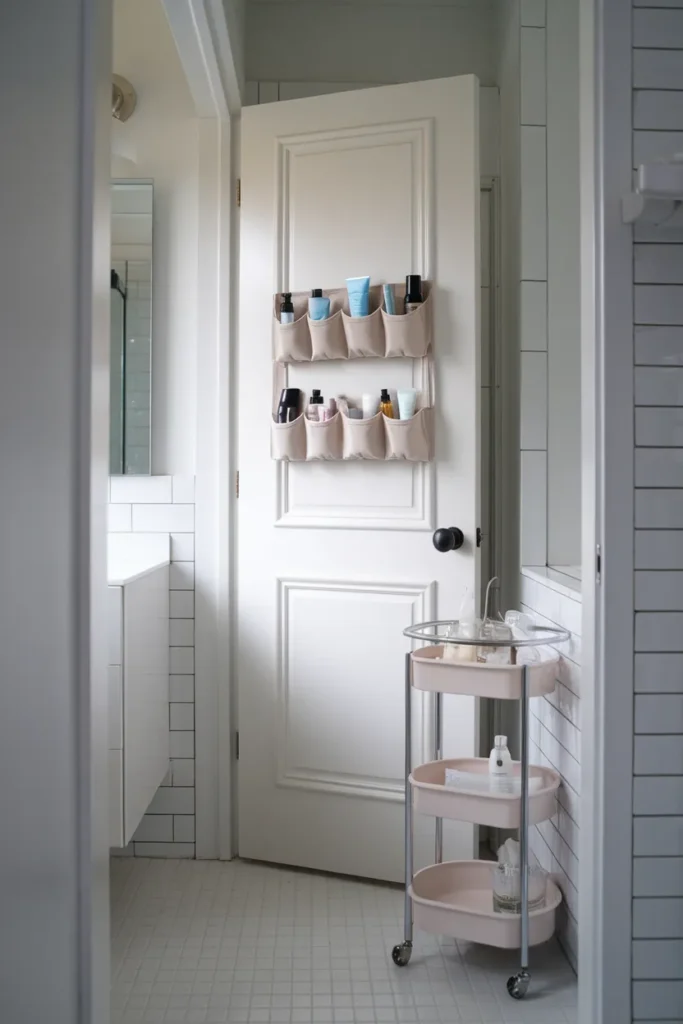
No drawers, no cabinet, barely a counter. Been there. When floor space runs out, look up, and lead with damage-free fixes so renters stay safe.
Start with an over-the-door organizer. It hangs on the back of the bathroom door and holds a shocking amount of small bathroom skincare storage with no tools at all. Next, a tension rod inside a cabinet lets you hang trigger bottles, freeing the shelf below. Command hooks (the damage-free kind) can hold a hanging basket or a small caddy on the wall, no drill needed.
Don’t forget the shower itself. A hanging caddy or a corner shelf keeps cleansers and body washes off the tub edge, which clears the counter fast. A suction or tension corner unit goes up with no tools, so it moves with you when you do.
Over-the-toilet shelving reclaims the deadest space in the room. Even a slim rolling cart, parked in a gap beside the vanity, adds three tidy tiers you can wheel out of the way. Vertical thinking is how tiny bathrooms suddenly hold everything.
Label, Rotate, and Know When to Toss
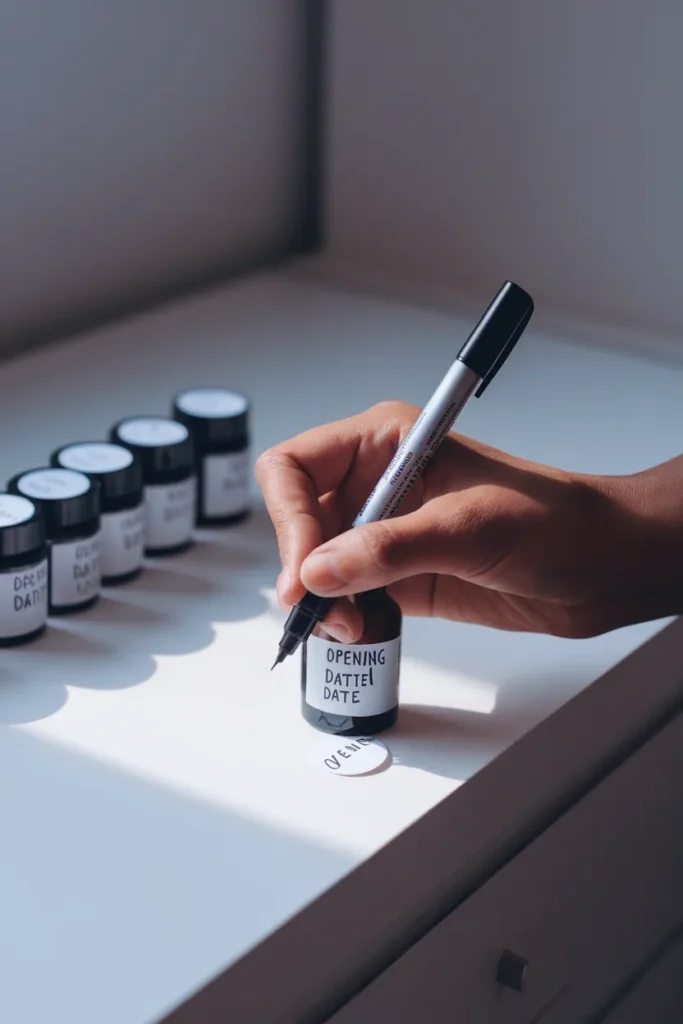
A system only stays neat if it tells you when something has to go. This is the second thing competitors skip, and it protects your skin. Look for the little open-jar symbol on the back of a product, the one with a number and an “M.” That’s the period after opening, so “12M” means twelve months once opened. Write the open date on the bottom with a grease pencil or a tiny sticker, and you’ll never guess again.
Since the FDA doesn’t require expiration dates on cosmetics, these are the rules of thumb we go by:
| Product | Rough use-by once opened |
|---|---|
| Cleansers | about 1 year |
| Moisturizers | 6 to 12 months |
| Vitamin C serum | 3 to 6 months |
| Retinol | 6 to 12 months |
| Sunscreen | check the printed date; up to 3 years unopened |
| Mascara and eye products | 2 to 4 months (per the FDA) |
Trust your senses on the borderline stuff. A changed color or a strange smell means it’s done, date or no date. Sunscreen earns extra attention, because a weakened SPF is worse than none once it lulls you into skipping shade. When you’re unsure, retire it.
Do a quick Retire pass every season. Pull anything expired, separated, or funky-smelling. Then wipe the tray, reset the zones, and you’re done. That fifteen-minute habit is what keeps bathroom skincare organization from sliding back into chaos.
Frequently Asked Questions
Is it bad to store skincare in the bathroom? Sometimes, and it comes down to the room. Heat, humidity, and light shorten shelf life, and steamy bathrooms speed that up. Keep delicate actives like vitamin C and retinol in a closed drawer or a cooler room, and the bathroom is fine for everything else.
How do you organize skincare in a small bathroom? Go vertical. An over-the-door organizer, a tension rod inside the cabinet, over-the-toilet shelving, and a slim rolling cart add storage with no floor space and, for renters, no drilling. Edit your routine down first so you’re only storing what you use.
Where should you store skincare products for the longest shelf life? Somewhere cool, dark, and dry. A closed vanity drawer or a bedroom drawer beats an open shelf near the shower. Some people keep vitamin C and eye products in a small skincare fridge, which is a nice bonus but not a must.
How do you display skincare without it looking cluttered? Use one tray and keep it to five or six hero products. Add a tiered riser so back bottles show, sort by height, and tuck everything else into a drawer. A single plant or stem finishes the look.
How long do skincare products last after opening? Check the open-jar symbol with the “M” number, which is the period after opening. As a rough guide, cleansers last about a year, moisturizers six to twelve months, vitamin C three to six months, and mascara two to four months per the FDA. Write the open date on the bottle so you’re never guessing.
What’s the best organizer for skincare in a bathroom drawer? Match it to the drawer depth. Shallow drawers do best with flat clear acrylic dividers, while deeper drawers work with liftout bins. Clear beats opaque so you can see everything at a glance.
Should I keep my skincare in the fridge? It’s optional. A small skincare fridge can stretch the life of vitamin C and eye cream, and a cool product feels soothing going on. Most items are perfectly happy at room temperature, so treat the fridge as a nice-to-have rather than a rule.
Wrap It Up (and Keep It That Way)
Good bathroom skincare organization isn’t about a perfect shelfie. It’s about a routine that’s easy to reach, products that stay fresh, and a five-minute reset you’ll actually keep up with. Edit first. Zone with Reach, Rotate, Retire. Store your actives somewhere cool and dark, display just a few heroes on a tray you love, and date your bottles so nothing lingers on the shelf long past its prime.
Start with one drawer this week. Just one. Once you feel how calm that small win is, the rest tends to follow. Save this guide, screenshot the toss table, and come back when you’re ready for the next zone. Your future self, reaching for a fresh serum on a busy Tuesday, will thank you.
This article is general information, not medical or dermatological advice. For concerns about a specific product or skin condition, check with a qualified US professional.