

Mudroom Organization: The 4-Zone System That Stops Family Clutter
You open the side door at 5:47 p.m. on a Tuesday. A backpack hits the floor. One sneaker lands sideways under the bench, the other vanishes behind a tote bag. Your seven-year-old is already halfway to the kitchen, jacket trailing. The dog leash is tangled around a soccer cleat. Somewhere in this pile is the permission slip you needed to sign by tomorrow morning.
Sound familiar? Mudroom organization is the single highest-leverage project in a busy home. The space is small. The traffic is brutal. And when it works, the entire house feels calmer. We tested a four-zone system in our own back-entry mudroom over the past two winters (with two kids, a dog, and a husband who refuses to use a hook), and it is the only setup that has actually held. Here is exactly how to build it, whether you have a full built-in or a single wall by the door.
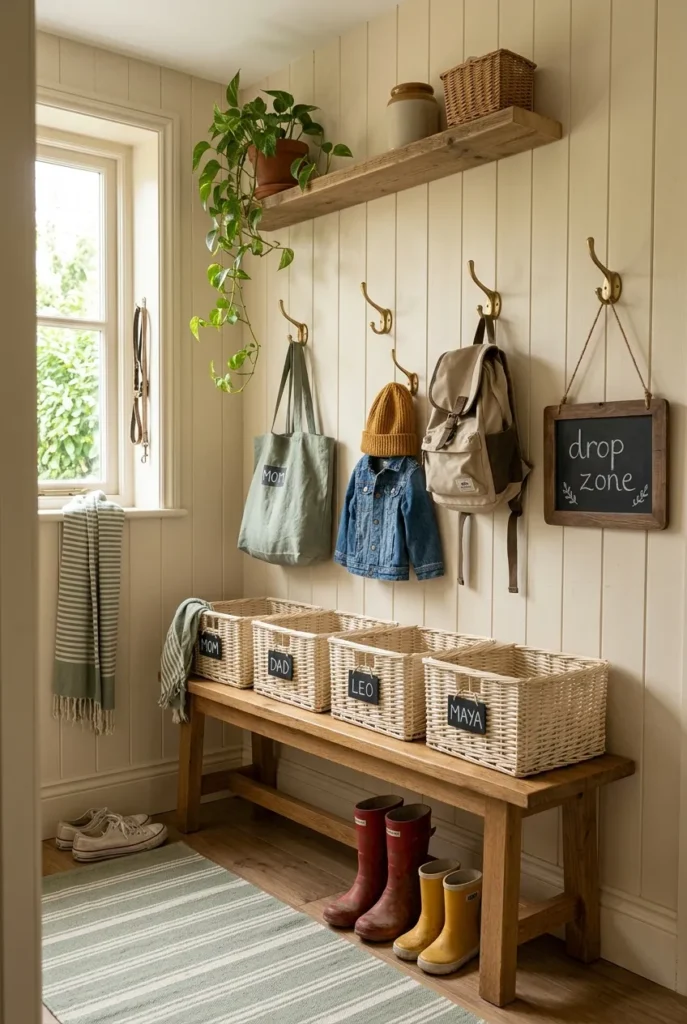
What a Real Mudroom Has to Do (Before You Buy a Single Bin)
Before any mudroom organization project, write down what happens in your space between 7 a.m. and 9 p.m. on a normal weekday. Who walks through. What they carry. What they drop. What they grab on the way out. Most of us skip this step and buy six matching bins from Target, only to discover three months later that the bins are full of mail and the actual shoes are still on the floor.
Honestly, a mudroom only fails for one reason: it was designed for how the room looks, not for how the family moves.
A working mudroom has to do four jobs. It stores outerwear. It holds bags and gear. It catches mail and keys. And it absorbs the seasonal overflow (sports equipment, beach bags, snow boots) without making the rest of the system collapse. That’s it. Get those four jobs sorted and the room runs itself.
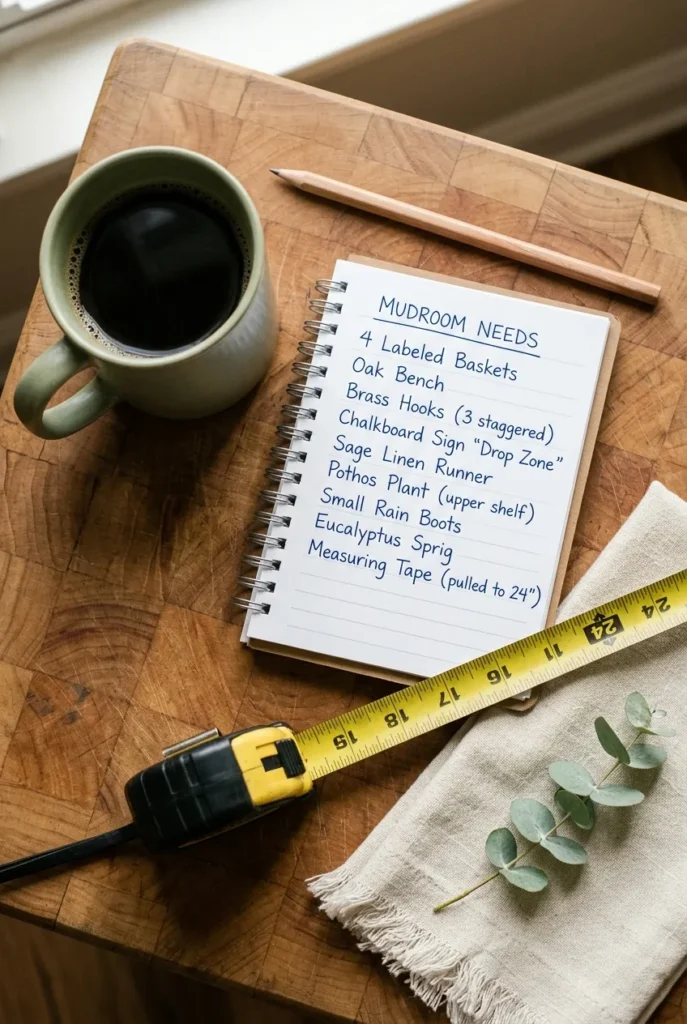
Meet The 4-Zone Mudroom System
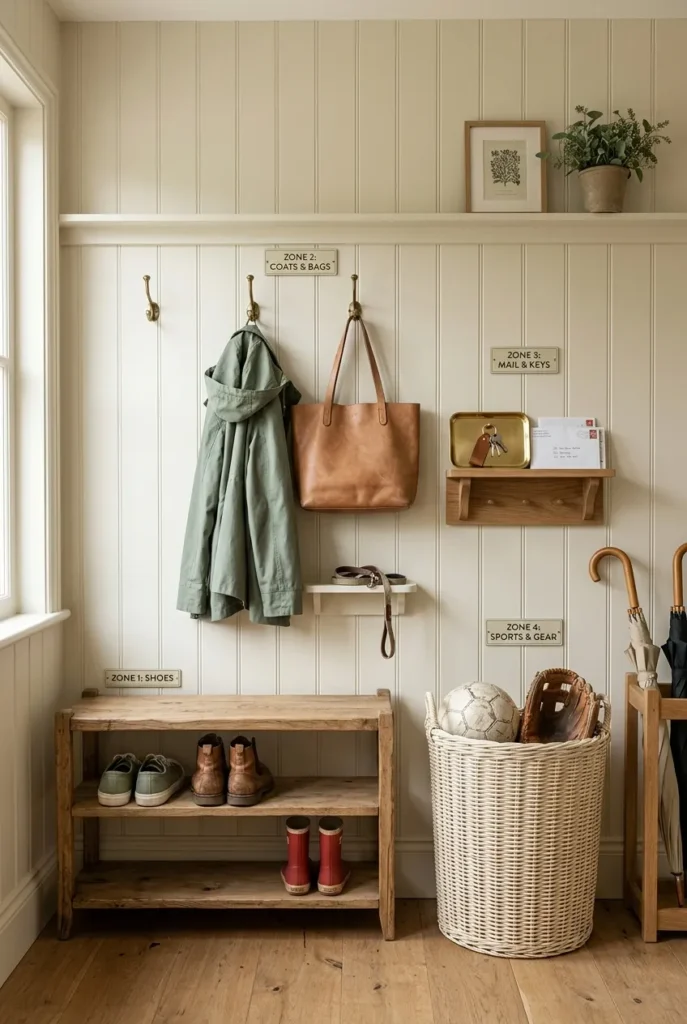
Here is the framework. We call it the 4-Zone Mudroom System, and every working mudroom we have built or fixed comes back to these four buckets.
- Zone 1: Shoes (boots, sneakers, slippers, seasonal swap-outs)
- Zone 2: Bags and Outerwear (jackets, backpacks, tote bags, dog leashes)
- Zone 3: Mail and Keys (the small daily stuff that gets lost in 8 seconds)
- Zone 4: Sports and Seasonal (cleats, helmets, beach gear, snow gear)
Each zone gets a dedicated landing spot. Each spot lives at the right height for the person using it. And every item in the room belongs to exactly one zone. When you can’t decide which zone an item lives in, it doesn’t belong in the mudroom at all.
The reason this works is friction. Family members will use a system only when it takes less effort than the floor. A hook within reach, a bin within view, a tray at hip-height — these all beat “go put it away upstairs” every single time.
Zone 1: Shoes (The Hardest Zone, So Tackle It First)
Shoes are the chaos engine. Get them right and the whole mudroom calms down by 40%.
Start by counting. Count every pair of shoes that lives in this space, not the ones in upstairs closets. In our house, that’s three pairs per person for active rotation (one daily, one athletic, one weather-appropriate). Anything beyond that lives elsewhere. Storing every shoe a family owns at the front door is the most common mudroom organization mistake we see.
Then pick a shoe-storage style based on your space:
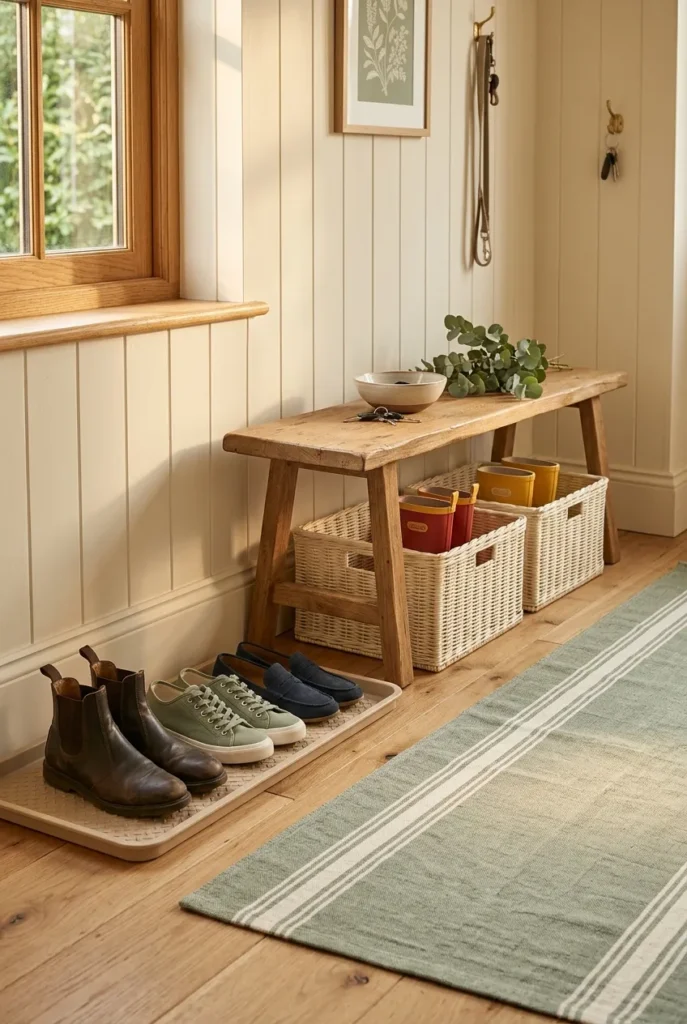
- Open boot tray (under 18 inches deep): great for renters, fast to wipe clean, holds 4 to 6 pairs. The Anji Mountain natural rubber and coir trays run around $35 on Amazon and hold up to slush.
- Cubby bench with bins (24 to 36 inches wide): the standard family pick. The IKEA Hemnes shoe cabinet with four compartments tucks into about 9 inches of wall depth and hides clutter behind doors. Around $269.
- Wire shoe rack inside a hall closet (for true small spaces): a $25 tension-rod shoe shelf turns a 24-inch hall closet into 8 shoe slots without a single drill hole.
Here’s the catch most articles miss. Shoes need air, not stacking. Wet sneakers stuffed into a cubby become a smell problem in two days. Leave one slot empty in every shoe zone so air can move, and add a small open-weave tray on the bottom for boots actively drying out.
According to the EPA, dust and outdoor pollutants ride into homes on shoes and clothing, and a designated drop zone helps trap those particles before they spread through the rest of the house. Soils and dusts on shoes and clothing carry pollutants from the outdoors into buildings, which is why the boot tray is doing more work than it gets credit for. Read the EPA’s full breakdown on indoor air quality and how shoes track outdoor pollutants into the home.
A Note on Kids’ Shoes
Kids’ shoes are their own micro-problem. The trick is to lower the storage. A 4-year-old will use a basket on the floor. They will not use a hook at 48 inches. Set up the bottom 18 inches of your mudroom as the kids’ shoe zone and watch how much faster the floor stays clear.
For kid-friendly toy and gear organization at the front door, we use the same age-down rule everywhere: storage at their height, labels at their reading level.
Zone 2: Bags, Outerwear, and the Hook Rule
Hooks beat hangers in mudrooms. Every time. Hangers require an extra step, a free hand, and a thought. A kid throwing a backpack at 3:15 p.m. does not have any of those.
The rule we use is three hooks per person. One for the daily jacket, one for the daily bag, one floater (sports bag, library tote, dog leash, swim bag depending on the season). For a family of four, that’s twelve hooks. Sounds like a lot. It isn’t. A standard 36-inch peg rail holds 6 to 8 hooks, so two stacked peg rails handle the whole family.
Hook height matters more than hook count. Set adult hooks at 60 to 66 inches from the floor. Set kid hooks at 36 to 48 inches depending on age. If your kids range in age, install one row at the lowest needed height and add a second row 18 inches above it, so the wall grows with them.
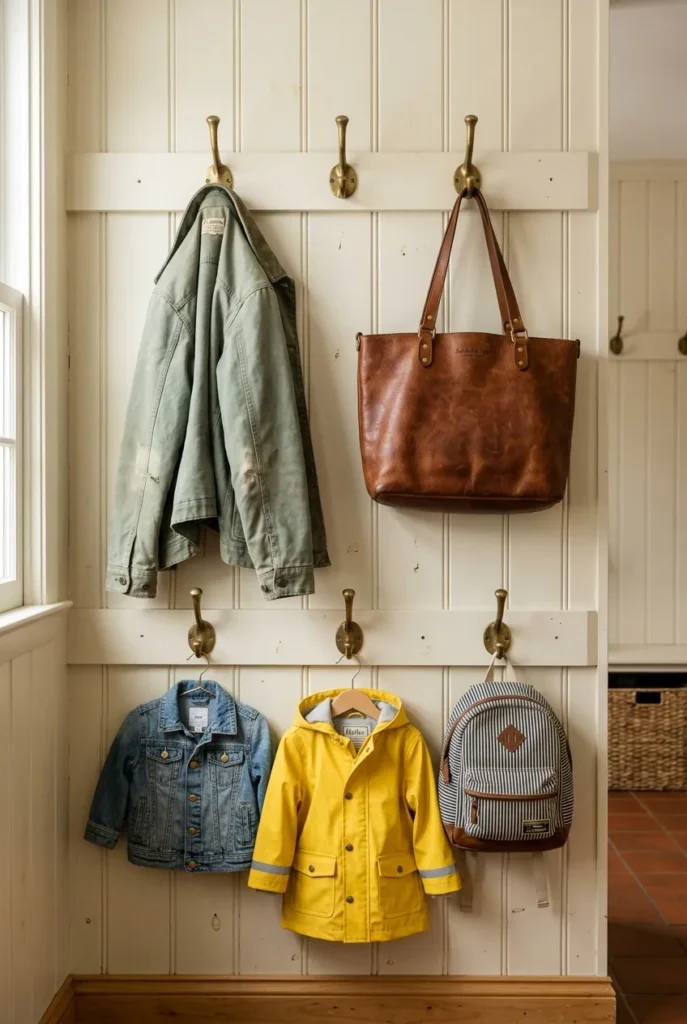
For renters, this is where the no-drill mudroom comes alive. The 3M Command Hook Jumbo line (rated for 7.5 pounds each) holds a loaded backpack and a winter coat without a single screw. We have run a row of six along a hallway in a rental for two years without one falling. Use the white version on white walls or the brushed nickel for a polished look — both peel off clean when you move out.
Hang one bigger Command Hook for the daily bag, a smaller one above it for the daily mask, hat, or sunglasses. Stack vertically, not horizontally, when wall space is tight.
Zone 3: The Mail and Key Catch (The 12-Inch Difference)
Zone 3 is small. It is also where every family’s mudroom organization plan dies. Mail comes in, lands on a flat surface, breeds for nine days, and becomes a pile.
The fix is a single 12-inch horizontal strip on the wall, dedicated only to mail and keys. Not a shelf full of decor. Not a console table with a bowl and a candle and a framed quote. A purpose-built strip. We use a small oak ledge (about 4 inches deep), a single brass tray for keys, and a wall-mounted three-slot file pocket from The Container Store ($24) labeled OPEN / PAY / FILE.
Mail rules that work:
- The mail gets opened the day it arrives. Standing up. Over the recycling bin.
- Junk hits recycling in the same motion.
- Bills go to PAY. School papers and personal mail go to OPEN. Anything to keep goes to FILE and leaves the mudroom within 48 hours.
- Keys live on the brass tray. Not in pockets. Not in bowls. On the tray.
A mail station that only handles three slots is a mail station you’ll actually use. Five slots becomes a junk drawer on the wall.
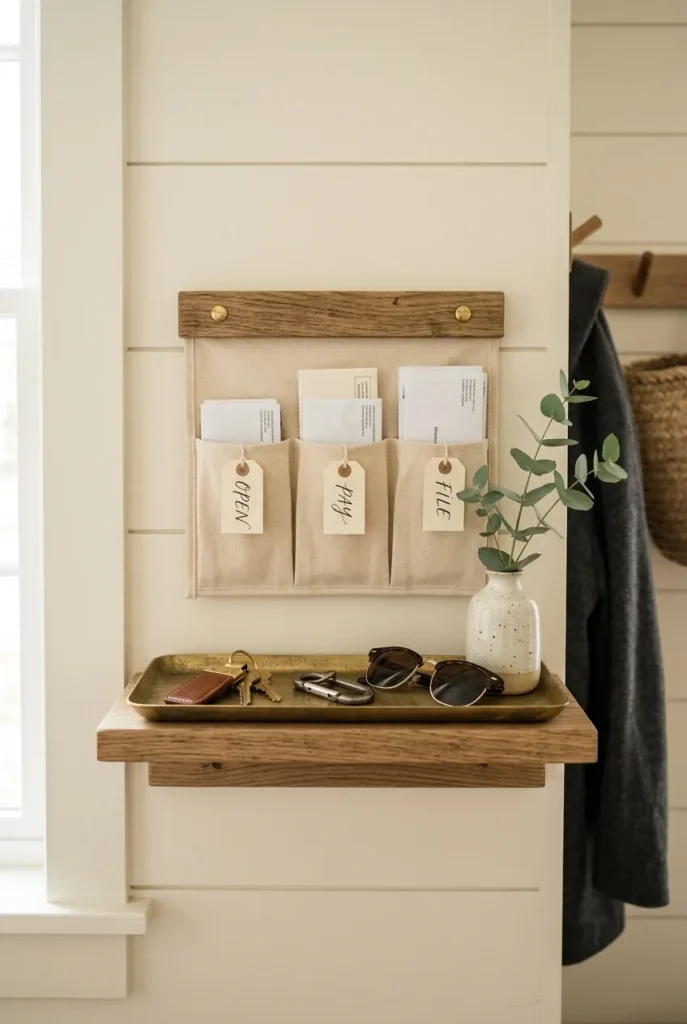
For families who need a true family command center, build the mail strip vertically alongside a wall calendar. We added a 12 x 18-inch monthly calendar from Amazon ($16) right next to the mail pockets, and Sunday-night family syncs went from chaotic to under 10 minutes. More on that flow in our full guide to the 5-zone entryway organization system for the front of the house.
Zone 4: Sports, Seasonal, and the Overflow Problem
Zone 4 is where mudroom organization usually breaks down by November. Cleats arrive in August. Snow boots arrive in October. Beach bags refuse to leave in September. Without a dedicated overflow zone, this stuff invades the other three zones until the whole system collapses.
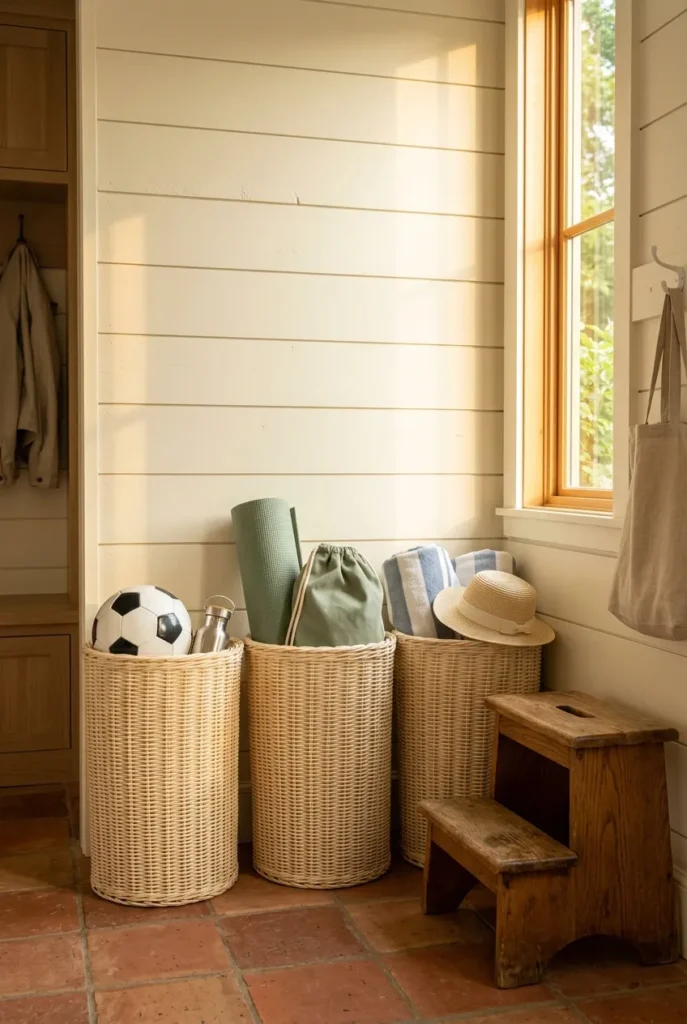
The rule is one tall basket per person for active-season gear, plus one shared bin for shared gear (dog supplies, sunscreen, bug spray, reusable grocery bags).
Tall woven baskets work better than open bins because they hide volume. A 14 x 14 x 18-inch cream wicker basket holds a soccer ball, two shin guards, a water bottle, and a pinnie without looking like a yard sale. Stack two if you have to.
For seasonal swap-outs, label two clear stackable bins (Sterilite 32-quart, around $11 each at Walmart) SUMMER and WINTER, and store them on the upper mudroom shelf or in a hall closet. Two days before the season flips, swap the contents of Zone 4 with the contents of the relevant bin. Done in 15 minutes.
How to Build a Mudroom When You Don’t Have a Mudroom
What if you don’t have a dedicated room? Most American homes don’t. The 4-Zone Mudroom System still works. You just compress it.
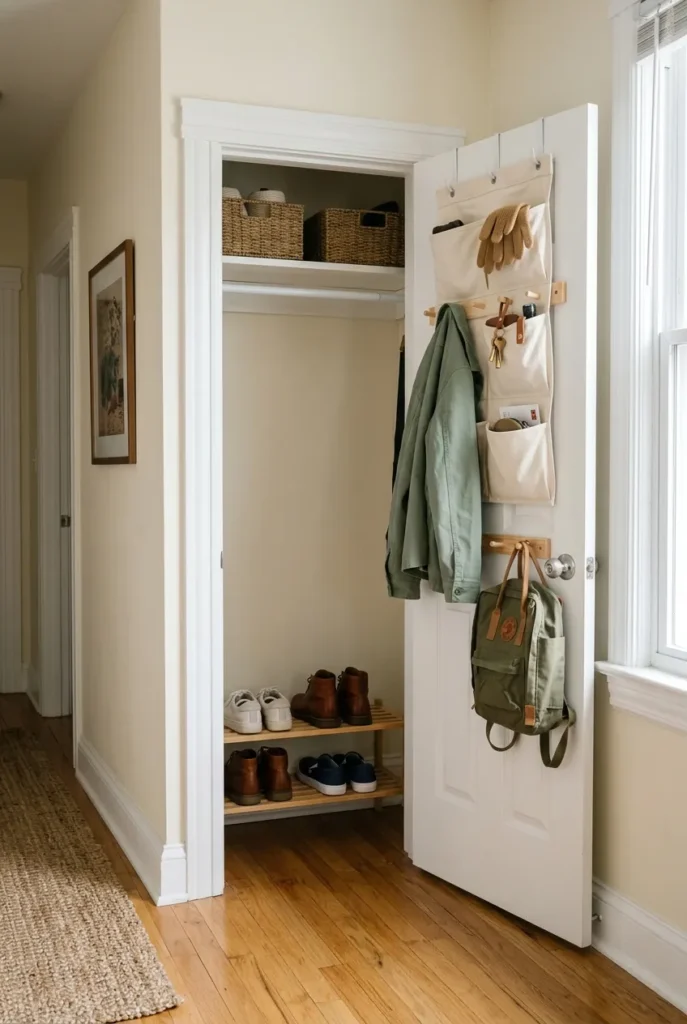
For a hall closet: Strip out the rod and the single overhead shelf. Add a tension rod 12 inches from the back wall (the new shoe shelf). Add a peg rail at adult height on the inside of the door. Hang an over-the-door 6-pocket organizer for Zone 3 (mail, keys, gloves). Use a single tall basket on the floor for Zone 4.
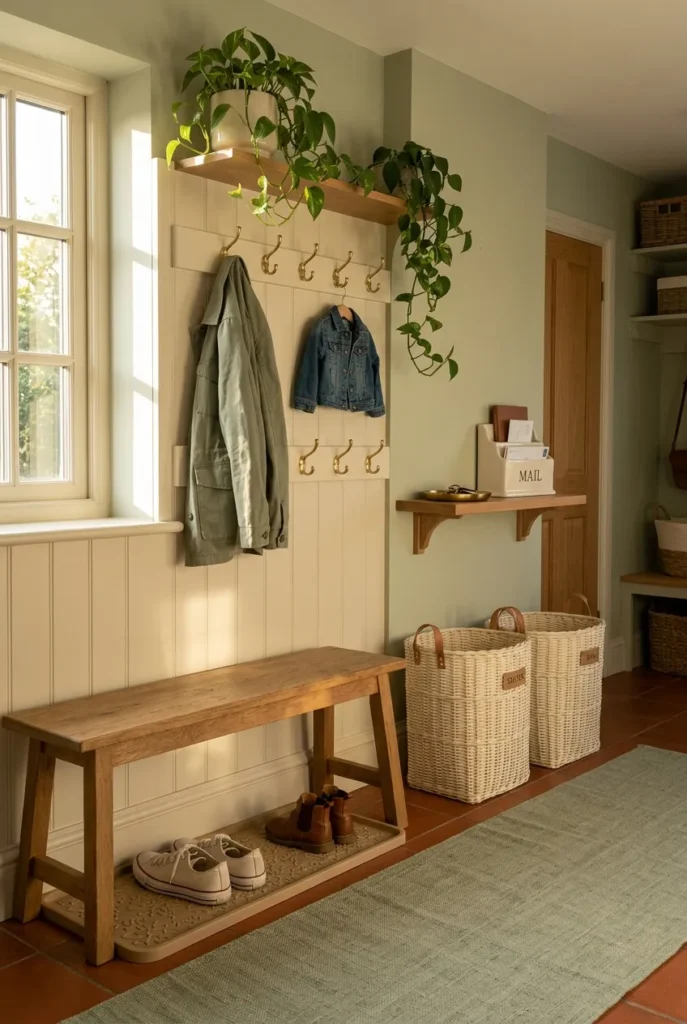
For a foyer with no closet: Float a 36-inch oak bench with three brass hooks above it. A boot tray slides under the bench (Zone 1). The hooks handle Zone 2. A small wall-mounted ledge to the right of the door does Zone 3. A single basket beside the bench does Zone 4. Total wall space needed: 42 inches.
For a garage-entry door: This is the underrated mudroom. Run a peg rail along the wall between the garage door and the kitchen door. Add a low shoe shelf below. Mount a small mail station inside the kitchen door, not in the garage (mail in a garage gets damp and chewed). For the deeper garage system that pairs with this, see our full garage organization walkthrough.
For all three setups, every single product can be installed without drilling a single hole. Tension rods, Command Hooks, over-the-door organizers, freestanding benches, and adhesive peg rails will carry the whole system. We know — we tested the rental version through a full winter with two adults and a German Shepherd, and not one piece failed.
Mudroom Organization on a Budget (Under $100 Total)
A working mudroom does not need a built-in. We have built complete 4-zone setups for under $100 multiple times. Here is one version that has held up in three different homes.
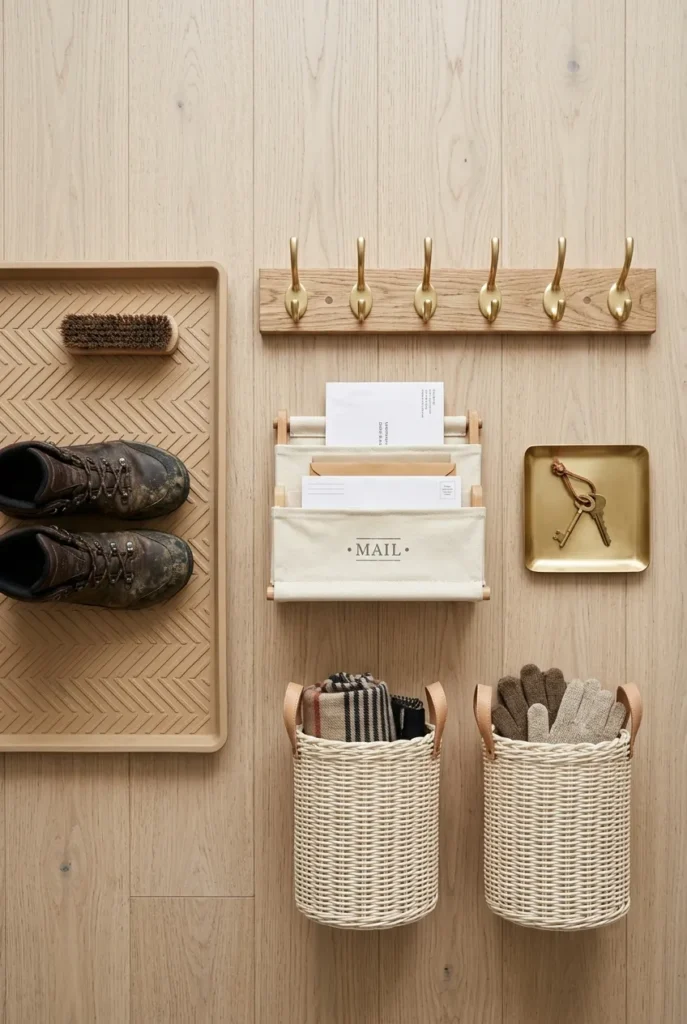
| Item | Source | Approx. Price |
|---|---|---|
| Natural rubber boot tray (Zone 1) | Amazon (Anji Mountain) | $35 |
| 36-inch wood peg rail with 6 brass hooks (Zone 2) | Amazon Basics | $22 |
| 3-slot wall mail organizer (Zone 3) | The Container Store | $24 |
| Small brass key tray (Zone 3) | HomeGoods or Target | $8 |
| Two tall cream wicker baskets (Zone 4) | Target Brightroom | $14 each ($28 total) |
| Total | $117 |
Trim the second wicker basket and you’re under $100. Swap the boot tray for a $5 plastic Sterilite version and you’re under $80. The system doesn’t care what the materials cost. It cares that all four zones have a home.
How to Keep It Organized (The 90-Second Reset)
A mudroom is the only room in the house that needs a reset every single day. The good news: the reset is 90 seconds if the system is set up right.
The 90-Second Mudroom Reset runs like this:
- Shoes back to the rack or tray. Pairs together.
- Bags and jackets back on hooks. One per hook.
- Mail sorted into OPEN / PAY / FILE. Junk into recycling.
- Keys onto the tray.
- One full Zone 4 basket scanned for anything that doesn’t belong.
If the reset takes longer than 90 seconds, the system is failing somewhere. Usually it’s because a zone has too much in it (too many shoes, too many bags, too many “I’ll deal with this later” items). The fix is rarely buying more bins. The fix is removing items, not adding more.
Professional organizers have been saying this for years. The National Association of Productivity and Organizing Professionals (NAPO) recommends decluttering the entryway as a daily habit, not a monthly project, precisely because entryways absorb whatever the rest of the house can’t catch. You can read more about daily reset habits from NAPO’s resources on entryway and productivity routines.
Mudroom Organization FAQ
What are the 4 C’s of decluttering?
The 4 C’s of decluttering are Categorize, Cull, Contain, and Coordinate. Categorize means grouping like with like (every glove in one pile, every leash in one pile). Cull means removing what you don’t use. Contain means giving the remaining items a defined home (a bin, a hook, a basket). Coordinate means matching the storage style to the family’s actual habits, not your Pinterest board. The 4-Zone Mudroom System is essentially the 4 C’s applied to one room.
How quickly can I organize a messy room in the fastest way?
A mudroom-sized space can be reset in 45 to 60 minutes if you follow the empty-sort-assign sequence. Step one: pull everything out into the next room. Step two: sort into 4 piles matching the 4 zones. Step three: discard or relocate anything that doesn’t fit those 4 piles. Step four: put each zone back in its dedicated home. Set a timer. The constraint speeds you up. Anything not done in 60 minutes goes into a “decide tomorrow” bin and gets revisited in the morning.
How do you keep a mudroom organized day to day?
Use the 90-Second Reset every evening before bed. Shoes to the rack, bags to hooks, mail sorted, keys to the tray, one Zone 4 scan. The whole thing takes a minute and a half if the system fits the family. Pair it with a Sunday-night sync where you swap out the contents of Zone 4 for the coming week (cleats out, library bags in, whatever).
What is the average cost of a mudroom?
A full custom built-in mudroom from a contractor runs $3,500 to $10,000 depending on cabinetry, bench depth, and finish. A semi-custom IKEA Pax or Hemnes-based mudroom can come in at $600 to $1,500. A no-drill renter mudroom using a freestanding bench, peg rail, Command Hooks, and bins lands comfortably under $200. The 4-Zone Mudroom System works at every one of those price points. The system isn’t about the spend.
What’s the best mudroom organization for a small space?
Compress the four zones into vertical real estate. Zone 1 (shoes) on the floor in a single-row rack. Zone 2 (bags and coats) on a wall-mounted peg rail above. Zone 3 (mail and keys) on a 4-inch deep ledge between the two. Zone 4 (sports and seasonal) inside a single tall basket on the floor. Total wall space: 36 inches wide, 72 inches tall. A small mudroom doesn’t need fewer features. It needs the features stacked.
Can I build a mudroom in a rental without drilling holes?
Yes, every zone has a no-drill version. Freestanding bench for Zone 1. Command Hook Jumbo strips for Zone 2 (rated to 7.5 pounds each). Adhesive shelf or a freestanding floor lamp with a tray for Zone 3. Floor baskets for Zone 4. We’ve run this exact setup in two different rentals for over two years without a single failure.
How often should I reorganize the mudroom?
The zones don’t change. The contents do. Reorganize the contents twice a year: once at the September back-to-school flip and once at the May summer flip. The Zone 4 seasonal swap takes 15 minutes. Anything more frequent than twice a year usually means the system needs tightening, not redoing.
Pull This System Together This Weekend
Your mudroom doesn’t need a remodel. It needs four zones, the right heights, and a 90-second reset. Try the system Saturday morning. Pick one zone, finish it, and let the other three follow over the next weekend. By the end of the month, the floor will stay clear without you nagging anyone.
What’s the one zone in your mudroom that always seems to break down first? Bookmark this guide, fix that one zone first, and come back for the next room.