

Nursery Closet Organization: Set Up Baby’s Closet Before They Arrive
Nursery closet organization is the one nursery project that pays you back at 2 a.m., and it takes about three hours if you do it before the baby gets here. Here’s the promise: by the end of this guide your closet will hold every size from newborn through 12 months, a caregiver who has never been in your house will find a clean sleeper on the first try, and you will not buy a single thing you don’t need. The trick isn’t more bins. It’s deciding what each shelf is for before anything goes back in.
Most closets are built for adults. A standard builder rod sits around 66 to 68 inches off the floor, which is fine for a trench coat and ridiculous for a 9-inch onesie. That gap under the hanging clothes is roughly four feet of dead air in a room that badly needs storage.
We’re going to claim all of it.
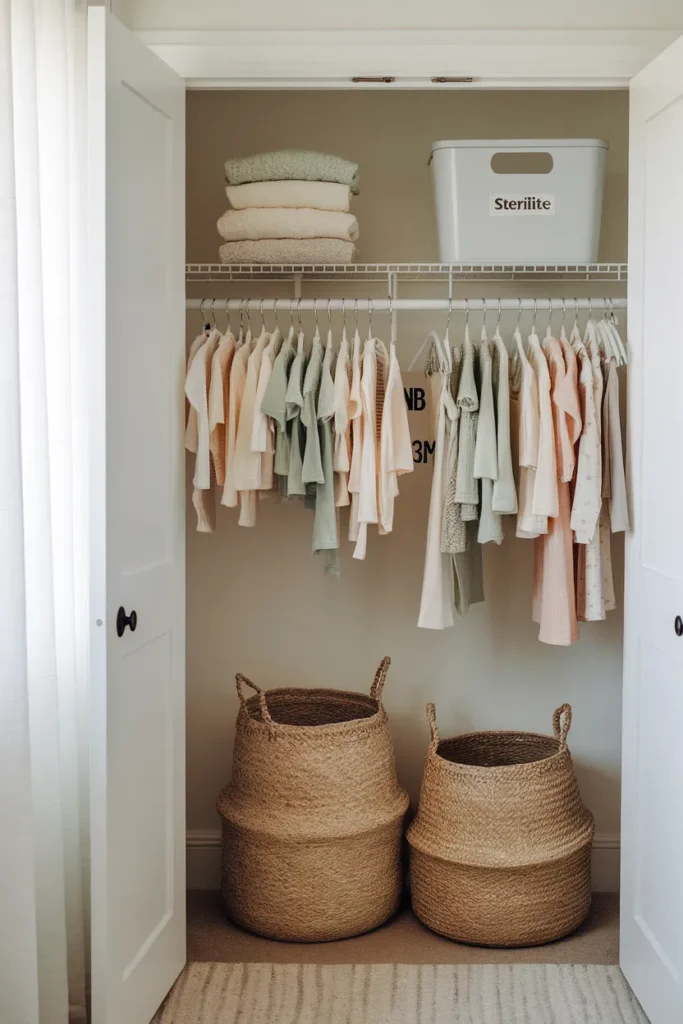
Empty the Closet Completely Before You Buy Anything
Take everything out. Yes, everything, including the wrapping paper and the vacuum attachments that migrated in there during the last move. You cannot plan a space you can’t see, and roughly half the people who “run out of room” in a nursery closet are storing household overflow in it.
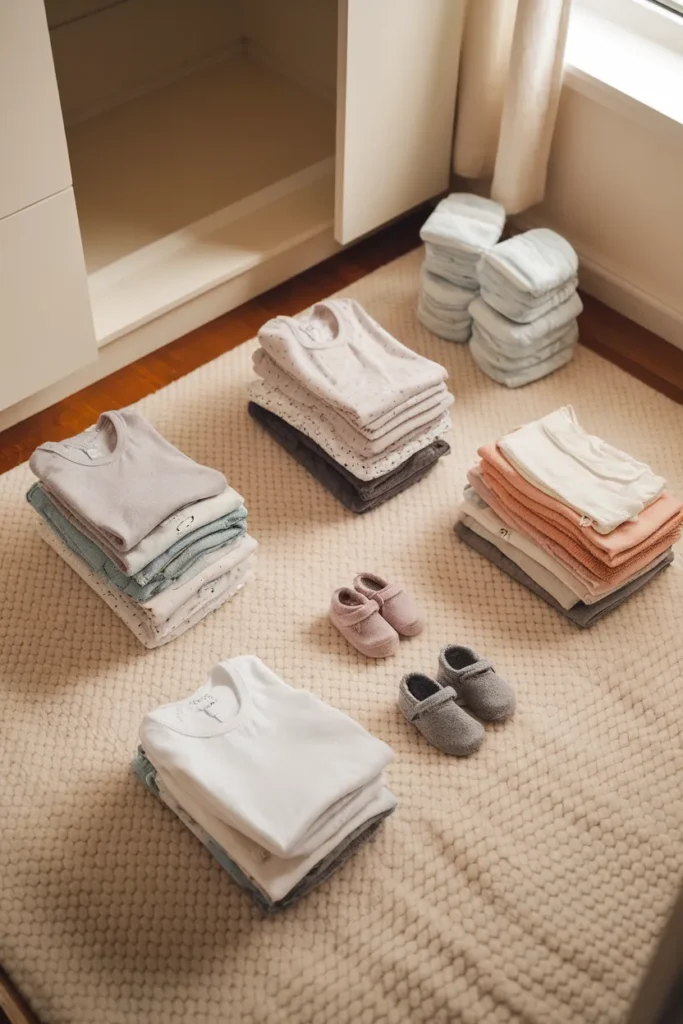
Then sort what’s left on the floor into piles by category, not by size yet: sleepers, daytime outfits, blankets and swaddles, socks and hats, shoes, diapering supplies, gear, keepsakes.
Now look at the piles. That’s your storage plan. If the blanket pile is huge and the shoe pile is three pairs, you need one deep basket and zero shoe racks. Buying bins first is how people end up with six empty containers and a pile of burp cloths on the changing table.
The Reach, Rotate, Reserve Rule
Here’s the framework we build every baby closet around, and it’s the reason this setup survives the first year instead of falling apart in week three.
The Reach, Rotate, Reserve Rule splits the closet into three horizontal bands by how often you touch things. Reach is everything you need with one hand while holding a baby with the other. Rotate is the next size up and the current season’s backup. Reserve is everything you won’t touch for months.
| Band | Height | What lives there |
|---|---|---|
| Reach | 30 to 55 inches | Current size hanging, daily bins, diapers, wipes |
| Rotate | 55 to 70 inches | Next size up, extra swaddles, backup crib sheets |
| Reserve | Top shelf and closet floor corners | Future sizes, off-season, keepsakes, outgrown bin |
The band heights matter more than the bins do. Anything you grab one-handed at 3 a.m. belongs between hip and shoulder height. Anything above your shoulders should require a deliberate decision to get down.
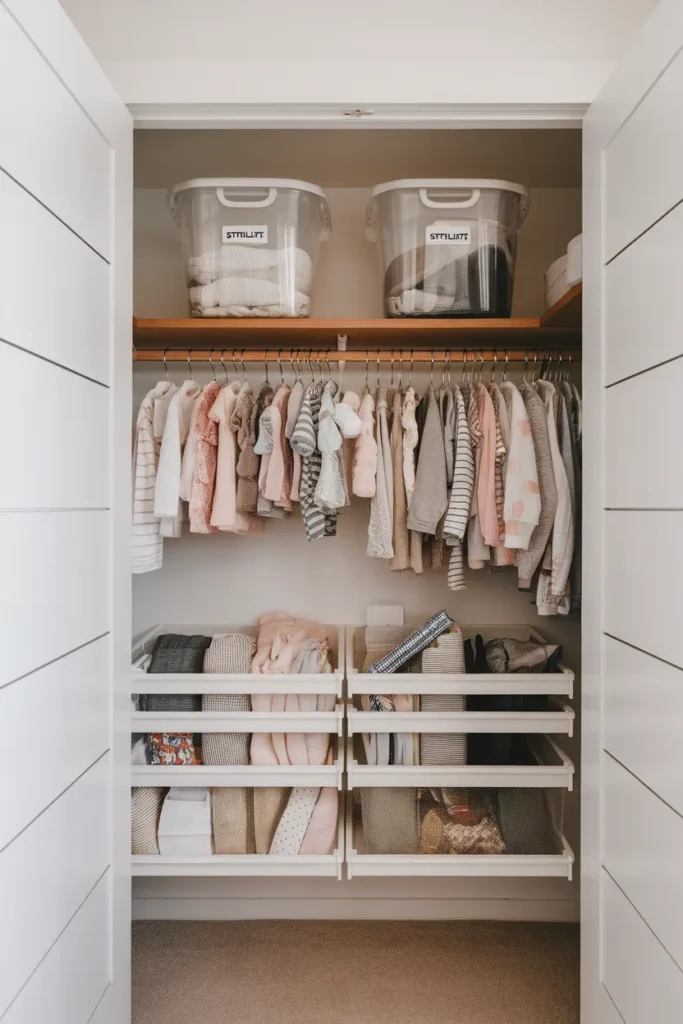
Add a Second Rod and Double Your Hanging Space
This is the highest-value move in the whole project, so do it first.
Baby clothes need about 24 inches of vertical clearance, sometimes less. A single rod at 66 inches wastes the entire lower half of the closet. Drop a second rod to roughly 34 inches off the floor and you now have two full rows, both of which you can reach without a step stool.
Two ways to do it. A hanging rod doubler clips onto the existing rod, costs around $15 to $25, and requires zero tools, which makes it the obvious pick for renters. Or mount a second rod on brackets screwed into studs, which costs about $20 in parts and holds far more weight. If you’re already thinking about a fuller redo, our budget closet makeover walkthrough covers the bracket and shelf math in detail.
One more thing while you’re up there: use identical hangers. Slim velvet kids hangers run about 11 inches wide versus 17 for adult ones, so you fit roughly a third more per foot of rod, and clothes stop sliding off onto the floor.

Use Size Dividers So You Never Miss a Size
Babies outgrow clothes faster than you’ll believe, and the real loss isn’t clutter. It’s the outfit your sister gave you that never got worn because it sat behind the 6-month stack until it was too small.
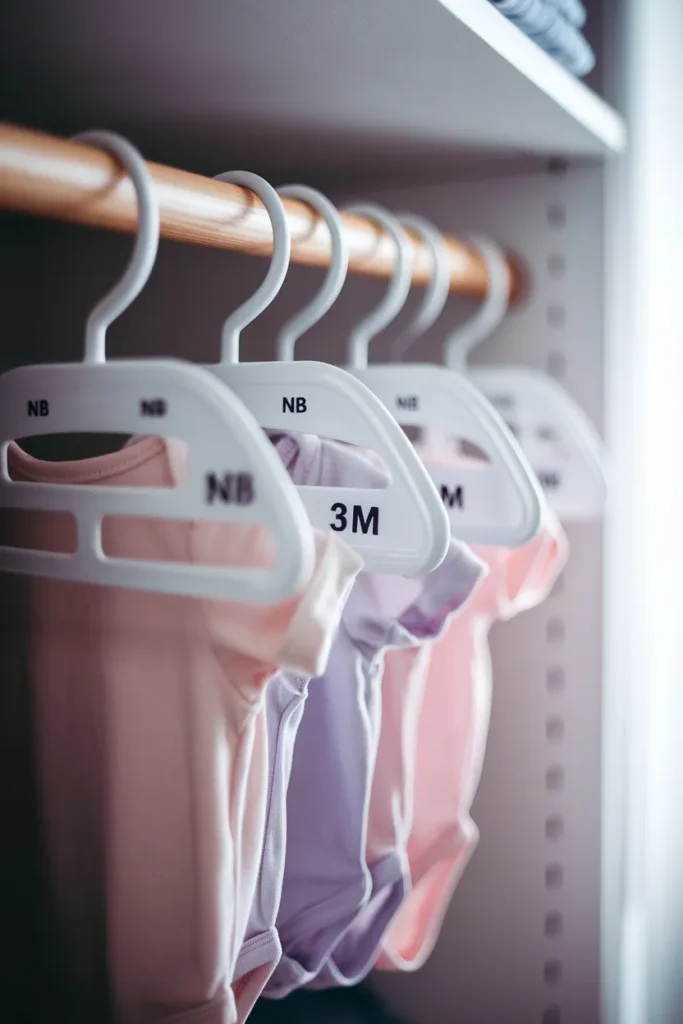
Size dividers fix this in about four minutes. They’re plastic or wood rings that slide onto the rod between size groups, and a 12-piece set covering newborn through 24 months runs about $10 to $15 at Amazon or Walmart. Hang them so the current size sits dead center at eye level, with smaller sizes to the left and larger to the right. You’ll dress the baby from the middle without thinking about it.
If you’d rather not buy anything, cut circles from a cereal box, punch a hole, and write the size in marker. Works exactly as well. Nobody sees the inside of a closet at eye level except you.
Bins and Baskets for Everything That Can’t Hang
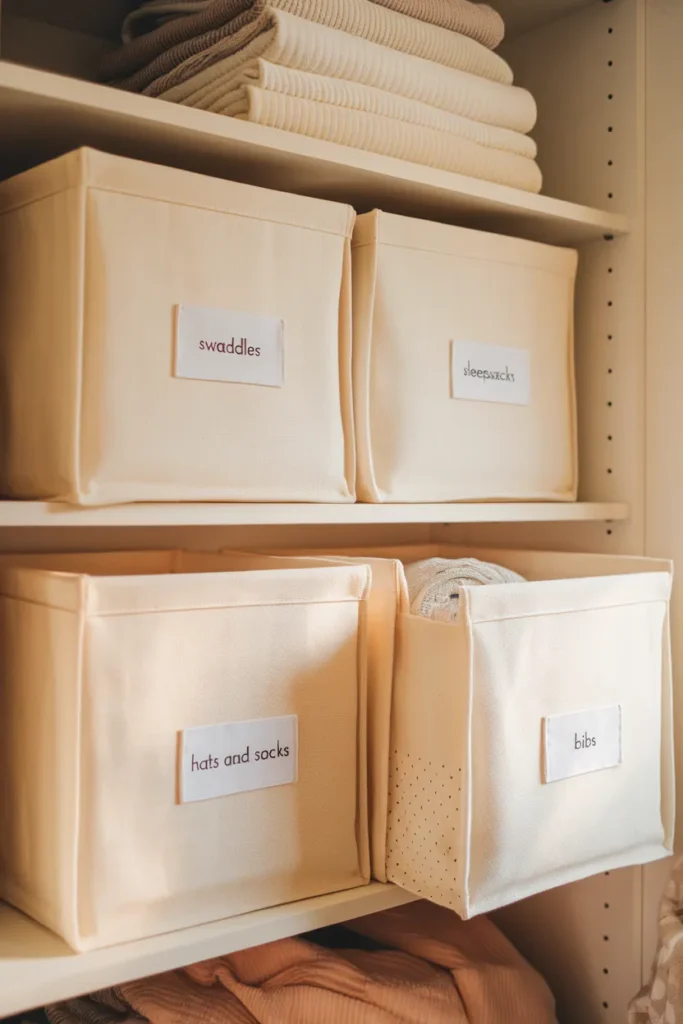
Most of what a baby owns doesn’t go on a hanger. Blankets, swaddles, burp cloths, socks, hats, bibs, crib sheets, and the frankly alarming number of muslin cloths you’ll accumulate.
Group them by category and give each category one container. Not two. One. When a category outgrows its bin, that’s your signal to donate, not to buy a bigger bin.
Sizes that work in a standard 24-inch-deep closet: fabric cube bins at 13 by 13 inches for blankets and swaddles, 6 by 9 inch open bins for socks and hats, and clear 6-quart shoeboxes for anything you want to see through. IKEA Skubb boxes and Target Brightroom fabric cubes both sit right around $6 to $10, and Dollar Tree white bins at $1.25 look surprisingly close to the expensive ones once they’re lined up and labeled.
Label the front of every single one. Not the top. Nobody reads the top.
Claim the Closet Floor
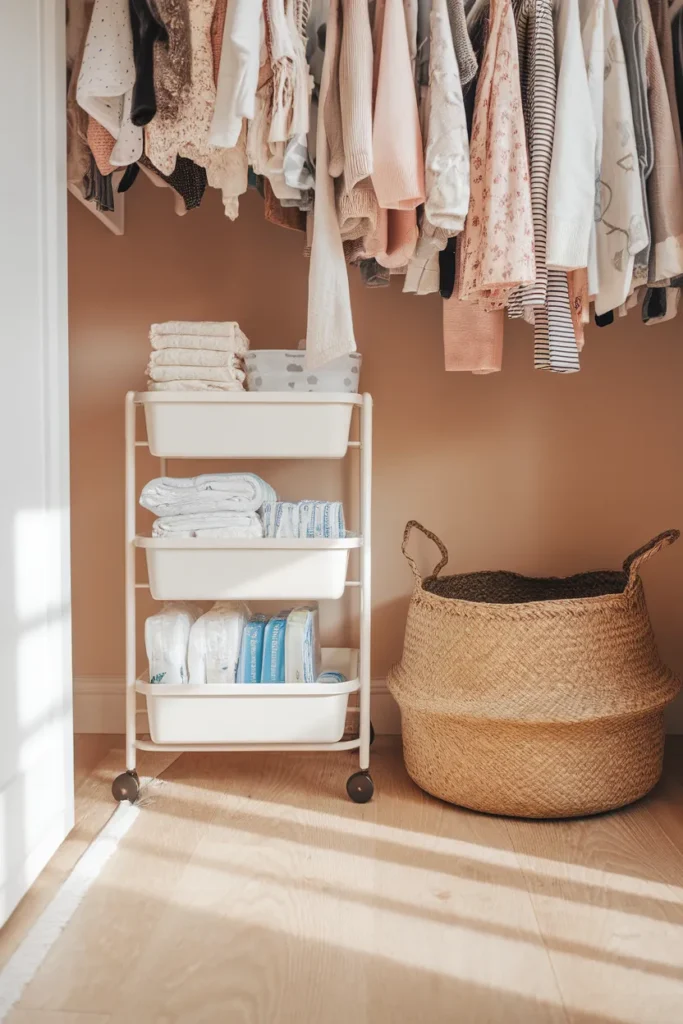
The floor of a nursery closet is usually the single most wasted square footage in the room, and it’s prime real estate because it’s the easiest spot to reach while you’re holding a baby.
Three things belong down there. A three-drawer rolling cart (roughly $25 to $35, 12 to 14 inches wide) that holds diapers, wipes, and creams within arm’s reach. One large open basket for the outgrown pile. And a shallow tray or shoe bin for the tiny shoes nobody will actually put on the baby.
If your closet is narrow, a slim cart on wheels beats a fixed shelf every time. You roll it to the changing table, restock, roll it back. Our small closet organization guide has more on making narrow reach-ins hold twice what they look like they should.
Put the Door and Side Walls to Work
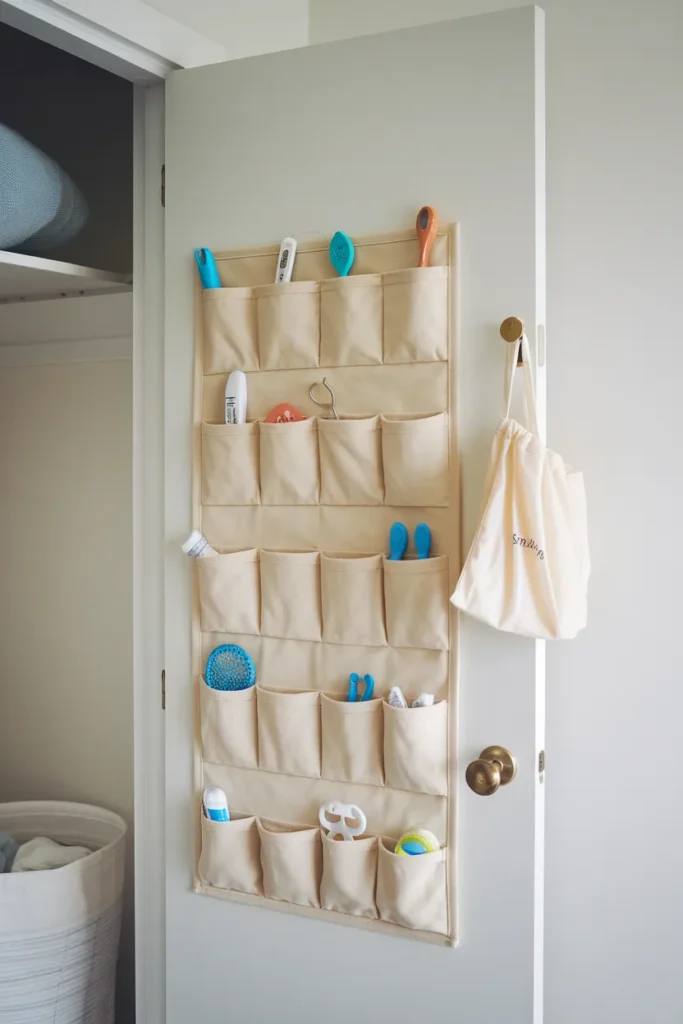
Two vertical surfaces sit unused in almost every nursery closet: the back of the door and the interior side walls.
An over-the-door pocket organizer, the kind sold for shoes, is close to perfect for baby gear. Each pocket holds one category: pacifiers, nail clippers, sunscreen, hair clips, thermometer, teething toys. You see all of it at once, which is the entire point.
On the side walls, 3M Command hooks (rated to about 5 pounds each, no drilling, no wall damage) hold a hanging laundry bag, a wet bag for cloth diapers, or a couple of small wire baskets for shoes. Renters, this is your section. Every idea here comes off the wall cleanly when you move.
Set Up the Outgrown Bin on Day One
This is the habit that keeps the closet organized after the initial setup, and almost nobody does it in advance.
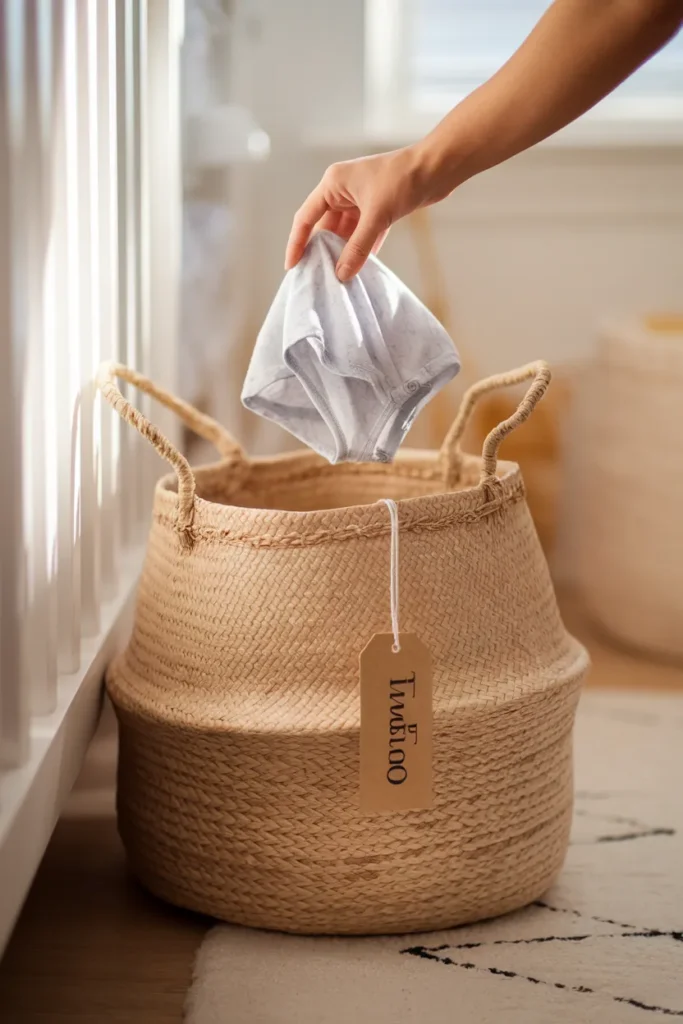
Put one open basket on the closet floor and label it Outgrown. The moment a sleeper doesn’t fit, it goes in the basket instead of back on the rod. No decision required, no sorting session, no folding. When the basket fills, you deal with it once: wash, sort into keep-for-next-baby or donate, and move it into a labeled tote in the garage or on the top shelf.
Double-label your future-size totes while you’re at it. Write “Newborn” on one side and “6 to 9 months” on the reverse. When the newborn clothes come out and go into storage, you flip the tote around and it’s already labeled for what goes in next. Same bin, zero relabeling, for about two years.
What Should Never Go in a Nursery Closet
Almost every nursery closet guide skips this part, and it’s the one section worth reading twice.
Diaper creams, medications, cleaning sprays, and laundry pods do not belong at Reach height. Ever. They go on the top shelf or out of the room entirely, because a closet a toddler can open is a closet a toddler will open, usually about six months earlier than you expect.
Loose bedding matters too. Extra pillows, quilts, crib bumpers, and plush toys should be stored in the closet rather than anywhere near the crib. The U.S. Consumer Product Safety Commission has repeatedly flagged cluttered sleep spaces as a leading factor in infant sleep deaths, and its safe sleep guidance is worth ten minutes of your time before you finalize the room.
And if you add any freestanding storage inside or beside the closet, a Billy bookcase, a drawer tower, a small dresser, anchor it to a wall stud. Tip-overs of clothing storage units are a documented hazard that CPSC addresses through furniture stability standards, and an anchor kit costs under $15. Do it the same day you assemble the piece, not later.
The 2 a.m. Test
Here’s the second thing competitors miss. You are not the only person who will use this closet.
Your partner, your mother, a night nurse, a babysitter, or your mother-in-law will all stand in front of it at some point, half asleep, looking for a clean sleeper in the right size. If the system only makes sense to the person who built it, it isn’t a system. It’s a memory.
So run the test before the baby arrives. Ask someone who wasn’t involved in the setup to find a 3-month sleeper, a burp cloth, and a spare crib sheet. Give them no hints. Time it.
Anything that takes more than about fifteen seconds needs a bigger label, a lower shelf, or a more obvious category name. “Layette” is not an obvious category name. “Sleepers” is. The same logic applies as your child gets older, which we walk through in our kids room organization guide.
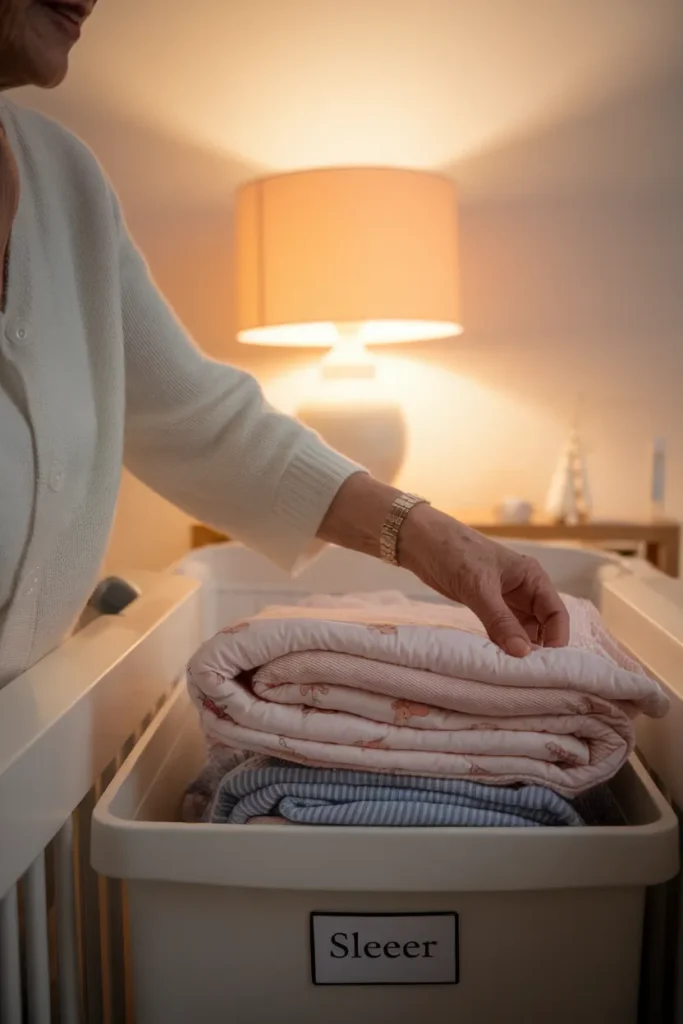
What This Costs
You can do the whole thing for under $80, and honestly, you can do a decent version for under $30.
| Item | Budget pick | Typical cost |
|---|---|---|
| Second hanging rod | Rod doubler, no tools | $15 to $25 |
| Slim kids hangers (30) | Amazon Basics velvet | $18 to $24 |
| Size dividers (12) | Plastic set, NB to 24M | $10 to $15 |
| Fabric cube bins (4) | Dollar Tree or Brightroom | $5 to $32 |
| Over-the-door organizer | Canvas pocket style | $12 to $20 |
| Command hooks (6) | 3M, 5 lb rating | $8 |
| Furniture anchor kit | Any brand | $10 to $15 |
Skip the matching wooden hangers, the custom closet system quote, and the label maker. A fine-tip marker on kraft tags reads better in photos anyway.
How the Closet Grows With Your Baby
The setup above holds for roughly the first eighteen months without changes. After that, three small edits carry it for years.
Around 18 months, drop the lower rod to about 28 inches so your toddler can hang and grab their own clothes. Around age three, swap the bottom basket from “outgrown” to “tomorrow’s outfit,” which kills the morning argument before it starts. Around age five, pull the size dividers off entirely and replace them with category dividers: school, play, dressy.
The bones stay the same. Reach, Rotate, Reserve works at every age, and that’s the whole reason to build it correctly now, while you have quiet hours and both hands free.
FAQ
How do I organize a nursery closet? Empty it completely, sort everything into category piles, then rebuild in three bands: Reach for daily items between 30 and 55 inches, Rotate for the next size up, and Reserve for the top shelf and future sizes. Add a second rod, use size dividers, and label the front of every bin.
How do you organize a small nursery closet with no space? Go vertical and use the surfaces you’re ignoring. A rod doubler creates a second full row, an over-the-door pocket organizer adds about twenty compartments, and Command hooks on the interior side walls hold laundry bags and wire baskets. The closet floor holds a slim rolling cart. Most narrow reach-ins have 40 percent more usable volume than people think.
What if the nursery has no closet at all? Use a small dresser or a Kallax-style cube unit as the clothing base, add a wall-mounted rail or a freestanding garment rack for hanging items, and put the rest in labeled bins under the crib. Anchor anything tall to a stud.
How should baby clothes be organized by size? Hang the current size at eye level in the center of the rod, smaller sizes to the left, larger to the right, separated by size dividers. Store anything more than one size ahead in a labeled tote on the top shelf so the rod stays uncluttered.
Where do you store outgrown baby clothes? Keep an open basket on the closet floor for immediate drop-offs, then move full loads into labeled clear totes in the garage, attic, or top shelf. Double-label each tote with the current size on one side and the next size up on the reverse.
Do you still need a dresser if you have a nursery closet? Not always. If the closet has drawers or room for a three-drawer cart plus shelving, you can skip the dresser entirely and use the wall space for something else. Many parents keep a dresser mainly as a changing table surface rather than for storage.
How many clothes should actually be in the closet at once? Roughly one current size plus one size up. Everything else goes to Reserve. Babies typically move through newborn and 0 to 3 month sizes in a matter of weeks, so a rod packed with six sizes is a rod you’ll have to reorganize six times.
Start With One Shelf
You don’t have to do all of this in one afternoon, and if you’re currently thirty-six weeks pregnant, please don’t try.
Pick the second rod. That single change opens up more space than everything else combined, and it takes about ten minutes with a rod doubler. Then the bins. Then the labels, whenever you have a quiet evening.
Which part of your nursery closet is giving you the most trouble right now, the sizes or the floor pile? Tell us in the comments, and if you want the rest of the room sorted next, our closet and bedroom guides pick up right where this one ends.