

Closet Makeover on a Budget: How to Organize Without Spending a Fortune
You opened the door, a sweater fell on your head, and three hangers slid off the rod in slow motion. The shoes are in a heap, the top shelf has become a graveyard for shopping bags, and you’ve forgotten you own at least four shirts. We’ve all stood there, coffee in hand, deciding it’s a tomorrow problem.
Today is the day we fix it. This closet makeover plan walks you through every fix, every product, and every DIY swap you need to organize a reach-in bedroom closet, a walk-in, or even an entryway closet, all without spending more than $200 (most readers spend half that). I tested every tip on my own 6-foot reach-in last fall, and I’ll flag what actually moved the needle versus what looked cute on Pinterest but failed in real life.
We’re organizing this guide by closet zone (top shelf, hanging rod, floor, door, walls), then layering in price tiers so you can pick what fits your wallet. Style direction leans Organic Modern: warm oak, cream, linen, with one quiet sage or terracotta accent.
Who This Closet Makeover Is For
You’ll get the most out of this guide if you’re:
- A renter who can’t drill, paint, or modify the closet (every fix has a no-drill version)
- A homeowner with a small or medium reach-in closet (4 to 8 feet wide)
- A walk-in closet owner who wants the look of a custom system without paying $5,000 for one
- A small-space dweller in a studio or one-bedroom under 700 square feet
- Anyone working with a budget between $25 and $200 total
Maximalists, minimalists, and the folks in between all welcome. The framework adjusts to your wardrobe size, not the other way around.
Step 1: The 5-Minute Closet Diagnostic (Do This Before You Buy Anything)
Most closet makeover articles skip straight to product lists. That’s why people drop $80 at The Container Store and still have a messy closet two weeks later. Diagnose first, shop second.
Stand in front of your closet and answer these five questions out loud:
- Where is the wasted vertical space? Look above the rod and below the hanging clothes. If you see more than 12 inches of empty air, that’s reclaimable real estate.
- What’s on the floor that shouldn’t be? Shoes, bags, and laundry baskets are the usual suspects.
- What’s hanging that should be folded? Sweaters stretch out on hangers. T-shirts and jeans take up rod space they don’t deserve.
- What haven’t you worn in 12 months? Be honest. This is the 365 rule and it’s brutal but effective.
- What can’t you see? If something is buried, you don’t wear it. Visibility equals usage.
Write the answers on your phone. Those five answers are now your shopping list filter. If a product doesn’t solve one of those five problems, you don’t buy it. That single rule will save you more money than any coupon.

Step 2: Declutter Using the 90-90 Rule (and Why It Beats Marie Kondo for Closets)
The 90-90 rule is simple. Have you worn it in the last 90 days? Will you wear it in the next 90? If both answers are no, it goes in the donate pile, with two exceptions: occasion wear (the one black dress, the one suit) and seasonal pieces (the heavy winter coat in July).
I prefer 90-90 over the KonMari “spark joy” method for closets specifically because clothes are functional, not just emotional. A perfectly fine pair of jeans might not spark joy, but if you wear them every Saturday, they earn their hanger.
Other rules worth knowing:
- The 333 rule: Wear only 33 pieces for 3 months. Useful for capsule wardrobe builders.
- The rule of 3 for cleaning closets: Sort everything into three piles only (keep, donate, trash). No “maybe” pile, because the maybe pile is where decisions go to die.
- The 5-4-3-2-1 method: Donate 5 shirts, 4 pairs of pants, 3 pairs of shoes, 2 bags, 1 coat. Quick, gamified, works for kids and teens too.
- The 70/30 rule: 70% of closet space stays full, 30% stays empty. Empty space is what makes a closet look organized, not full shelves.
Run whichever rule fits your personality. The goal is the same: less stuff, more breathing room. Plan on losing 20 to 30 percent of your wardrobe on the first pass. That’s normal.
Step 3: Reclaim the Top Shelf (The Most Wasted Zone in Every Closet)
The top shelf is where good intentions go to die. It’s too high to see, too deep to use, and most of us throw soft luggage and old purses up there until the pile collapses.
What to do:
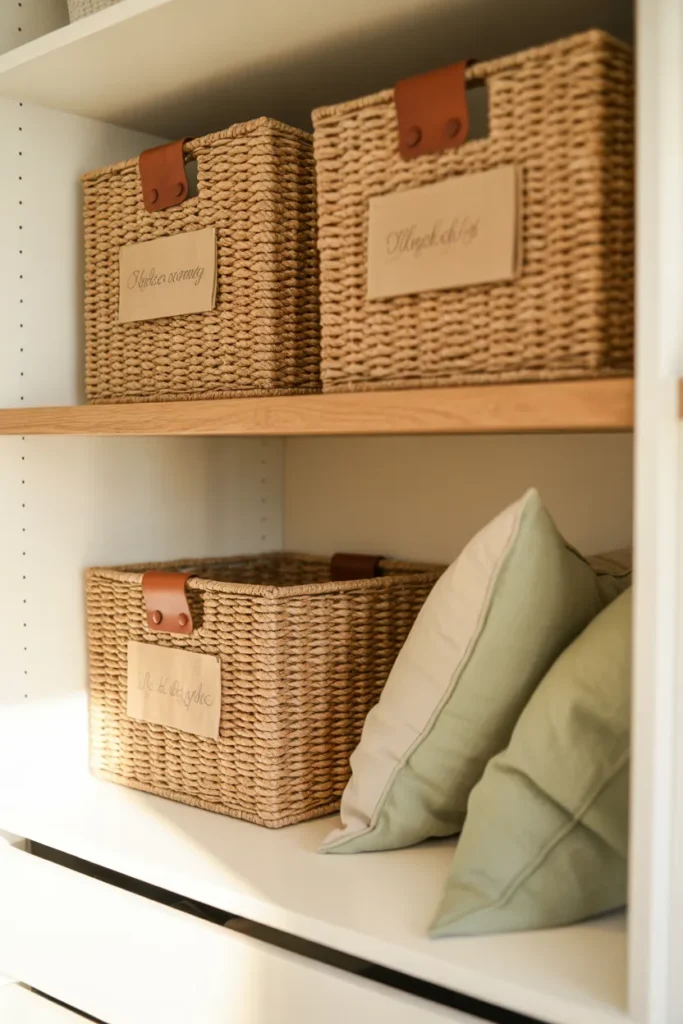
- Add two or three woven seagrass or canvas bins, 13 inches deep, with handles. Label them by category (off-season sweaters, swimwear, gift wrap, sentimental). Bins under $15 each at Target’s Brightroom line, IKEA’s KUGGIS or NORDRANA, or HomeGoods.
- If the shelf is taller than 14 inches, add a single shelf divider or a small wire shelf riser to create a second tier. Riser cost: about $12 on Amazon.
- Store seasonally. Summer linens up top in winter, wool sweaters up top in summer.
Why it works: Bins turn a chaotic shelf into a labeled grid. You stop “losing” things because there are only four possible homes for any item.
Rental flag: Zero drilling required. Bins sit on the existing shelf.
Step 4: Upgrade Your Hangers (The Single Highest-Impact $20 You’ll Spend)
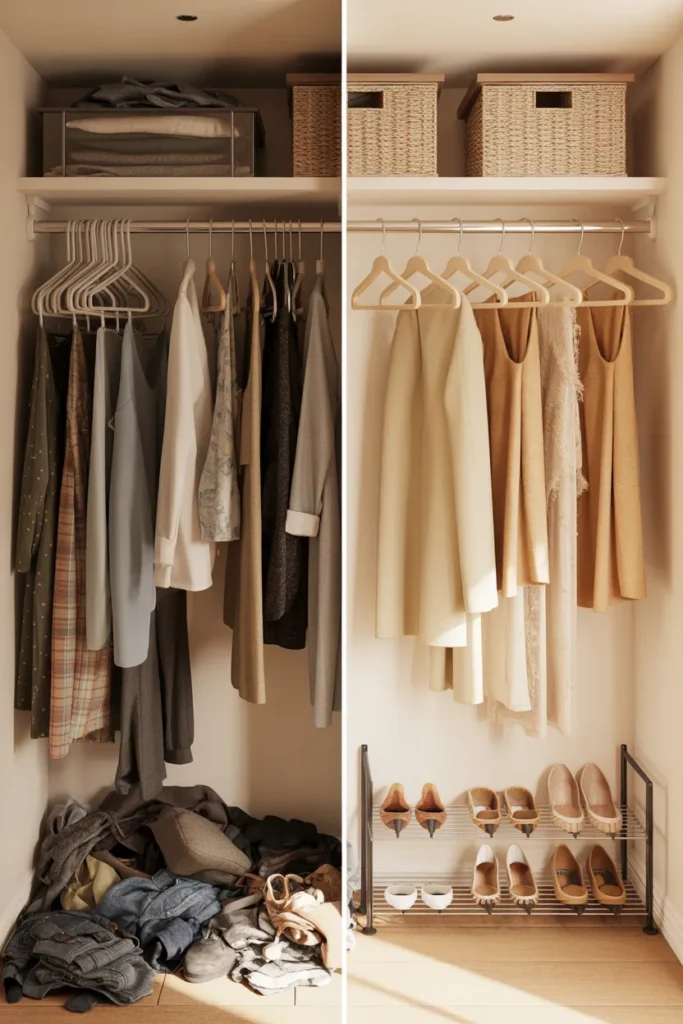
If you do nothing else on this list, do this. Mismatched hangers (the wire ones from the dry cleaner, the plastic ones from old packaging, the wood ones from a bridesmaid dress) are the number-one reason closets look chaotic.
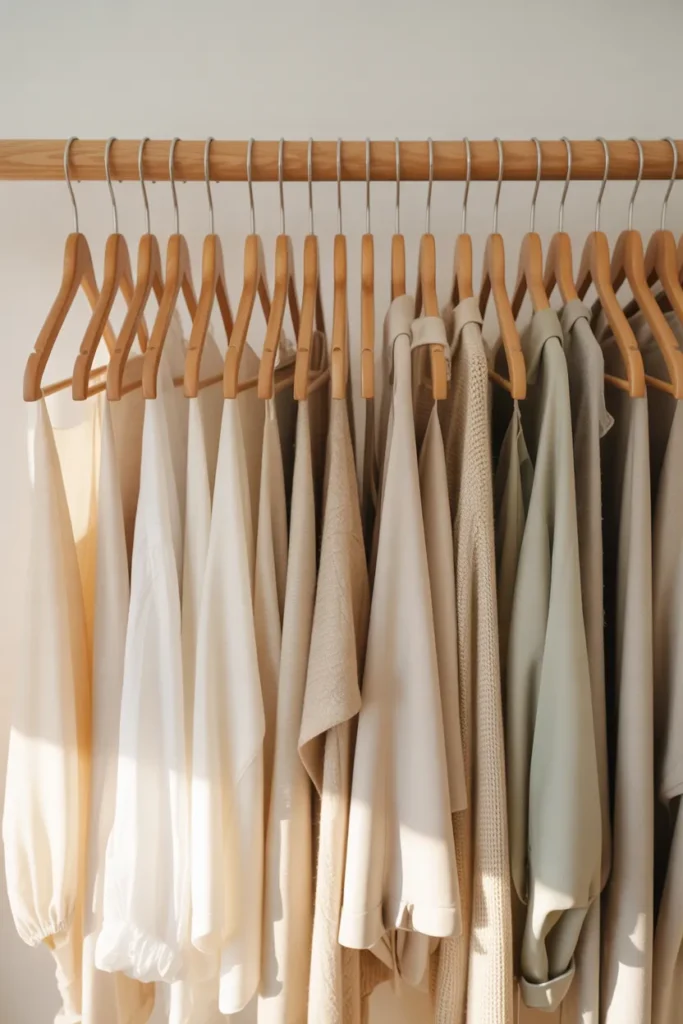
Replace every hanger with a single style. My pick: slim velvet hangers in a neutral color (oat, cream, or charcoal). They take up half the rod space of plastic, the velvet grip stops slippage, and a 50-pack runs about $20 at Amazon Basics, $25 at Target, or $35 at The Container Store.
The visual difference is jarring. A closet of matching slim hangers looks 60% less cluttered without removing a single item of clothing.
The 4 P’s of fashion (the merchandising rule retailers use) tell you to consider product, price, place, and presentation. Same logic applies at home. Presentation is what makes a closet feel like a boutique. Matching hangers do most of the heavy lifting.
Budget version: Dollar Tree sells velvet hangers in 3-packs for $1.25 each. They’re slightly thicker than the Amazon ones but identical in function.
Step 5: Double Your Hanging Space With a $15 Add-On Rod
Most reach-ins have a single rod with three feet of empty air below short items like shirts and folded pants. Reclaim it.
Two options:
- Tension rod method: A spring tension rod ($8 to $12) wedges between the side walls of the closet. Hang short items on the upper rod and add a second one below. No drilling.
- Hanging closet rod extender: A simple chain or bar that hooks over the existing rod and creates a second rod underneath. About $15 at Amazon. Holds 30 to 50 pounds. Genuinely the best $15 I’ve spent on my closet.
Why it works: Reach-in closets have roughly 7 feet of vertical hang space. A single rod uses 4. A double rod uses 7. You just doubled your hanging capacity.
Walk-in closet variation: Install double rods on one wall for shirts and short items, keep a single full-length rod on another wall for dresses and coats.
Step 6: Fix the Closet Floor (Where Shoes Multiply Like Rabbits)
The floor is the second most wasted zone. Shoes piled up, laundry hampers wedged sideways, vacuum cords tangling around your ankles.
Fixes by price tier:
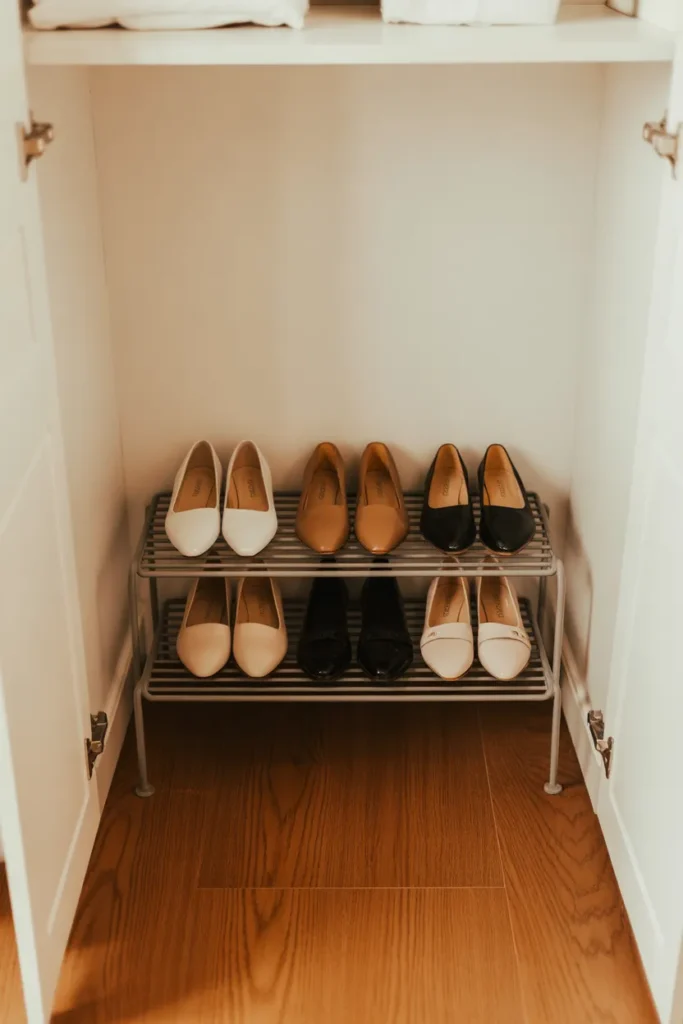
- Under $25: A 2-tier metal shoe rack from Target or Walmart, $18. Holds 10 pairs. Stack two for 20 pairs.
- $25 to $100: A canvas hanging shoe organizer with 10 pockets, $22 at Amazon, doubles as accessory storage for hats and small bags.
- $100+: A clear acrylic stackable shoe drawer system from The Container Store, about $10 per drawer, fully customizable but adds up fast.
Pro move: Decant out-of-season shoes into a rolling under-bed bin and only keep current-season shoes in the closet. Frees up roughly half your floor space.
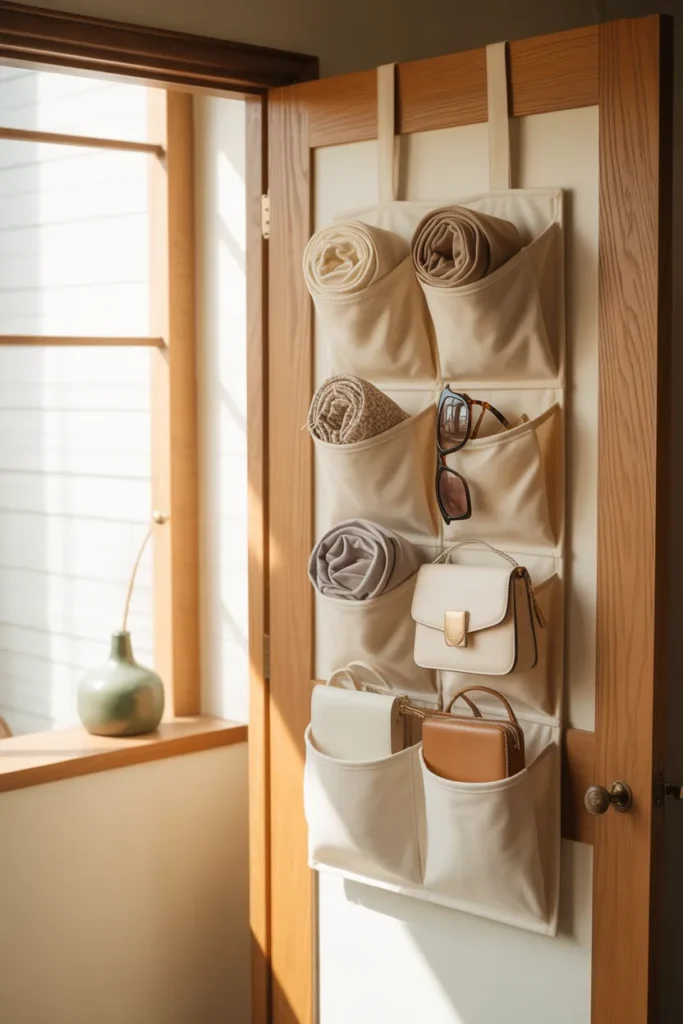
Step 7: Use the Door (The Most Underrated Square Footage in Your Home)
The back of the closet door is roughly 14 square feet of vertical real estate that 90% of people leave blank. Don’t be those people.
Renter-friendly options (no drilling):
- An over-the-door shoe organizer with clear or canvas pockets, about $15. Repurpose pockets for accessories, scarves, hair tools, or small handbags.
- Over-the-door hooks (3 to 5 hooks per bar) for robes, tomorrow’s outfit, or gym bags. Roughly $10.
- A slim over-the-door jewelry organizer with mirror, $25 to $40.
Owner option: Mount a thin pegboard to the door and customize with hooks, small shelves, and bins. Pegboard runs about $15 at Home Depot or Lowe’s, plus another $10 to $15 in hooks.
The pegboard idea comes straight from competitor coverage and it deserves the hype. You can rearrange it endlessly as your needs change.
Step 8: Add Drawer Dividers, Shelf Dividers, and Small Bins
Once the big zones are solved, the small fixes finish the look.
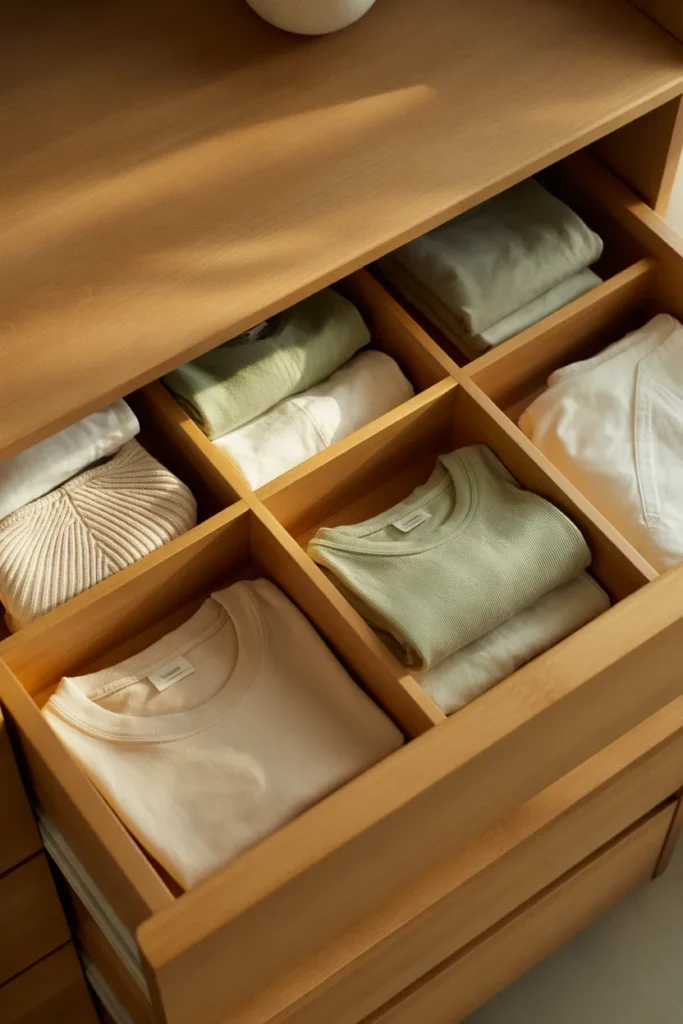
- Drawer dividers: Bamboo expandable dividers, about $15 a pair, segment a single drawer into four. Underwear, socks, and folded tees all stay in their lanes.
- Shelf dividers: Acrylic or matte black metal, $10 for a 2-pack. Stack folded sweaters in 12-inch tall columns instead of lopsided towers.
- Small bins for the hanging rod area: Use shallow fabric bins on the top shelf for items like belts, ties, and clutches. Or hang a fabric cube organizer ($18 at Amazon) from the rod itself for purses.
- Shower curtain rings on a hanger: A genuine viral DIY that works. Loop 10 to 15 metal shower rings around a single sturdy hanger to hold scarves, belts, or tank tops. Costs about $4. Frees up an absurd amount of drawer space.
Step 9: The Aesthetic Layer (Where Most Budget Makeovers Quit Too Early)
Function is solved. Now make it look like the closet you actually want. This is the difference between “organized” and “Pinterest-worthy.”
Five low-cost aesthetic upgrades:
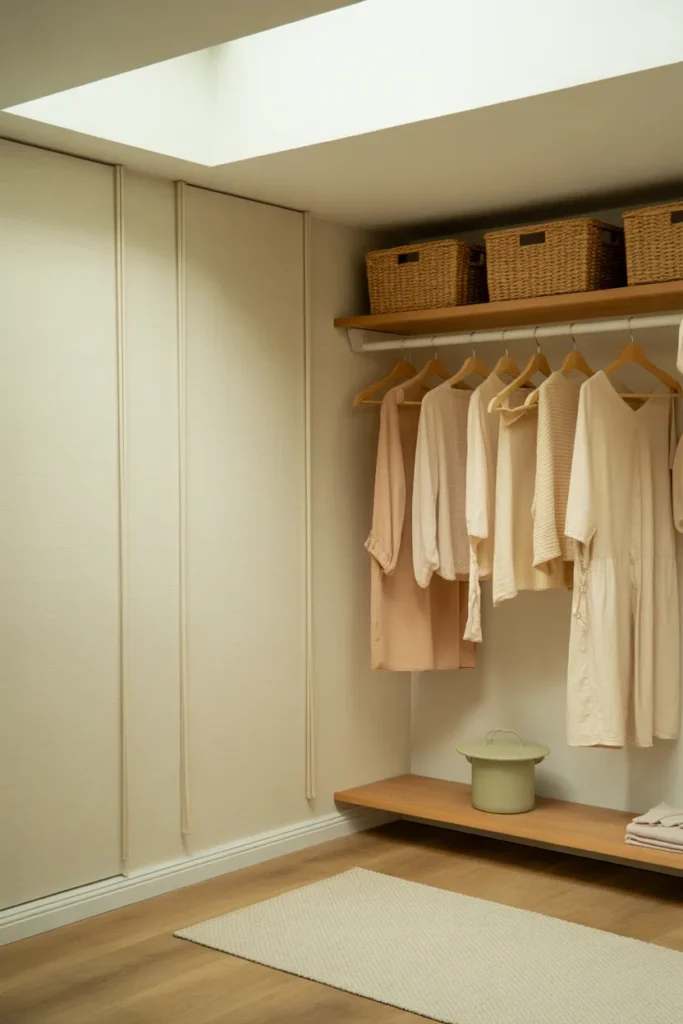
- Peel-and-stick wallpaper on the back wall. A roll runs $25 to $40 at Target or Amazon. Pick a soft pattern (cream grasscloth, narrow stripe, small floral). Renter-safe. Peels off without damage.
- Battery-operated motion sensor lights. $15 for a 3-pack at Amazon. Stick under the top shelf with included adhesive. The closet glows when you open the door. Game-level upgrade for under $20.
- A small accent rug. A 2×3 washable cotton rug in cream or oat for $20 at Target. Softens the floor and pulls the room together.
- Fabric or leather hanger tags. Hand-letter or print labels for each storage bin. Free if you DIY, $8 for a printed set on Etsy.
- One ceramic catchall on a shelf. Holds rings, watches, loose change. About $10 at HomeGoods. Adds the boutique feel.
Budget vs Splurge: The Side-by-Side That Will Save You Money
Here’s where most closet makeover articles fall short. They list ideas but don’t price them. Here’s what each closet zone actually costs at three tiers.
| Closet Zone | Budget (Under $25) | Mid-Range ($25 to $100) | Splurge ($100+) |
|---|---|---|---|
| Hangers (50 pack) | Dollar Tree velvet, $20 | Amazon Basics velvet, $25 | The Container Store wood, $150 |
| Top shelf bins (3) | Walmart canvas, $18 | Target Brightroom seagrass, $45 | West Elm woven, $120 |
| Shoe storage | 2-tier metal rack, $18 | Hanging shoe organizer, $22 | Acrylic stackable drawers, $120+ |
| Drawer dividers | DIY cardboard, free | Bamboo expandable, $15 | Acrylic custom-fit, $60 |
| Door organizer | Dollar Tree adhesive hooks, $5 | Canvas over-door, $15 | Mounted pegboard system, $80 |
| Lighting | Battery LED puck lights, $12 | Motion sensor strip, $25 | Hardwired LED rod, $200+ |
| Accent layer | Peel-and-stick wallpaper, $25 | Washable rug + ceramic catchall, $30 | Custom built-in shelving, $500+ |
| Total | About $98 | About $180 | About $1,200+ |
The mid-range tier at $180 gets you 90% of the splurge result. That’s the sweet spot.
Common Closet Makeover Mistakes to Avoid
I’ve made most of these. Skip the lessons I learned the hard way.
- Buying organizers before decluttering. You’ll buy too many and the wrong sizes. Always purge first, measure second, shop third.
- Ignoring the door. Free real estate, ignored by 90% of closets.
- Mismatched hangers. Even an organized closet looks chaotic with three hanger styles. Pick one.
- Buying matchy plastic bins that don’t fit. Measure your shelf depth and width before you order. A bin that’s 1 inch too deep ruins the install.
- Skipping lighting. A dark closet always looks messy, even when it’s not. $15 in motion lights changes the feel of the entire space.
- Going monochrome white with no warmth. A closet of only white plastic looks clinical. Mix in oak, seagrass, or cream linen for warmth.
- Forgetting the 70/30 rule. Stuffing every inch full undoes everything. Empty space is the look.
Beyond the Bedroom: Closet Makeover Ideas for Other Closets
The same playbook works in:
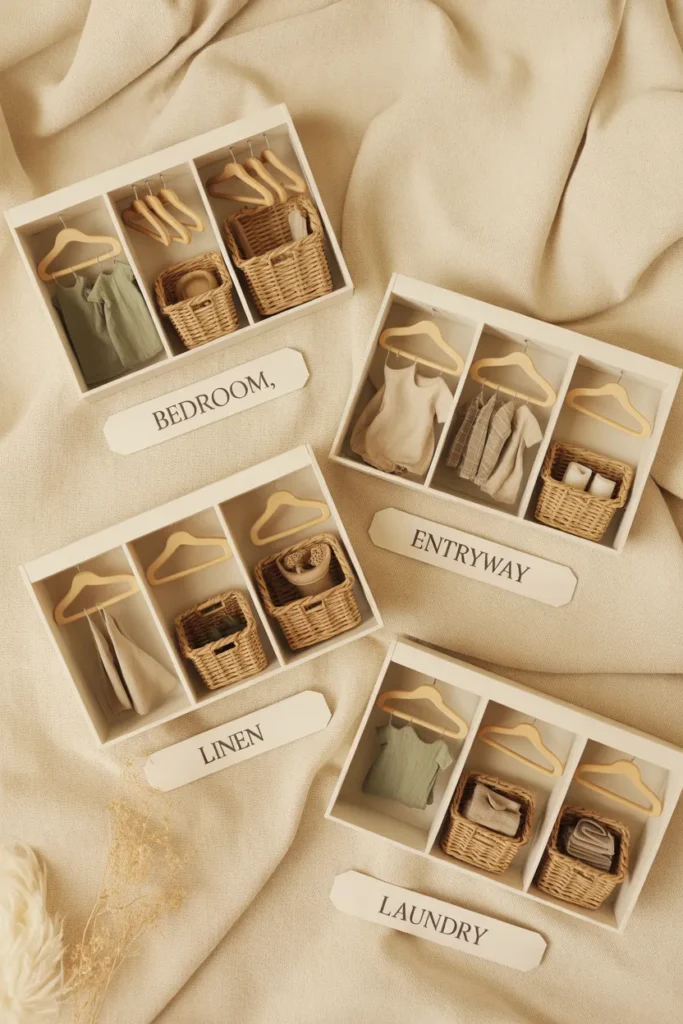
- Entryway and coat closets: Swap the rod height to accommodate long coats, add a low shoe rack, and use a single woven bin for hats and gloves. Add a small tray for mail and keys.
- Hall and linen closets: Bin and label by category (sheets, towels, toiletries). A tension rod across the back creates a hanging spot for cleaning supplies.
- Laundry closets: Add a slim rolling cart between the washer and dryer. Use a tension rod above for hanging air-dry items.
If small-space organization is your bigger challenge, this guide on smart organization tricks for tiny apartments walks through the same logic for studios. And if your pantry is the next disaster on your list, the small pantry makeover under $50 uses many of the same product picks.
How to Maintain Your Closet Makeover (So You’re Not Doing This Again in 6 Months)
The makeover is the easy part. Maintenance is what separates a Pinterest-perfect closet from one that collapses in three weeks.
The five-minute weekly reset:
- Rehang anything dropped on the floor or chair.
- Put shoes back on the rack.
- Empty the donate bin into your car if it’s full.
- Wipe the top shelf with a microfiber cloth.
- Scan for anything that doesn’t belong and remove it.
That’s it. Five minutes. Sunday afternoon, with a podcast on.
A consistent cleaning rhythm across the rest of the home keeps closets from becoming the dumping ground again. This printable weekly cleaning schedule builds the closet reset right into the routine.
For deeper organization psychology, the American Cleaning Institute has solid science-backed guidance on clothing storage and care. And if you’re chasing the calm-closet aesthetic that the minimalism crowd swears by, The Spruce’s wardrobe organization research covers the long-tail studies on why visible clothing gets worn 3x more than hidden clothing.
Frequently Asked Questions
How do I do a closet makeover in a small space or rental?
Stick to no-drill solutions: tension rods, over-the-door organizers, peel-and-stick wallpaper, freestanding shoe racks, and command-strip hooks. The full makeover in this guide is renter-safe at every step. A 4-foot reach-in can be done for under $100.
What is the budget version of a closet makeover?
Hit four basics for about $50 total: matching velvet hangers from Dollar Tree ($20), three woven bins from Walmart or HomeGoods ($18), a 2-tier shoe rack ($12), and battery puck lights ($10). That alone fixes 70% of what’s wrong with most closets.
What if I don’t have any extra closet space to start with?
Go vertical and go on the door. Add a tension rod for a second hanging level, an over-the-door organizer for shoes or accessories, and a shelf riser on the top shelf. You’ll find roughly 30% more usable space in any reach-in without changing its footprint.
How long does a closet makeover take?
A reach-in closet takes one weekend. Friday night to declutter (2 hours), Saturday to shop and install (3 to 4 hours), Sunday morning to style and label (1 hour). A walk-in takes one full weekend, sometimes two. Budget extra time if you’re painting or wallpapering.
How do I organize a wardrobe without hangers on a budget?
Fold-only systems work for casual wardrobes. Use shelf dividers and stack folded items vertically (file-folding style) so each piece is visible. For long hanging items, a wall-mounted hook bar or a freestanding garment rack ($30 at IKEA) replaces the rod entirely.
What is the 90-90 rule for decluttering clothes?
Worn it in the last 90 days? Will you wear it in the next 90? If both answers are no, donate it. Exceptions: occasion wear and seasonal pieces (winter coat in summer, swimsuit in winter).
How do I keep a closet organized long-term?
Run a 5-minute weekly reset, follow the 70/30 rule (never fill more than 70% of available space), and do a 90-90 cull twice a year, once at each season change. The makeover holds for years if maintenance is built in.
Save This for Your Next Free Weekend
Bookmark this post or pin the before-and-after image up top so it’s waiting when you finally get a free Saturday. Pick one zone, set a $50 cap, and start there. The closet that’s been stressing you out for two years can be fixed in 48 hours and under $200.
If you want the next room to tackle, the studio apartment organization hacks post is the natural follow-up. Same playbook, smaller footprint.