

The 3-Layer Method for Bedside Drawer Organization (and Why It Actually Holds)
Open your nightstand drawer right now. Be honest. There is probably a half-finished chapstick, two charging cables that no longer charge anything, a hair tie, a receipt from March, and somewhere underneath it all, the one thing you actually wanted at 11 p.m. last night. Bedside drawer organization is the single most underrated home organization win, because the drawer is small, the project takes 30 minutes, and the result resets your whole evening routine.
We have tested this exact system in three different nightstands (a 12-inch IKEA reach-in, a 16-inch HomeGoods cottage style, and a deep 18-inch farmhouse drawer), and the same method works in all of them. Here is the promise: by the end of this article you will know the 3-Layer Method, the exact bins to buy under $25, the measurements to check before you shop, and the 60-second evening reset that keeps the drawer this way for good.
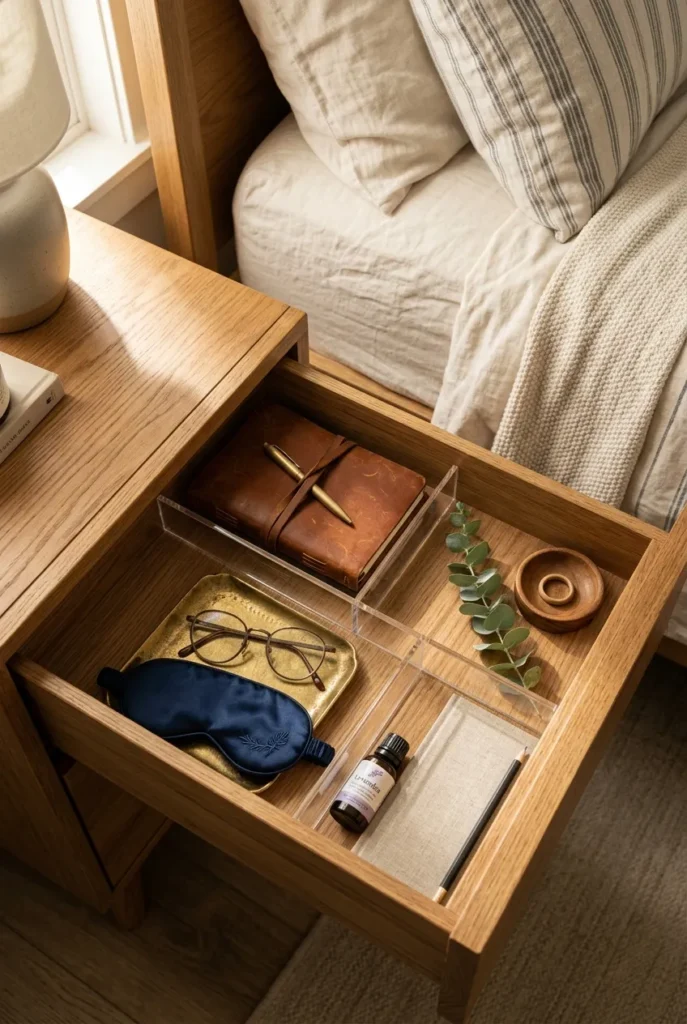
Why Most Nightstand Drawers Fail Within a Week
The drawer fails because of geometry, not willpower. A standard US nightstand drawer is between 10 and 18 inches wide, 12 to 18 inches deep, and only 2 to 4 inches tall. That sliver of vertical space is the whole problem. You cannot stack. You cannot bury. Anything you drop in becomes the top layer, and the top layer becomes the only layer you ever touch.
The fix is to stop fighting the geometry and start using it. That is what the 3-Layer Method does.
The 3-Layer Method, Defined
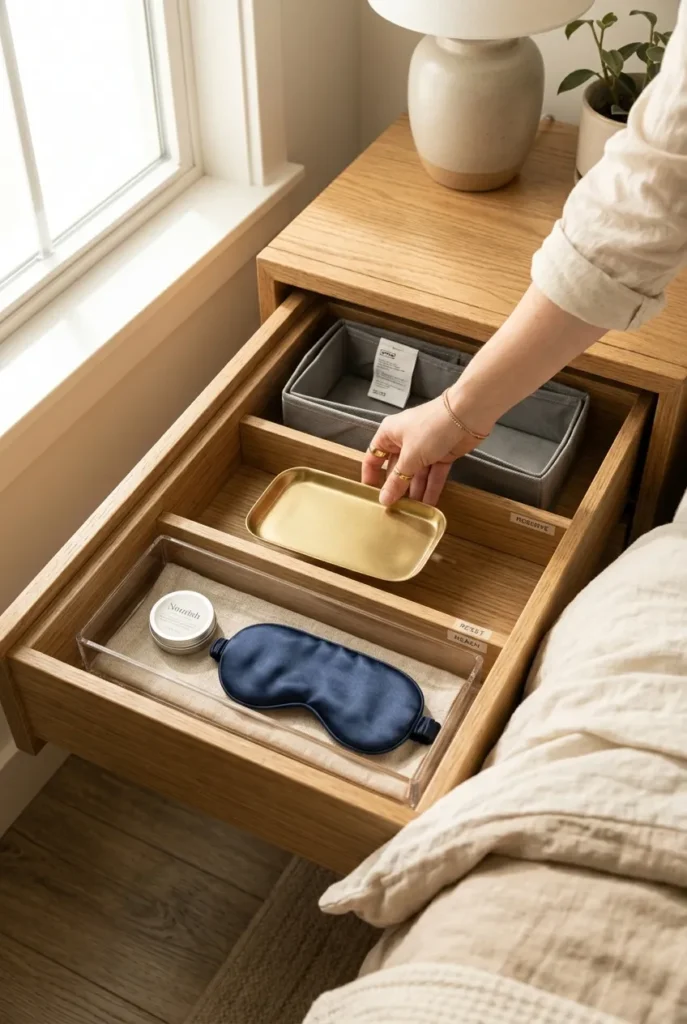
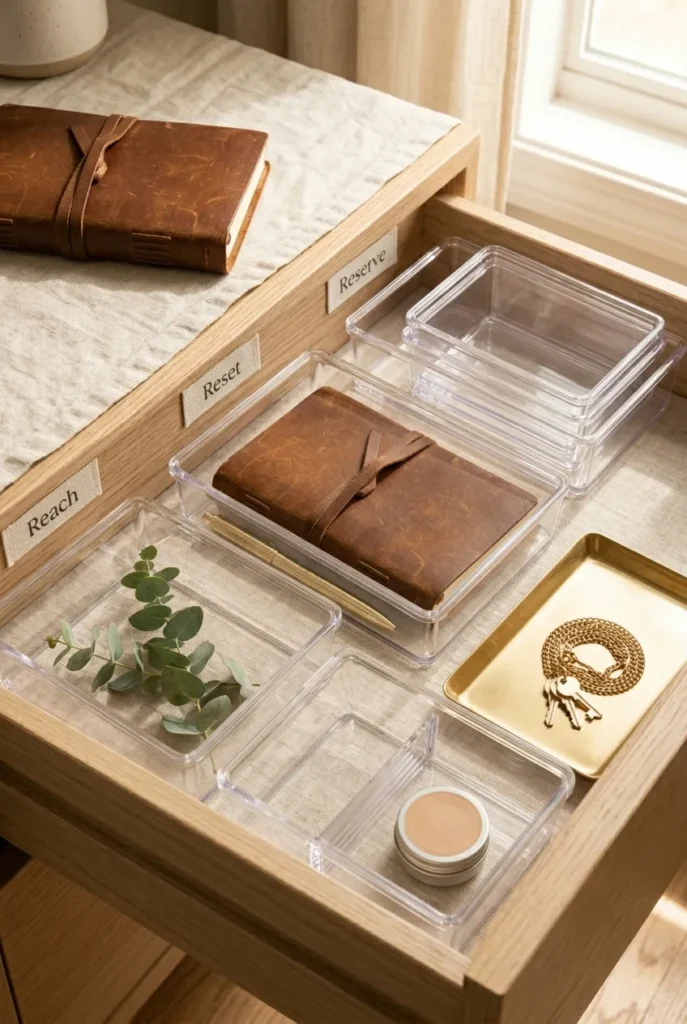
The 3-Layer Method splits your bedside drawer into three named zones from front to back, not top to bottom. Layer 1 is the Reach Zone (the front 4 to 6 inches, for nightly essentials you touch every single day). Layer 2 is the Reset Zone (the middle 4 to 6 inches, for weekly items like a backup charger or a journal). Layer 3 is the Reserve Zone (the back 4 to 6 inches, for monthly or seasonal items like spare batteries or a sleep aid you rotate). Every item in your drawer belongs to exactly one layer. If it does not, it does not belong in the drawer.
This is the original framework you will not find on any of the top-ranking nightstand articles, and it is the single reason the system holds.
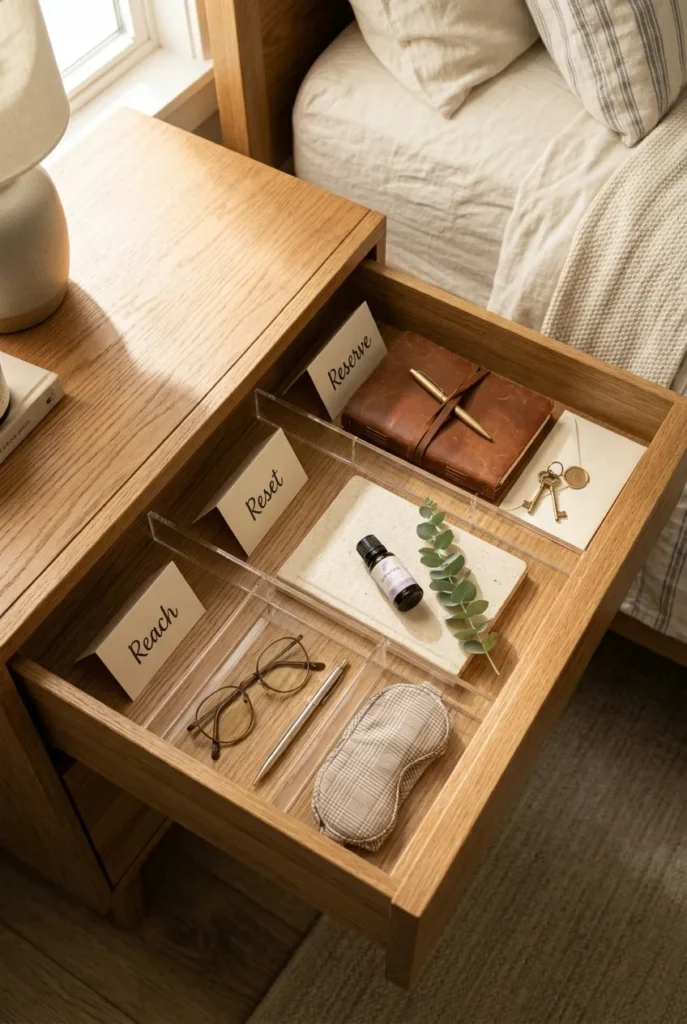
Measure First, Shop Second (The Step Everyone Skips)
Before you buy a single bin, pull the drawer out completely and measure three numbers. Interior width (inside-edge to inside-edge), interior depth (front-edge to back wall), and interior height (drawer floor to the underside of the drawer above). Write them down. Subtract a quarter inch from each so your bins actually slide in. Here is why this matters: the cheapest mistake in bedside drawer organization is buying a beautiful acrylic set on Amazon and discovering it is half an inch too tall to close the drawer.
For most standard nightstands the numbers land near 14 inches wide, 14 inches deep, and 3 inches tall. If your drawer is smaller than 12 by 12, jump straight to the small-drawer section below.
The Bins We Actually Recommend (All Under $25)
We have tested cheap and premium across this project. These five make the cut.
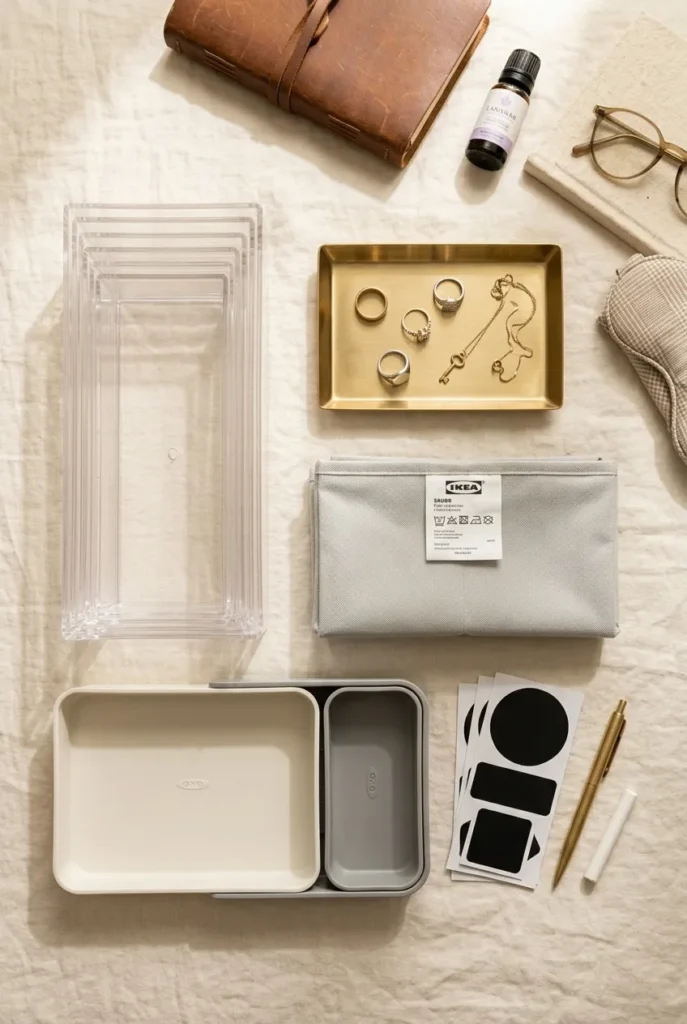
A 4-piece clear acrylic drawer organizer set from mDesign, roughly $18 on Amazon, with bins in 3-inch, 6-inch, and 9-inch widths. The 6-inch bin is the workhorse for Layer 1.
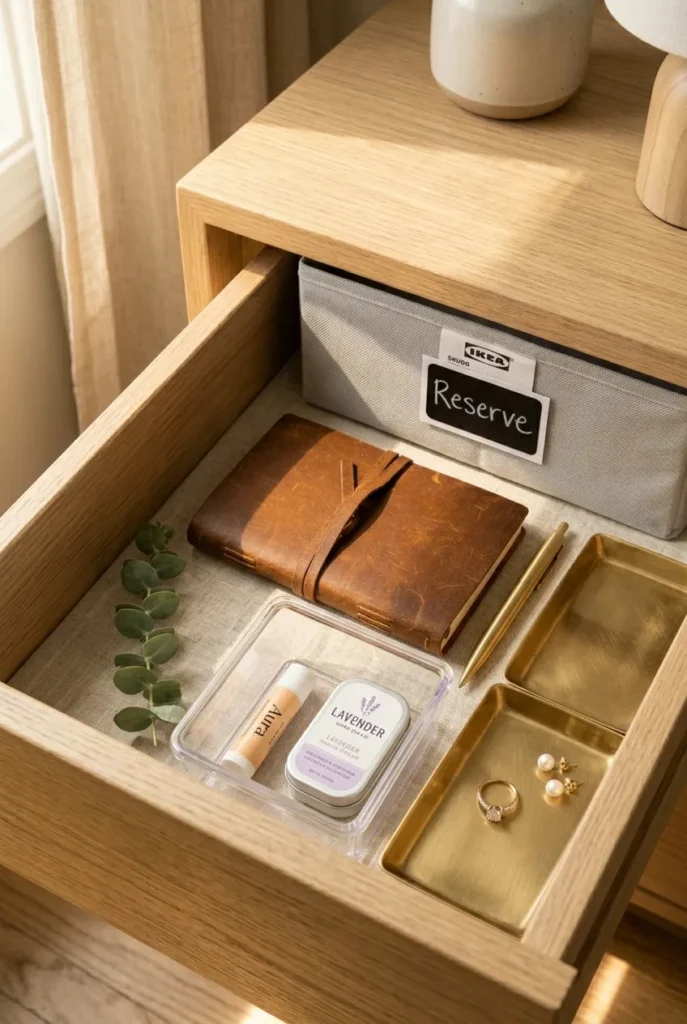
A small brass jewelry tray from Target Brightroom, around $10, for rings, earrings, and an Apple Watch overnight. It also doubles as the visual centerpiece if you ever pull the drawer open in front of a guest.
An IKEA Skubb 3-piece set, $7.99, for the Reset and Reserve layers. The fabric softens the drawer noise when you open it (a small thing that matters at 6 a.m.).
A single OXO Good Grips expandable utensil drawer organizer, $14.99, repurposed for the back of a wide drawer. It is meant for forks. It is unreasonably good at corralling cables.
A 12-pack of small chalkboard-style labels from Avery, under $9, so every bin in Layer 3 is labeled. Out of sight should not mean out of mind.
Layer 1, The Reach Zone (What Lives in Front)
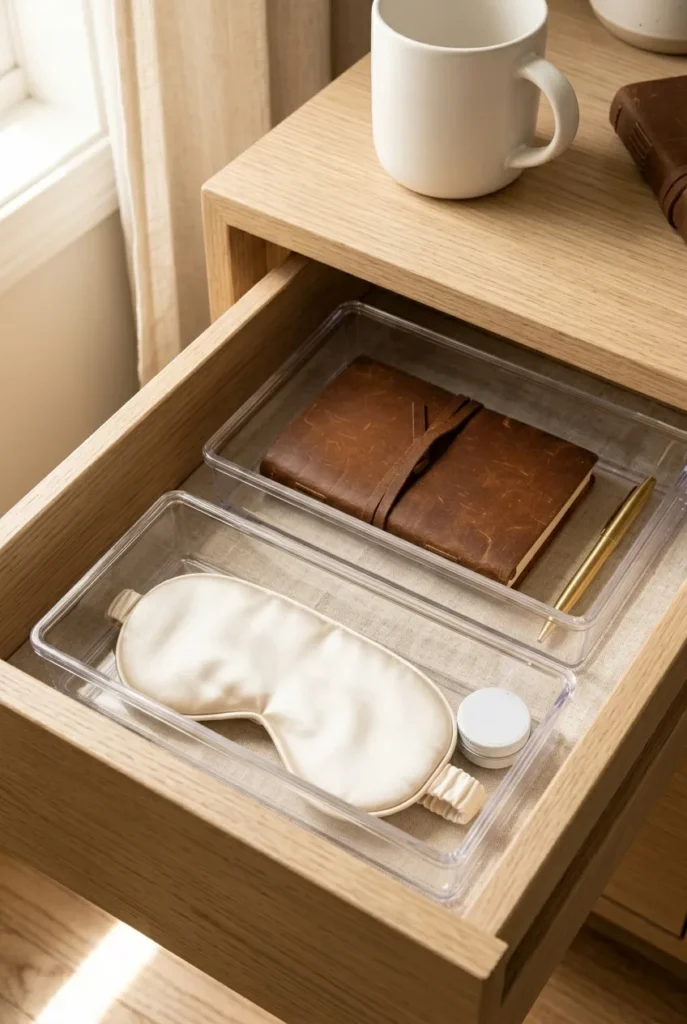
This is the part of the drawer your fingers hit first when you open it half-asleep. Six items, maximum. We use clear acrylic bins so you can spot what you need without lifting anything. The standard Reach Zone kit: hand cream (we like the 2.5-ounce travel size), lip balm, a single reading book or Kindle, the cable for the device you sleep with, a pen and a pocket notebook, and an eye mask. That is it. If your charging cable lives on the surface of the nightstand instead, swap the cable slot for a sleep aid (melatonin, magnesium spray, or whatever your routine includes).
Anything you reach for less than four times a week does not belong in Layer 1. Move it back one zone.
Layer 2, The Reset Zone (What Lives in the Middle)
This is the weekly drawer. A small box of tissues, a backup phone charger, a journal and your weekly planner, a small bottle of lotion, and a soft eye mask for travel or naps. If you read before bed, this is where the second book goes. If you wear a retainer, this is its labeled home.
The Reset Zone is also where his vs hers diverges. Skip ahead to that section below if you share the nightstand.
Layer 3, The Reserve Zone (What Lives in Back)
The back of the drawer is your seasonal and emergency layer. A small flashlight, spare batteries (we keep AAA and AA in separate labeled bins), a backup charging brick, a sleep aid you do not use nightly, an extra pack of earplugs, and one small first-aid kit (the Band-Aid plus pain reliever kind, not a full kit). This zone should be labeled because you will only open it once or twice a month.
If you have not touched anything in Layer 3 in 90 days, it leaves. That is the only rule.
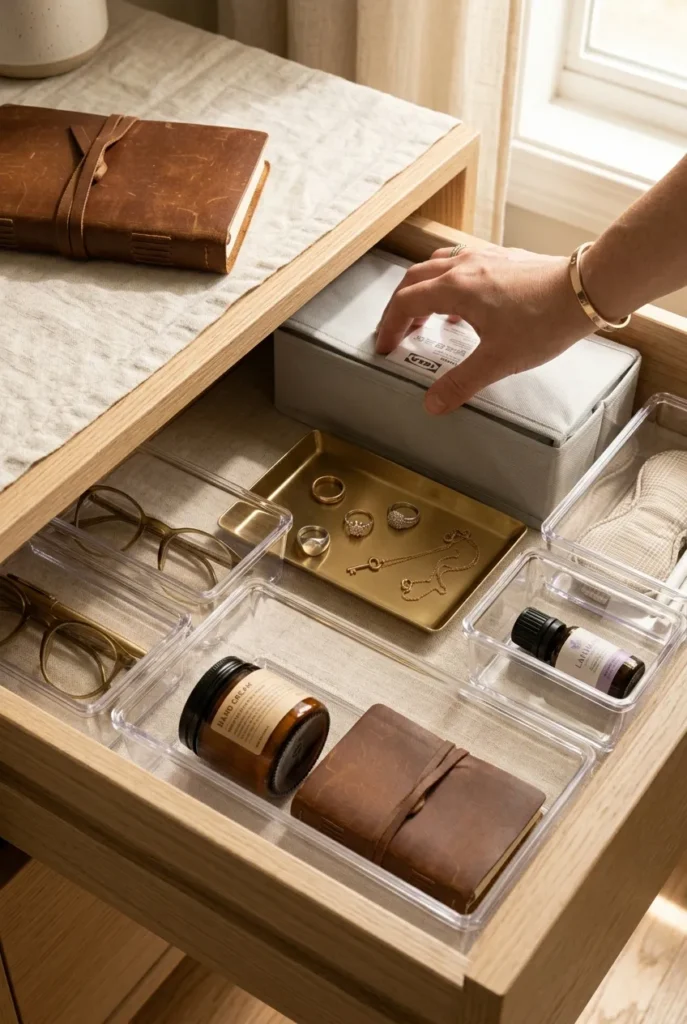
His, Hers, and Shared Nightstand Drawers
Nobody else writing about this divides it out, even though “nightstand organizer for him” and “for her” both rank in Google’s related searches. So here it is.
For a his-side drawer, the typical Layer 1 needs to hold a wallet drop, an analog watch, AirPods, lip balm, and a small notebook. The Reset Zone holds a backup wallet card, a tie clip box if relevant, and a single pocket tool. The Reserve Zone holds spare cufflinks and batteries.
For a her-side drawer, Layer 1 usually holds hand cream, a hair tie corral (the brass tray earns its keep here), a small jewelry catch dish for rings overnight, lip balm, and an eye mask. The Reset Zone holds backup jewelry, a journal, a small skincare extra, and a hair clip set. The Reserve Zone holds menstrual supplies, spare contact lens cases, and a backup charger.
For a shared single-drawer setup, split the drawer left and right instead of front to back. Each person gets a Reach + Reset stack of bins on their half, and the back row becomes a shared Reserve Zone. We learned this the hard way after two months of one of us digging through the other person’s earplugs at 1 a.m.
For a deeper organizing reset on the entire nightstand and the room around it, our walkthrough on the drawer dividers DIY vs store bought comparison covers exactly which divider style holds up best for split drawers.
Small Nightstand Drawer? Use the Mini Method
If your nightstand drawer is under 12 inches wide or under 12 inches deep, the 3-Layer Method shrinks to a 2-Layer Mini. Drop the Reserve Zone entirely. Move all monthly and emergency items to a labeled shoebox-sized bin in the closet or under the bed. Inside the drawer, Layer 1 takes the front 60 percent and Layer 2 takes the back 40 percent. Use two acrylic bins, not five.
This is the version we run in a guest room with a slim 10-inch IKEA Nordli, and it works.
The 60-Second Evening Reset (The Reason the System Holds)
The drawer fails when nothing puts it back. The fix is the 60-second evening reset. Before you turn off the light, every item you used today goes back into its bin in its layer. Earrings into the brass tray. Cable looped into the OXO slot. Journal closed and slid back into Layer 2. Phone on the charger. Light off.
You do not need an app. You do not need a reminder. You need a cue that already exists in your routine (turning off the lamp), and a 60-second action that lives on top of it. This is sleep hygiene and home organization stacked, and it is why this method outlasts the Sunday-reset systems that fall apart by Wednesday. If you want a full evening-routine framework that fits around this drawer reset, the cleaning supplies storage walkthrough shows how to pair drawer resets with the rest of the home in a 10-minute close-out.
The Aesthetic Layer (Pinterest, Without Sacrificing Function)
You can have a drawer that photographs beautifully AND functions every night. The trick is the visual rule of one: one sprig of eucalyptus in the corner of Layer 1, one warm-toned brass tray instead of plastic, one cohesive material across all bins (all clear, or all fabric, not mixed). Skip candles inside the drawer (fire risk and they leach scent into everything). Skip silk or velvet liners if you have hand cream in the same zone.
For the styled overhead shot Pinterest rewards, leave one inch of negative space around the bins. That tiny gap reads as intentional, not empty.
Common Bedside Drawer Mistakes to Avoid
Treating the drawer as overflow storage for the rest of the bedroom. The nightstand is for the things you use in bed, not for the things you cannot find a home for elsewhere.
Buying bins before measuring. We mentioned it earlier and it is worth repeating. The number-one return reason for nightstand organizers on Amazon is “did not fit.”
Skipping labels in Layer 3. You will forget what is back there. You will buy a duplicate. You will be annoyed at yourself.
Storing medications loose in the drawer. The FDA recommends keeping medications in their original containers in a cool, dry place away from light, which a closed bedside drawer technically qualifies for, but unlabeled loose pills are a hard no. For full guidance on safe medication storage, the FDA’s how to store and dispose of medicines page is the most current authority.
How to Maintain the System for 90 Days and Beyond
Once a week, take 90 seconds during your Sunday reset to pull the drawer fully open, scan the layers, and return any drift item to its home. Once a month, do a 5-minute Layer 3 audit. Once a quarter, swap the seasonal items (allergy meds in spring, sleep aid blends in winter, extra throw blanket fold in fall).
This is the same maintenance cadence that keeps a closet running, just shrunk to the scale of one drawer. For the parallel system applied to the rest of the bedroom, our companion piece on purse storage ideas that keep every bag visible uses the same layer logic on closet shelves.
When to Reset the Whole Nightstand (Not Just the Drawer)
If you have done a full Reach-Reset-Reserve pass and the drawer still feels chaotic within two weeks, the nightstand itself is probably wrong for the space. A drawer under 2 inches tall cannot hold standard acrylic bins. A drawer over 5 inches tall encourages stacking, which kills the layer method. For a deeper read on how sleep environment shapes nightly habits, the National Sleep Foundation’s bedroom environment guidance is a reliable starting point.

The 30-Minute Setup, Step by Step
Pull the drawer fully out and empty it onto the bed. Sort every item into four piles: keep in drawer, move elsewhere in the bedroom, donate, trash. Wipe the empty drawer with a damp cloth. Measure interior width, depth, and height. Place bins in the Reach, Reset, and Reserve positions empty first. Load each layer with only the items you committed to. Label Layer 3. Close the drawer. That is the project.
Total time on the second pass is closer to 20 minutes. The first pass usually runs 30 to 35 minutes because of the sorting decisions.
Frequently Asked Questions
How do you organize a small nightstand drawer?
Use the 2-Layer Mini Method described above. Drop the Reserve Zone, give Layer 1 the front 60 percent and Layer 2 the back 40 percent, and stick to two clear acrylic bins. Move all monthly and emergency items to a labeled bin in the closet or under the bed.
What should I keep in my bedside drawer?
Only items you use four or more times per week in bed: hand cream, lip balm, an eye mask, a charging cable, a book or Kindle, a small notebook, a pen, and a jewelry catch tray. Everything else belongs in Layer 2 or 3, or out of the drawer entirely.
How do I declutter my nightstand drawer?
Pull the drawer fully out, empty it on the bed, sort into four piles (keep, move, donate, trash), wipe the drawer, then refill using the 3-Layer Method. Most readers tell us they discard 40 to 60 percent of what was in there.
What is the best nightstand drawer organizer?
For most standard drawers, the mDesign 4-piece clear acrylic set (around $18) is the workhorse. For drawers under 12 inches, the IKEA Skubb 3-piece fabric set ($7.99) wins because it flexes to fit irregular spaces.
How do you organize a nightstand drawer for a man?
Use the same 3-Layer Method with a his-side load: a wallet drop, an analog watch tray, AirPods, lip balm, and a small notebook in Layer 1. Backup wallet card, pocket tool, and a tie clip box in Layer 2. Spare cufflinks and batteries in Layer 3.
Are nightstand drawer dividers worth it?
Yes, but only if you measure first. A $9 set that fits is worth more than a $40 set that does not. Drawer dividers are the single highest-impact dollar in bedside drawer organization because they create the layers the method depends on.
How do I keep my bedside drawer organized long term?
The 60-second evening reset. Every item you used today goes back to its bin in its layer before the lamp goes off. Pair the reset with the cue you already do nightly (turning off the light) and the system holds for months, not days.
A Soft Close, Not a Sales Pitch
Here is the small truth behind all of this. An organized nightstand drawer is not really about the drawer. It is about the 30 seconds before you fall asleep and the 30 seconds after you wake up, which together are the bookends of your entire day. When those 60 seconds are calm and the things you need are exactly where your hand expects them, the rest of the morning runs differently. Try the 3-Layer Method this weekend. If it feels too tight for your life, loosen it. If it feels right, send us a before-and-after, we love seeing them. Which layer do you think will be the hardest one for you to hold for a full week?

This article is general home-organization guidance for a US-based reader. For any medication storage or sleep-related health questions, please consult a qualified US healthcare professional.


