
Free Printable Chore Chart by Age: Toddler to Teen (and One for the Whole Family)
Every parent has tried a chore chart. Most quit by Thursday.
That’s not a willpower problem. It’s a chart problem. A generic chore chart printable with blank boxes and a clip-art star at the top doesn’t tell a six-year-old what “clean your room” actually means. It doesn’t explain to a four-year-old what a “chore” is at all. And a family chore chart that assigns tasks only to children while the adults stay off the list? That’s not a system. It’s a negotiation that restarts every single evening.
This post gives you something built for how real families actually work. You’ll get a free, age-specific chore chart printable for every stage from age 2 through 18, plus a whole-family version that puts the adults squarely on the list too. There’s a complete age-by-age breakdown, a reward system that won’t turn your kitchen into a labor market, display ideas that make the chart something kids actually notice, and a free PDF that’s US Letter size, six pages total, and prints in two minutes flat.
Why a Chore Chart Printable Works (and Why Most Families Quit After Week Two)
The chart is not the system. It’s the anchor for the system.
Kids are visual learners. Seeing a task written down, checked off, or stickered activates a feedback loop that verbal reminders miss entirely. According to the American Academy of Pediatrics, children who take on household responsibilities as early as age three build stronger executive function and a higher sense of self-efficacy compared to those who don’t. Age-appropriate chores and child development at HealthyChildren.org
So why do most chore charts fail? Three reasons, every time.
First: the chart is too vague. “Clean up” is not a chore. “Put your three stuffed animals in the blue bin on the left shelf” is a chore. Specificity is what turns words on paper into actual action.
Second: the chart doesn’t grow with the child. A task list built for a kindergartner bores a nine-year-old and overwhelms a toddler. Age-specific tasks are everything.
Third: there’s no feedback loop attached. A chart with no consequence for completion and no acknowledgment for skipping is just wall decor. Kids and most adults need a signal that finishing matters.
The right chore chart printable solves all three problems before you ever tape it up.
Introducing the Age-by-Age Chore Ladder
The framework behind this entire printable is called the Age-by-Age Chore Ladder, and once you see it, you will reorganize how you think about household responsibilities permanently.
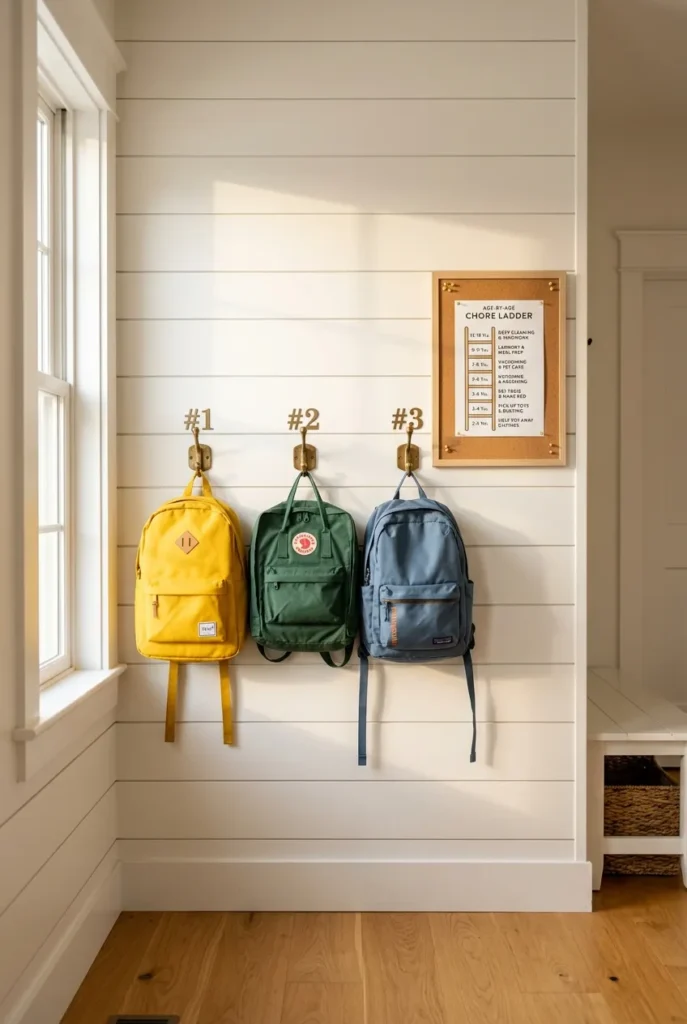
Picture a five-rung ladder, one rung per developmental stage. Each rung holds specific, physically and cognitively achievable tasks for that age group. As a child grows, they don’t restart the chart from scratch. They step up a rung. The tasks from the rung below stay in muscle memory. Two or three new, slightly harder tasks get added at the top. Over time, a twelve-year-old who has been on the Chore Ladder since age three has a decade of built habit behind them, not a fresh list of demands to resent.
The Ladder does three things at once. It builds real competence without overwhelming any single stage. It gives you a clear progression so you’re never guessing whether your child is ready for something new. And it makes the fairness conversation easy when a seven-year-old notices their four-year-old sibling has fewer tasks. “You’re on rung three. She’s on rung one.” Done
Chore Chart by Age: The Full Rung-by-Rung Breakdown
Here’s where most chore chart articles stop at the surface. Below is the complete Age-by-Age Chore Ladder with tasks built around what children can genuinely do at each stage, not just what sounds tidy on a Pinterest graphic.
| Age Range | Ladder Rung | Daily Chores | Weekly Chores |
|---|---|---|---|
| 2-3 (Toddler) | Rung 1 | Carry plate to sink, put toys in bin, wipe spills with a cloth | Help sort laundry by color |
| 4-5 (Pre-K) | Rung 2 | Feed a pet, clear dinner table, water a plant | Match and pair socks, dust low surfaces |
| 6-8 (Elementary) | Rung 3 | Make bed daily, load/unload dishwasher, sweep kitchen | Fold simple laundry, wipe bathroom sink |
| 9-11 (Tween) | Rung 4 | Pack own lunch, take out trash, wipe counters | Vacuum a room, scrub bathroom, change bed sheets |
| 12-18 (Teen) | Rung 5 | Do own laundry, clean full bedroom | Cook one meal per week, deep-clean a shared space |
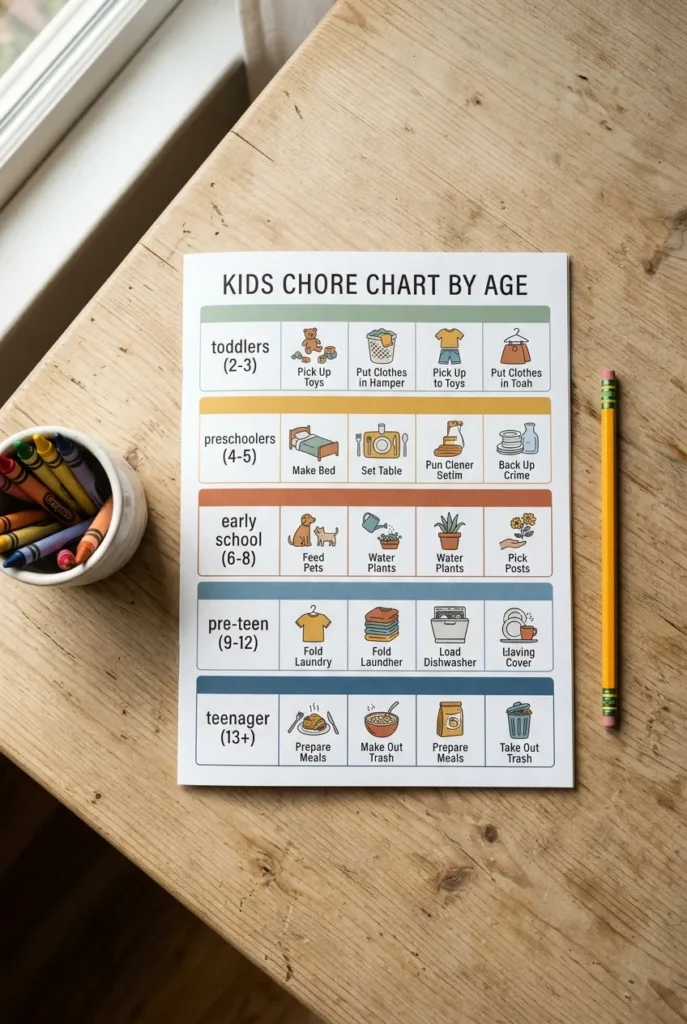
Toddlers (Ages 2-3): Rung One
Toddlers want to help. That drive peaks around age two and a half, and the biggest mistake at this stage is saying no because you assume they’ll make a mess. They will. That is fine. The goal at rung one is participation, not precision.
Keep the toddler chore chart to three tasks maximum. Each should take under two minutes. A bin they can reach, a spill they can wipe with a cloth you hand them, a plate they can carry with both hands. Visible, physical, and repeatable is the whole formula.
Pre-K and Kindergarten (Ages 4-5): Rung Two
By four, kids can follow a short sequence without hand-holding through every step. They can feed the dog if you pre-measure the scoop and place it by the bowl. They can clear their dinner spot and carry their cup to the sink. They can match a pile of socks, which (honestly) plenty of adults quietly avoid.
The chore chart for this age works best when pictures accompany the words. IKEA Trofast bins with photo labels pair naturally with a visual chart. A child who isn’t fully reading yet can match the picture of “books” to the bin that holds them, which makes the whole system self-explanatory.
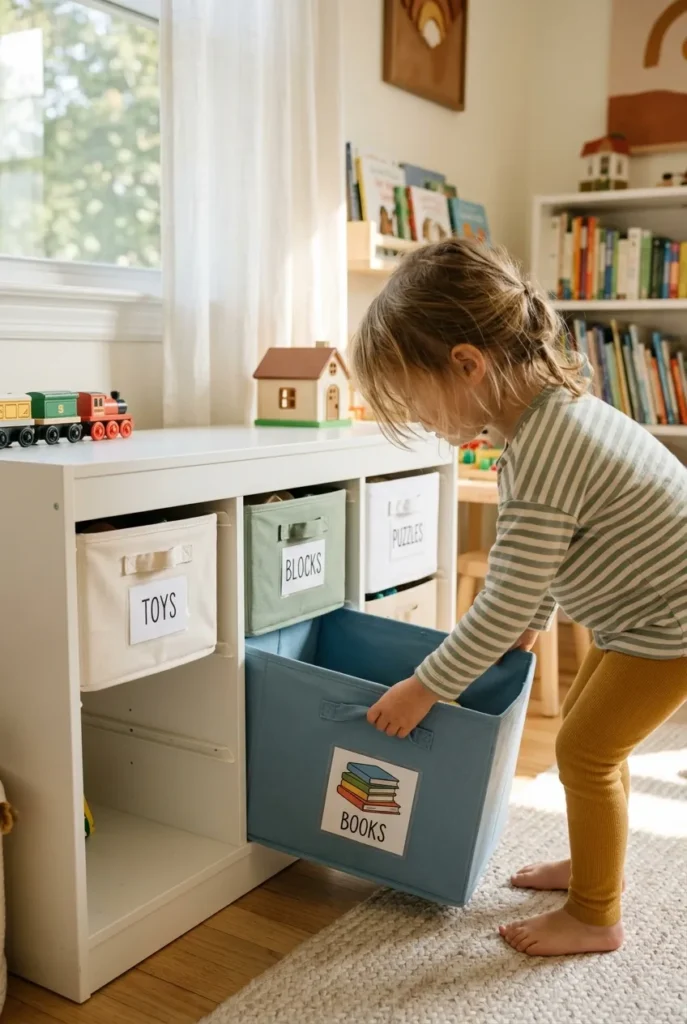
Early Elementary (Ages 6-8): Rung Three
Six is the rung where chores become genuinely useful contributions to the household. Loading the dishwasher cuts your after-dinner cleanup time in half. Sweeping the kitchen floor takes real physical effort. Making a bed every morning without a reminder is a habit that takes about three weeks to solidify, then runs on autopilot.
I tested a two-sided chore chart printable at home last spring with my six-year-old: daily tasks on the front, weekly tasks on the back. She kept the streak going for 19 days before needing a single reset conversation. That result came entirely from the chart being specific enough that she never had to guess what “help with the kitchen” meant.
This age responds well to streak tracking. Seven completed days earns something small: a movie pick, an extra story, staying up 20 minutes later on a Friday. Time-based rewards are harder to opt out of than cash, which matters a lot.
Tweens (Ages 9-11): Rung Four
Tweens can handle full room care. Vacuuming, scrubbing the bathroom sink, taking out the trash. The challenge at this rung is not capability. It’s buy-in.
This age pushes back on arbitrary rules but responds well to a fairness argument. Show them the family chore chart with everyone’s tasks visible side by side, including yours. Then say: “This is what I do every week. Here’s what’s left. Pick two.” That small amount of choice makes a measurable difference in follow-through. Every single time.
Teens (Ages 12-18): Rung Five
Teens should own a system, not just a task. Their laundry, their space, a cooking night once a week. The chore chart for this age looks less like a daily grid and more like a weekly responsibility tracker.
The Sunday Backpack Reset pairs naturally here. Every Sunday evening, teens go through their bag, prep clothes for Monday, and check off their weekly household responsibilities. When household contribution connects to personal organization and their own life running smoothly, teens see the point of it in a way they never do when it’s framed as helping you.
Pairing the teen chore chart with a visible home command center gives the whole family one shared wall for the week’s schedule, key tasks, and reminders, which makes the weekly check-in feel like a team sync rather than a parent lecture.

The Family Chore Chart: Why Adults Belong on the List Too
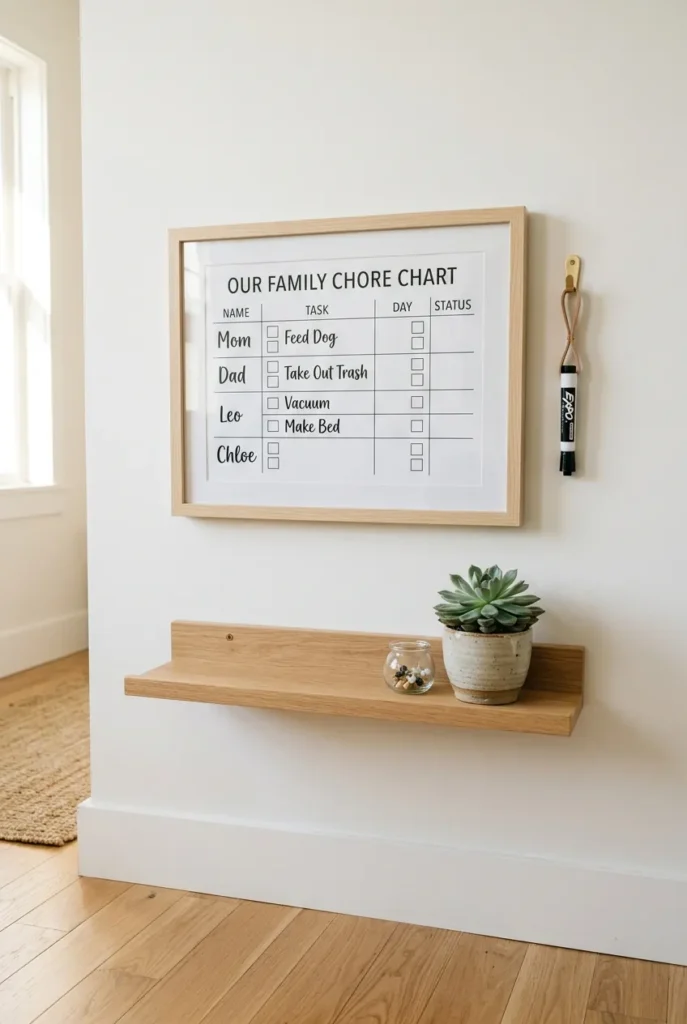
None of the top-five competitors cover this. Most “family” chore charts quietly treat the parents as the enforcers, not the participants. That framing wears out fast.
A whole-household chore chart does two things. It shows children that housework is not a punishment handed down to small people. It’s shared responsibility that every person in the home carries. For adults, whether partners or roommates, it distributes tasks fairly without the quiet resentment that builds when one person assumes the other doesn’t notice the full trash bag or the stovetop that has been cleaned by the same two hands for six weeks straight.
For any adult household, the fair distribution system works like this. Write out every recurring household task. Time each one honestly, because “the dishes take five minutes” is almost never accurate. Assign based on actual schedules and genuine preference where you can. Post the full list somewhere everyone passes daily and revisit it once a month.
A well-designed mudroom organization system with labeled zones for each family member is the natural physical partner to a chore chart: the morning launch and the daily responsibilities connect in the same ten-foot radius, which makes the routine feel cohesive instead of fragmented.
Research on household responsibilities from the University of Minnesota Extension notes that children raised in homes where adults visibly model shared domestic labor are more likely to carry those habits into their own adult lives. Family chores and child development at University of Minnesota Extension

Building a Reward System That Actually Holds Up
This is the section most chore chart printable articles skip entirely. A chart without a feedback loop is just a list of demands.
Here’s what works at each stage, and one thing to avoid across all of them.
What to avoid: paying per individual chore. This turns every task into a negotiation. “I don’t feel like taking out the trash tonight. I’ll just skip the $0.25.” You’ve quietly built a labor market in your kitchen, and the market closes the moment the price stops being worth the effort.
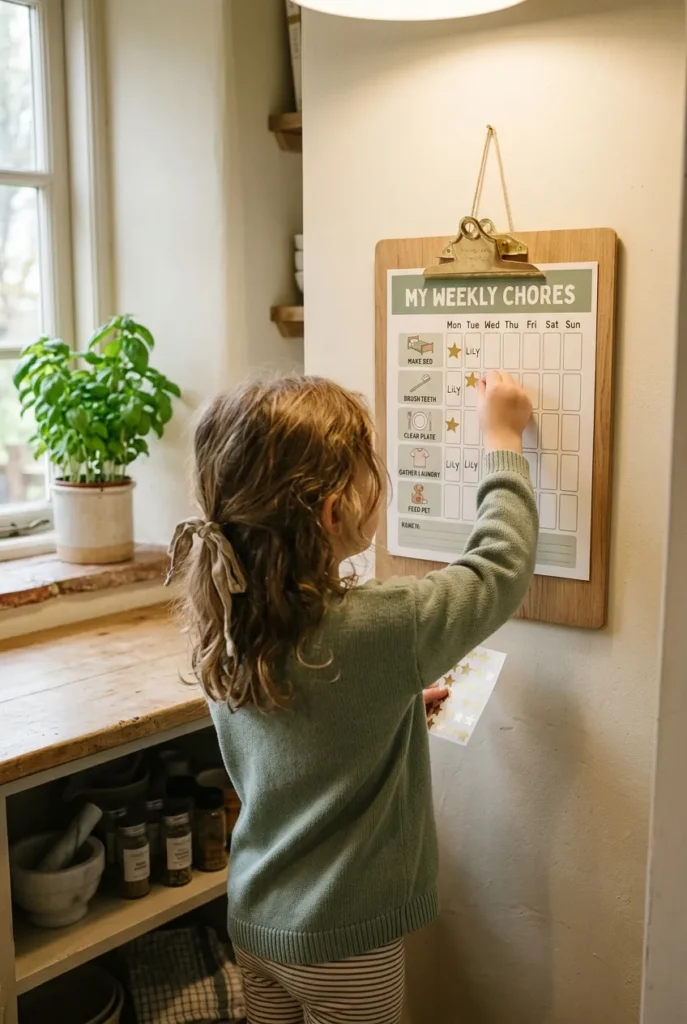
What works for ages 4-10: a visual streak or sticker system. Completing all daily tasks earns one sticker. Five stickers earn a small, non-monetary reward: extra story time, choosing the Saturday movie, a Friday-night stay-up pass. The reward is time and access, not cash, which makes opting out feel less appealing to the child.
What works for tweens and teens: an allowance tied to the week’s completion rate, not individual tasks. The household runs as a team. When the team completes the week’s chart, everyone gets paid. Partial completion means partial pay. This reflects how working in the actual world functions, and older kids respond to that framing.
What works for screen time at any age: place the chore chart before screens as a sequence, not a punishment. Daily tasks done, afternoon screens earned. You can print this directly into the chart by adding a “screens unlock when:” line at the bottom of the daily task column.
If toy clutter is making the daily tidy-up feel endless, a working toy rotation system cuts down the number of items kids have to put away each day, which makes the chores on the chart feel genuinely achievable rather than like a wall they’ll never climb.
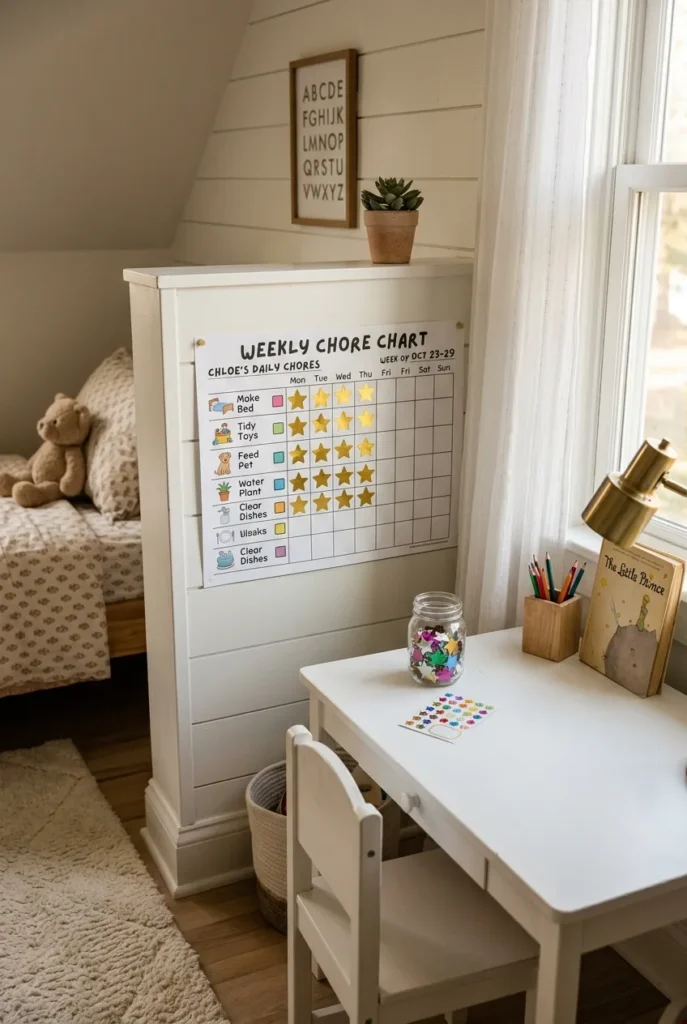
Chore Chart Aesthetic: Why the Visual Design Actually Matters
“Chore chart aesthetic” is a real Pinterest search term. That might sound like a vanity concern. It isn’t.
A chart that looks like it belongs on the wall stays on the wall. A black-and-white photocopy that has been wet and re-dried on the refrigerator door twice gets ignored. Kids respond to visual warmth. So do adults. If the chart feels like part of the home, it gets used. If it feels like a school worksheet, it disappears by week two.
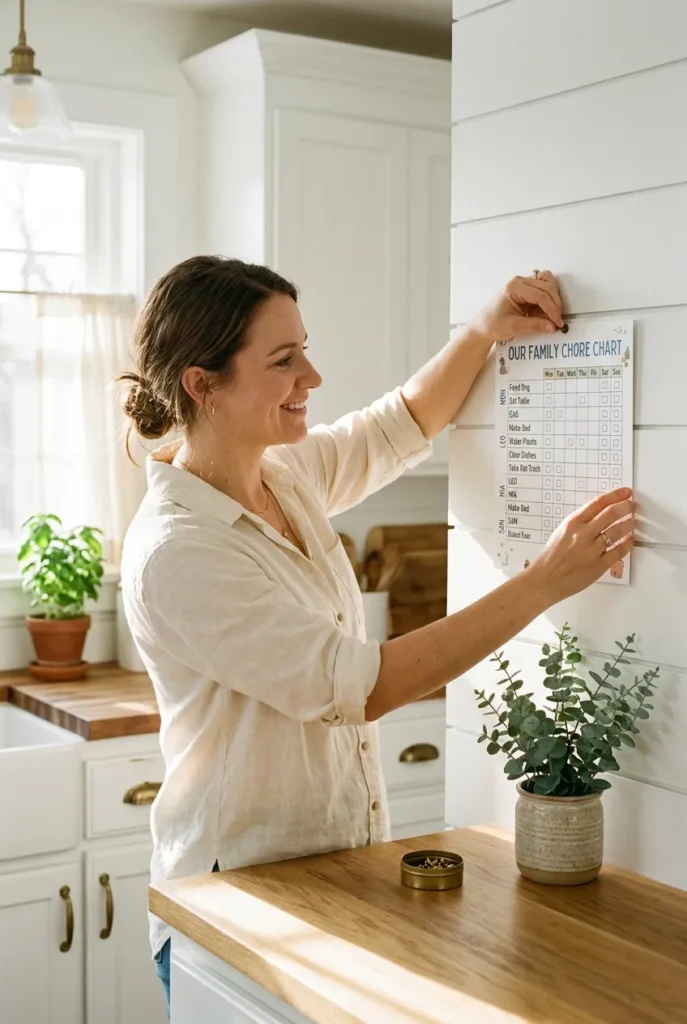
Three display options that work and cost almost nothing. First, clip the printed sheet to a US Letter-size clipboard and hang it on a 3M Command Hook inside a cabinet door at child height: easy to swap weekly, no drilling, works in any rental. Second, laminate it with a $25 Amazon laminator and reset it every Monday with a dry-erase marker, no reprinting ever. Third, slide it into an IKEA RIBBA frame (the 8.5×11 size runs about $6) and write directly on the glass with a dry-erase marker for a finished, framed look that costs less than a coffee.
The printable in this post comes in two color palettes: warm cream with natural tones and soft sage green. Both photograph well and coordinate with most modern American home interiors, which matters if you’re sharing the setup on Pinterest.
How to Download and Print This Free Chore Chart Printable
The free PDF is formatted for US Letter size, 8.5 x 11 inches. It includes six pages: one chart per age group (toddler, pre-K, elementary, tween, and teen) plus one combined whole-family version that includes adults. No Etsy account needed. No Canva login. Click the download button below, save the file, and print from any home printer.
Print tip: use 65 lb. cardstock instead of standard copy paper if you plan to laminate. It runs through most home printers without any special settings and holds up to months of weekly dry-erase use. Standard copy paper is fine if you’re printing a fresh sheet each Monday. Laminate after printing to get a reusable version that wipes clean in under ten seconds with a paper towel.
Frequently Asked Questions About Chore Chart Printables
What is the best chore chart printable for kids?
The best chore chart printable for kids is one that’s built around their specific age. A chart designed for a ten-year-old means nothing to a five-year-old who isn’t reading fluently yet. Look for a printable that uses illustrated icons for younger ages and written weekly breakdowns for older kids, with separate pages per stage.
Is there a free editable printable chore chart for adults?
Yes. The free PDF in this post includes a whole-family version that puts adults on the list alongside children. It covers daily and weekly tasks, fits US Letter paper at 8.5 x 11 inches, and can be laminated for weekly reuse with a dry-erase marker. No account required to download.
What chores should a 5-year-old have on a chore chart?
At age five, realistic daily chores include clearing their dinner plate, feeding a pet with a pre-measured scoop, watering a small plant, and wiping low surfaces with a damp cloth. Keep the list to three or four tasks maximum. Use picture icons beside each word so the chart works even before they’re reading independently.
How do I get kids to actually use the chore chart instead of ignoring it?
Three things make the difference: specificity in each task (no vague instructions), a visible streak system with a small reward waiting at the end of the week, and displaying the chart at the child’s eye level where they pass it every day, not tucked behind the cereal boxes.
Can I reuse the printable without reprinting it every week?
Yes. Laminate it after printing and use a dry-erase marker to reset the checkboxes each Monday. Alternatively, slide the printed page into an IKEA RIBBA glass-front frame and write directly on the glass. Both methods give you months of use from a single printed sheet.
What size is the printable, and does it print in black and white?
The printable is US Letter size, 8.5 x 11 inches, and the file is a PDF. It prints clearly in black and white on any standard home printer, which works especially well if you plan to use it as a sticker or dry-erase chart. The black-and-white version is also ink-friendly for everyday reprinting.
How often should I update the chore chart as my child grows?
Reassess at the start of each new school year. That tends to align with a natural developmental shift. With the Age-by-Age Chore Ladder, you don’t start fresh. You step up one rung and add two or three new tasks at the top while the habits from the rung below stay intact.
You’re One Chart Away From a Week That Runs Itself
A chore chart printable is only as good as the thinking behind it. The chart doesn’t build responsibility by sitting on the wall. It does that by being specific enough to act on, calibrated to what a child can genuinely do right now, and backed by a reward loop that makes finishing feel like it was worth the effort.
The Age-by-Age Chore Ladder gives you a framework that grows with your family instead of one you have to rebuild from scratch every year. The whole-family version puts every person in the household on the list, which is the single biggest mindset shift most families need to make the system feel fair rather than punitive.

Download the free PDF below, print the pages that match your household’s current stages, laminate the ones you’ll reuse every week, and get it on the wall somewhere everyone walks past before breakfast. What’s the one stage in your home that’s overdue for a reset? Drop it in the comments and I’ll tell you exactly which rung to start on.