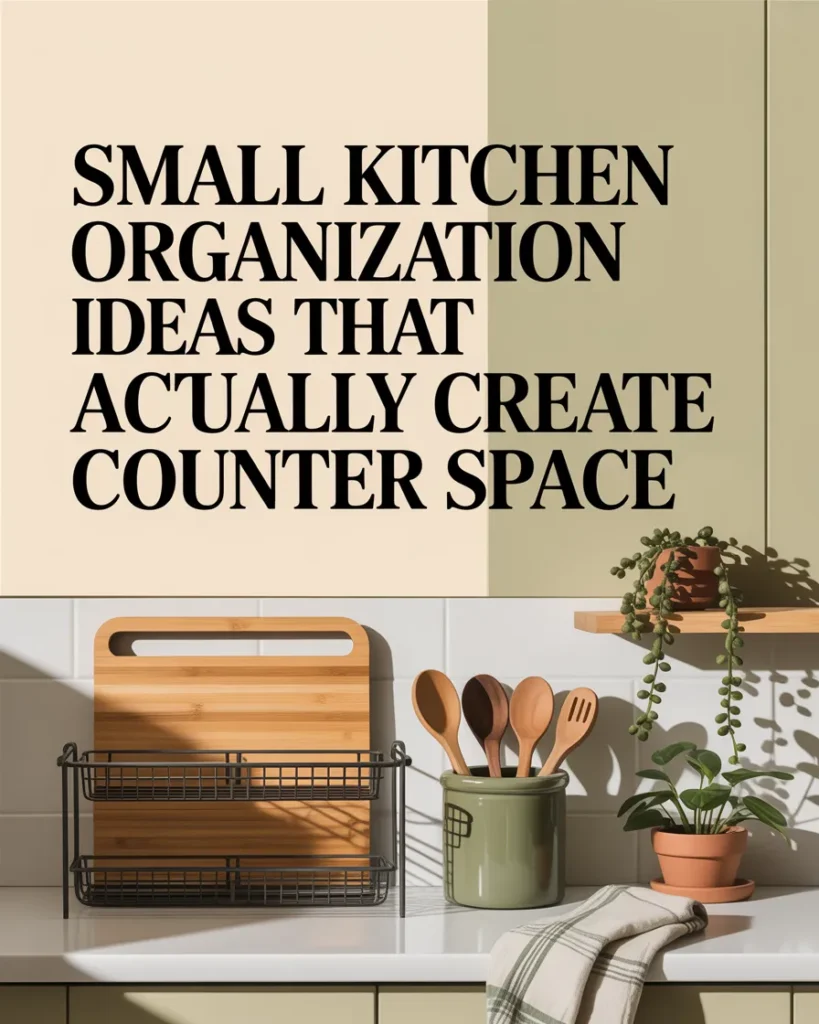

Small Kitchen Organization Ideas That Create More Counter Space
The toaster is shoved against the coffee maker. The cutting board is propped sideways behind the dish rack. There’s a bag of onions you keep meaning to put away on the only six inches of counter you still have. We’ve all stood in a tiny kitchen at 7 p.m., elbows tucked in, trying to chop garlic on a postage stamp of granite.
Good news. You do not need a renovation, a contractor, or a bigger lease. You need a system. These small kitchen organization ideas are the ones that actually claw back counter inches, work in rental apartments with zero drilling, and start at $3 if you want them to.
Who This Guide Is For
This one’s for you if any of these sound familiar:
- You rent and can’t drill holes
- Your kitchen is under 100 square feet and counters feel like a fight
- You’re working with a galley or one-wall layout
- You’re tired of “organization tips” that assume you have a walk-in pantry
- You’re on a budget (we cover $3 fixes and $300 splurges so you can pick your tier)
How this article is organized: By kitchen zone, starting with the most visible (counters) and working inward (cabinets, drawers, walls, awkward dead zones, then renter-only add-ons). Each idea answers three questions: what it is, why it works, how to do it. Price tier is called out beside every product.
Counter Space First: Where to Steal Inches Back
Counters are the highest-stakes real estate in any small kitchen. Clear them and the whole room feels bigger. Here’s how.
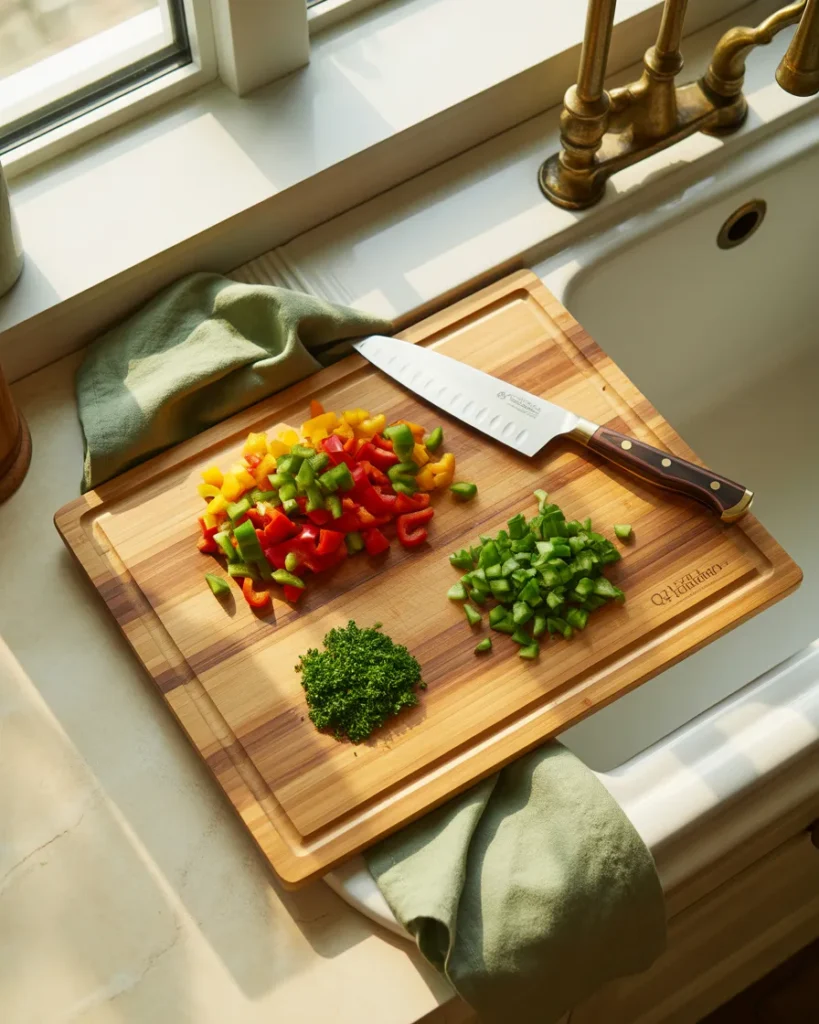
1. The Over-the-Sink Cutting Board (Best First Buy Under $40)
What it is: A bamboo or silicone cutting board that bridges your sink with side grips that lock it in place.
Why it works: A standard kitchen sink is 22 to 33 inches wide. Cover it and you’ve added roughly 4 to 6 square feet of prep surface, which doubles a 24-inch run of usable counter.
How to do it: Measure your sink lip to lip before buying. The Joseph Joseph Chop2Pot ($35 at Target) and the Bambüsi bamboo board ($28 on Amazon) are the two I’ve personally tested. Drain veggies right into the sink. Slide it off when you need the sink back.
- Budget pick ($15-$25): Bambüsi bamboo board, Amazon
- Mid-range ($30-$50): Joseph Joseph or OXO, Target
- Splurge ($80+): Solid teak custom-fit board, Etsy
2. The Wall-Mounted Magnetic Knife Strip
What it is: A 12 to 18 inch magnetic bar mounted above your backsplash that holds knives off the counter.
Why it works: A knife block eats about 50 square inches of prime real estate. A magnetic strip eats zero. You also see every blade at a glance, so you stop digging.
How to do it: Mount it 16 to 20 inches above the counter so blades clear your hands. Renters, you can do this with heavy-duty 3M Command Strips rated for up to 7.5 pounds, per the official spec sheet, which is plenty for a strip plus three or four kitchen knives.
3. The Wall-Mounted Paper Towel Holder
What it is: A paper towel bar that mounts under a cabinet or on the wall instead of standing on the counter.
Why it works: A standing paper towel holder claims 6×6 inches of counter, every day, forever. Wall-mounting reclaims that and looks tidier.
How to do it: Get a Simplehuman under-cabinet model ($35) with a built-in tear edge. For renters, the Yamazaki adhesive version sticks to tile or smooth cabinet sides with no holes.
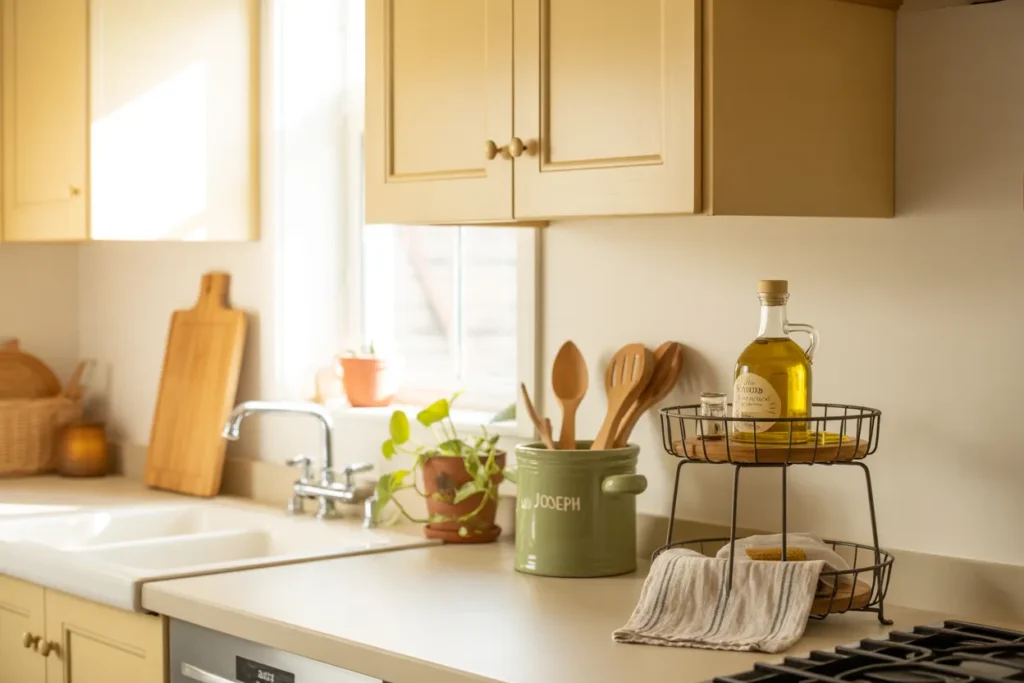
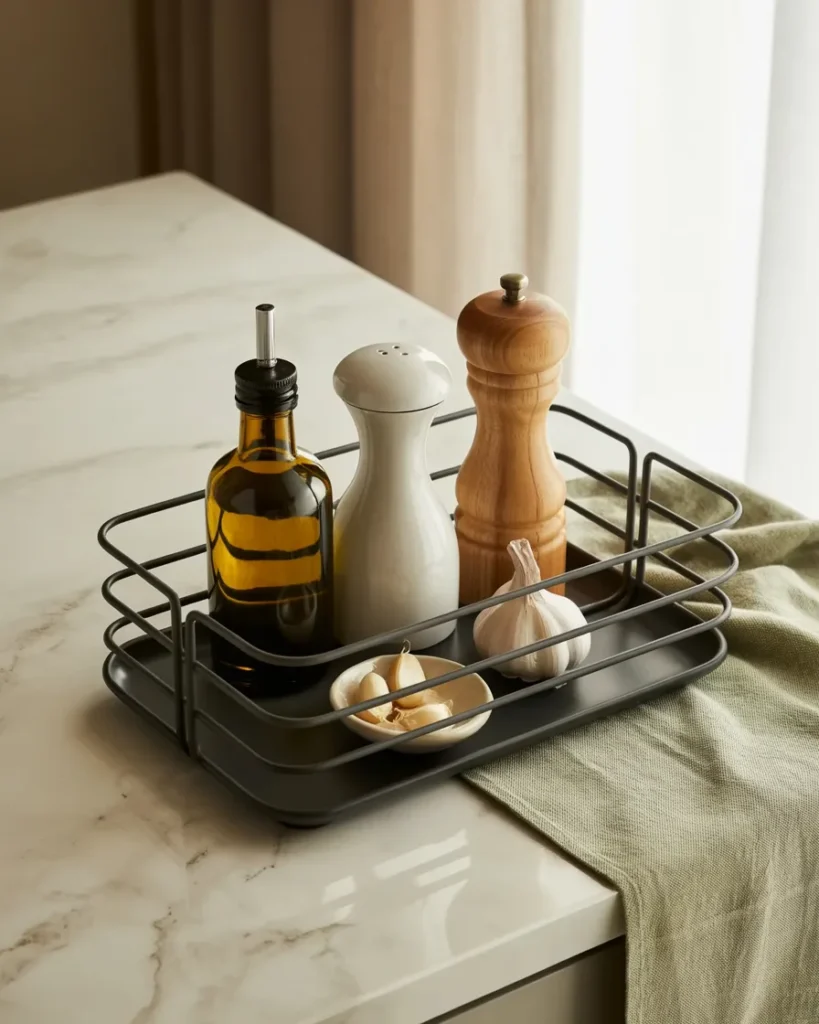
4. The Two-Tier Counter Caddy
What it is: A small two-tier rack that holds your everyday items (salt, pepper, olive oil, vitamins) stacked instead of sprawled.
Why it works: Two stacked tiers occupy the footprint of one item but hold five or six. You’re using inches of air, not counter.
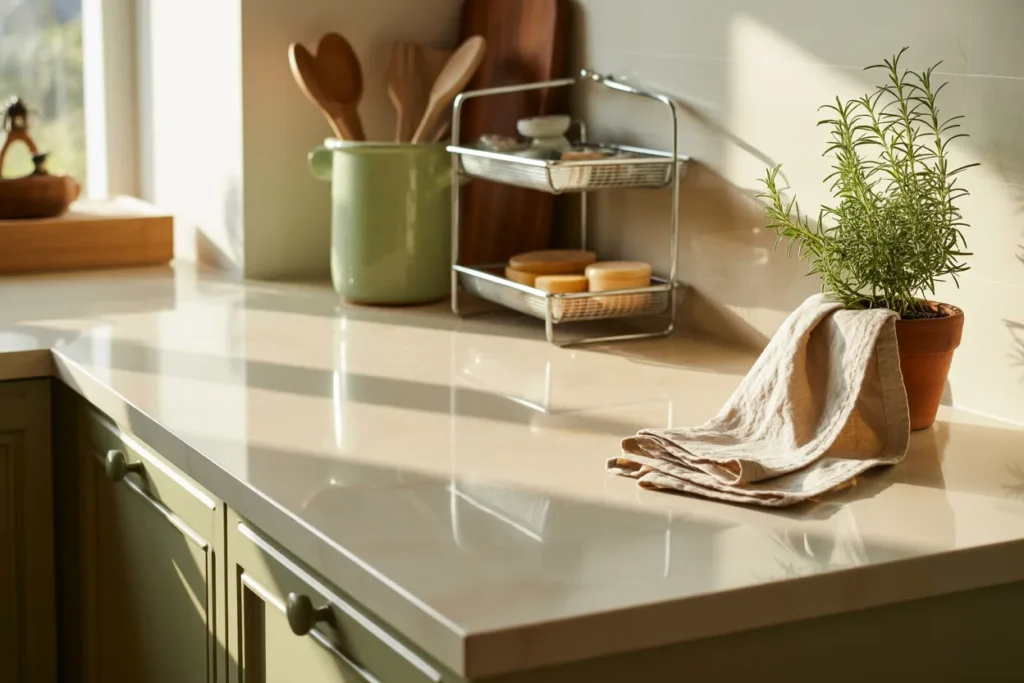
How to do it: A wire two-tier riser from HomeGoods runs $15. A marble version from West Elm runs $89. Both do the same job. Group all daily items here so the rest of the counter stays bare.
Cabinet Reorganization: Where Most People Lose 40% of Their Space
Open any cabinet in a small kitchen and you’ll usually see one item per shelf height, with eight inches of dead air stacked above it. That air is storage you’re not using. Time to fix it.
5. Shelf Risers (The $9 Cabinet Doubler)
What it is: A small wire or bamboo platform that sits inside a cabinet to add a second tier.
Why it works: A single 9-inch shelf can hold one row of plates. Add a 4-inch riser and you now have two rows in the same vertical space. You’ve doubled storage with no construction.
How to do it: Measure your shelf depth and pick a riser that’s 1 inch shorter so air can move. The Dollar Tree wire risers are $1.25 each. The bamboo Seville version on Amazon is $24 for a set of two. Use them under plates, mugs, and canned goods. For more cheap wins like this, here’s a roundup of Dollar Tree organization hacks that look way more expensive than they cost.
6. The Lazy Susan in Your Corner Cabinet
What it is: A rotating tray that turns a deep, dark cabinet into something you can actually see into.
Why it works: Anything pushed to the back of a 20-inch deep cabinet is, functionally, lost. A Lazy Susan brings the back row to you with a flick.
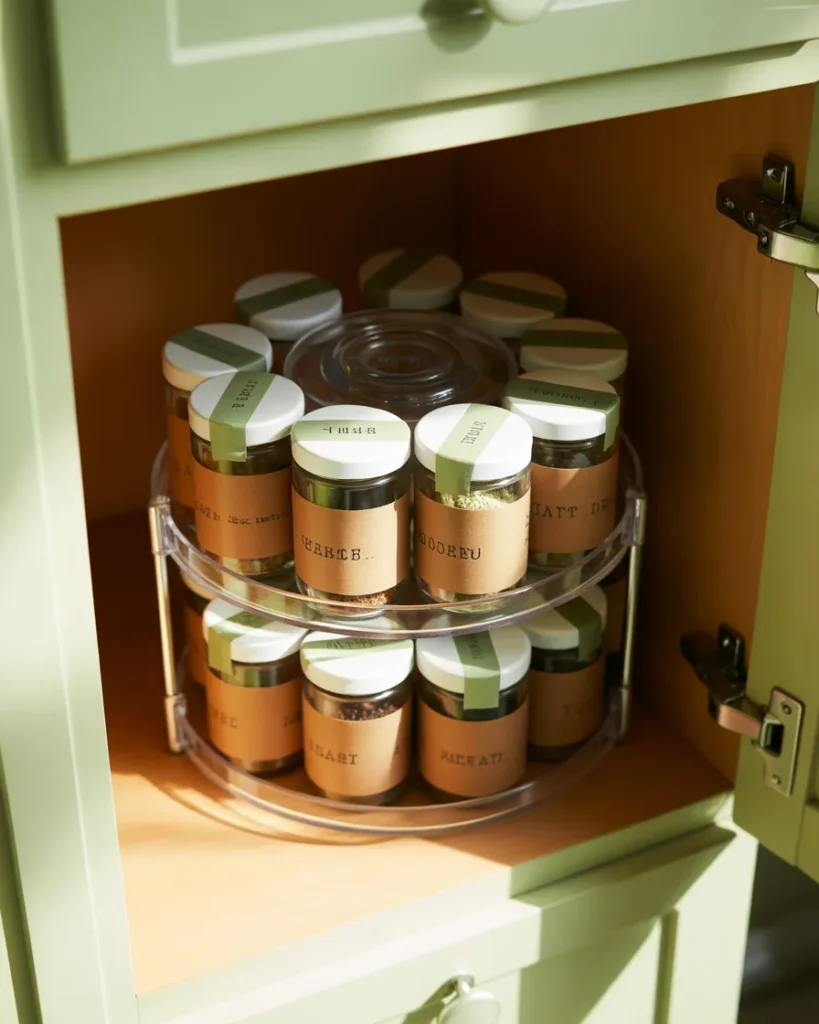
How to do it: Pick a turntable 1 inch smaller than your cabinet’s interior width. Use one for oils and vinegars (sticky bottles love this). Use another for spice jars in a corner cabinet.
7. Door-Mounted Spice Rack
What it is: A slim 3-inch deep rack that screws or sticks to the inside of a cabinet door and holds spice jars.
Why it works: Spice jars are tiny but multiply fast. Storing them on a shelf wastes the full shelf height. On a door, they live in space that was previously empty air.
How to do it: Decant your spices into matching 4-ounce glass jars first (a $20 Amazon set of 24 jars makes this whole project look custom). Then mount a Spice Gripper clip strip, no drilling required for the version with 3M backing.
8. The Tension Rod Hack Inside Cabinets
What it is: A small spring-loaded rod installed vertically inside a cabinet to divide it.
Why it works: Lay cookie sheets, cutting boards, and serving trays on their sides and a tension rod keeps them upright. Stacking flat means digging through the whole stack to grab one. Vertical means grab-and-go.
How to do it: A pack of two $6 tension rods at Walmart will divide a single cabinet into three vertical slots. Install on the cabinet floor and ceiling at the slot widths you want.
Drawer Strategy: From Chaos to Calm in Under an Hour
Drawers are easier wins than cabinets because you control every inch. Most small kitchens have 3 to 5 drawers and waste half the volume.
9. Bamboo Drawer Dividers (The Single Best Drawer Buy)
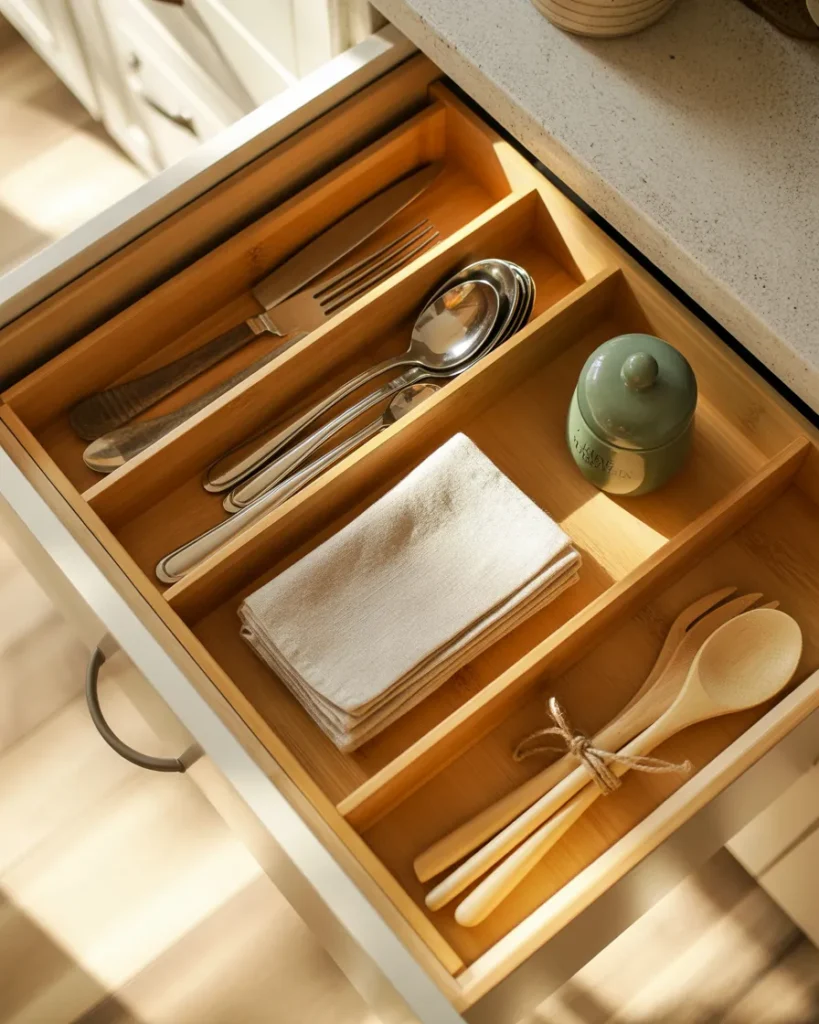
What it is: Expandable bamboo separators that lock into your drawer at the widths you choose.
Why it works: Without dividers, every drawer becomes a junk drawer within three weeks. Dividers force categories: utensils here, gadgets there, baking tools in the back.
How to do it: The SpaceAid expandable set ($25-$35 on Amazon) fits drawers from 17 to 22 inches wide. Group like with like, give every category its own slot, and label the front of the drawer with a small sticker if multiple people use the kitchen.
10. The Tiered Silverware Drawer Insert
What it is: A stepped silverware tray that lifts the back row of utensils above the front row.
Why it works: A flat silverware tray uses about half the drawer height. A tiered one uses 80% of it, which means one drawer holds the contents of nearly two.
How to do it: YouCopia DrawerFit and Joseph Joseph DrawerStore both work. Spend $30 once and you’ll feel it every meal.
11. The Junk Drawer Reset
What it is: A scheduled 10-minute purge of your one designated junk drawer.
Why it works: Every kitchen has one. Letting it sprawl across multiple drawers eats space you could use for actual tools. Contain the chaos to one drawer with a divided tray, and the rest stay functional.
How to do it: Empty everything onto a kitchen towel. Toss expired coupons, dead batteries, mystery keys. Use a 4-slot bamboo organizer ($12 at Target) to hold tape, scissors, pens, and rubber bands. Done.
Walls and Ceiling: The Storage You Forget You Own
If your floor space is locked in, your walls and ceiling are the only direction left.
12. Pegboard Wall (Julia Child Style)
What it is: A 2-foot by 4-foot pegboard mounted on a kitchen wall, painted to match the room, hung with pots, pans, and utensils.
Why it works: It moves bulky items out of cabinets and onto a wall, opening cabinet space for less photogenic items. It also looks intentional, not cluttered.
How to do it: Paint a pegboard a soft cream or sage green to fit a Modern Farmhouse or Japandi palette. Use S-hooks for pans, basket hooks for measuring spoons. Owners can screw directly into studs. Renters, mount it on a French cleat anchored to two studs and remove cleanly later.
13. Hanging Pot Rack from the Ceiling
What it is: A wood or iron pot rack suspended from ceiling joists with chains.
Why it works: Pots and pans are usually the bulkiest items in any kitchen. Getting them out of cabinets opens up roughly 6 to 9 cubic feet of cabinet volume. That’s room for everything else.
How to do it: Anchor into joists with toggle bolts rated for the rack weight plus 30 pounds of cookware. The Enclume oval rack ($199 at Crate & Barrel) is a forever piece. Skip this one if you rent.
14. The Under-Cabinet Stem-ware and Mug Rail
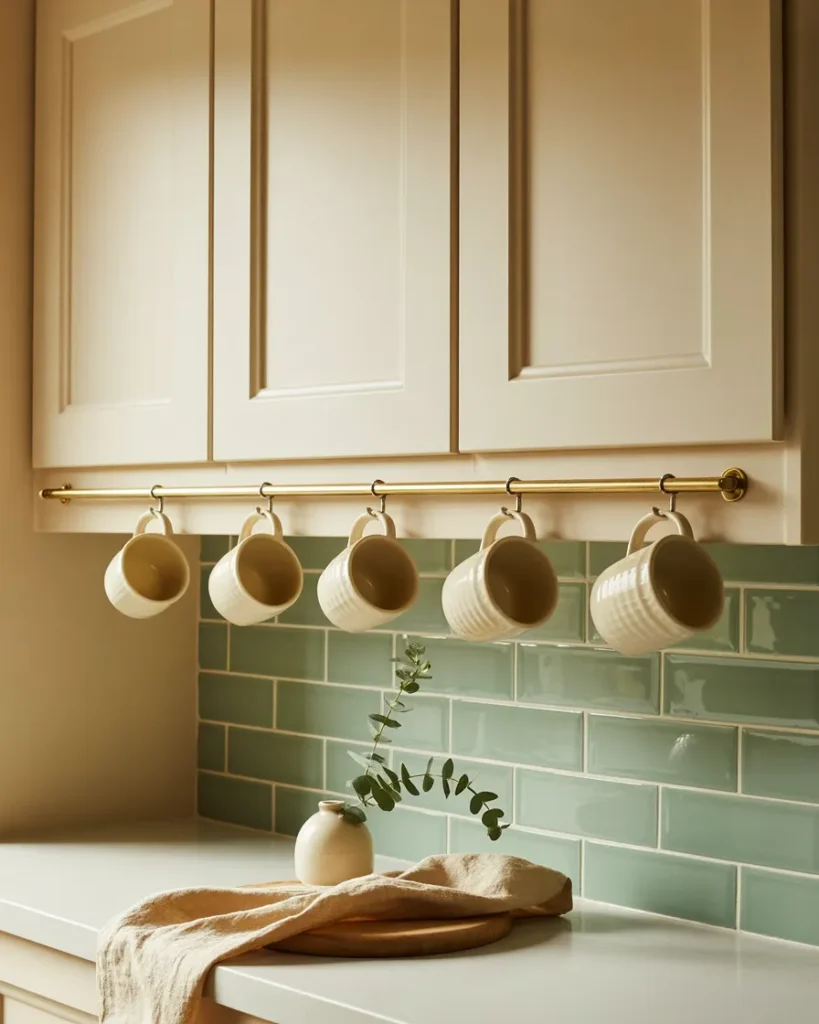
What it is: A slim rail or set of hooks screwed (or stuck) to the underside of an upper cabinet to hang mugs or wine glasses.
Why it works: Mugs stack badly. Hanging them frees an entire cabinet shelf. The bottom of your upper cabinets is dead space until you use it.
How to do it: Pre-drilled rails from Amazon run $18. For the no-drill renter version, use Command Hooks with the clear adhesive backing, rated to 1 pound per hook (per the 3M Command product spec). Five hooks, five mugs, one shelf back.
Awkward Dead Zones: The Storage Nobody Talks About
This is the section I promise you have not read on the other ranking articles. These are the inches everyone forgets.
15. Inside the Cabinet Doors
The flat inside surface of every cabinet door is a free vertical real estate panel. Use it for measuring spoons (Command hook), cutting boards (slim wire rack), pot lids (tension rod plus hooks), or a printed weekly meal plan (a $4 plastic sleeve from the Container Store).
16. The Toe-Kick Drawer Hack
The 4-inch recessed gap at the base of your lower cabinets (the toe-kick) usually holds nothing. A pre-built toe-kick drawer kit from Rev-A-Shelf ($120 at Home Depot) gives you flat storage for cookie sheets and rarely-used trays. Owners only, since this involves cabinet modification.
17. The Fridge-Side Slim Cart
A 5-inch slim rolling cart slides into the gap between your fridge and the wall, which is usually 4 to 7 inches in most apartments. The Yamazaki Tower slim cart ($75) and the IKEA RÅSHULT cart ($30) both fit. Use it for canned goods, baking supplies, or paper towels.
18. Top of the Fridge, Styled
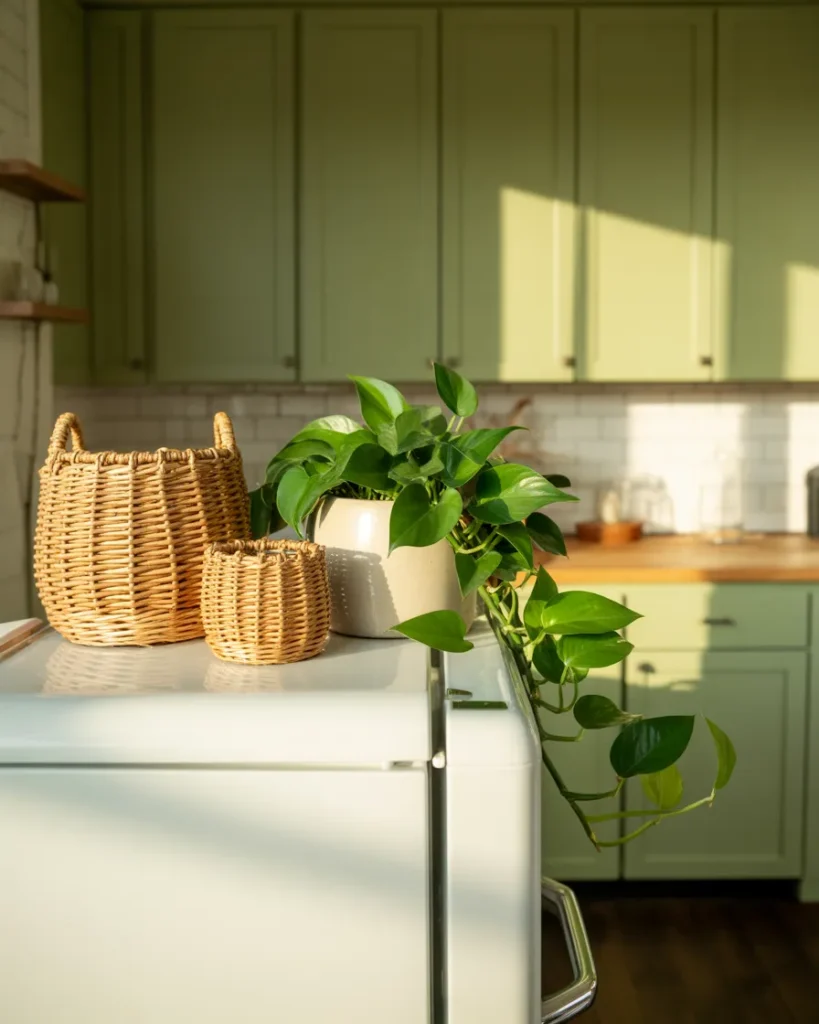
Most people pile cereal boxes on top of the fridge. Stop. Use two matching woven baskets ($15-$25 each at HomeGoods) labeled “Snacks” and “Backup Pantry.” Now the top of your fridge looks like a designed shelf instead of a junk pile, and you’ve gained 1.5 cubic feet of pantry overflow. This pairs beautifully with the same baseline approach we use in this walk-in pantry organization layout.
19. The Dead Corner Cabinet
Every kitchen has one terrible corner cabinet where the back-back is unreachable. A two-tier Lazy Susan ($35 at the Container Store) or, if you own, a Rev-A-Shelf pull-out half-moon ($180-$250) makes that whole black hole accessible.
Renter-Friendly Add-Ons: No Drilling Required
This is the section apartment dwellers actually save and screenshot. Every item below is removable with zero damage.
- Command Hooks (under 7.5 lb rated, $4-$15 per pack): Hang utensils, lightweight rails, dishtowels.
- Tension rods ($3-$8 each): Vertical dividers, under-sink shelf, mini curtain to hide open shelving.
- Adhesive shelf liners ($10): Protect cabinets and update the look.
- Over-the-cabinet door hooks (no adhesive, $6 a pair): Hang oven mitts, dish towels, even small cutting boards.
- Peel-and-stick wallpaper or contact paper ($25-$45 a roll): Reface a tired backsplash in an afternoon.
- Over-the-door storage: A pantry door or even the back of a cabinet is prime real estate. Full breakdown in this over the door organizers guide covering 25 uses across every room.
- The Container Store Elfa system: For the deeper-pocket renter, the Elfa over-the-door rack is free-hanging, no drilling, and reusable when you move.
Budget vs Splurge: The Honest Shopping Framework
I’ve stress-tested both ends of the price spectrum so you don’t have to. Here’s the cheat sheet you can screenshot.
| Solution | Budget (Under $25) | Mid-Range ($25-$100) | Splurge ($100+) |
|---|---|---|---|
| Drawer dividers | Dollar Tree bamboo, $5 | SpaceAid expandable bamboo, $32 | The Container Store Elfa custom, $120 |
| Counter caddy | HomeGoods wire 2-tier, $15 | OXO POP organizer, $45 | West Elm marble 2-tier, $89 |
| Spice jars set of 24 | Dollar Tree jars + chalk labels, $24 | Amazon 24 glass jar set, $30 | Crate & Barrel set, $80 |
| Knife strip | Generic 12-inch magnetic, $14 | OXO 18-inch, $35 | Wüsthof walnut magnetic bar, $130 |
| Over-the-sink board | Amazon Bambüsi, $25 | Joseph Joseph Chop2Pot, $35 | Custom teak, $150 |
| Lazy Susan | IKEA SNUDDA, $12 | OXO POP 2-tier, $45 | Custom wood corner unit, $180 |
| Rolling cart | IKEA RÅSHULT, $30 | Yamazaki Tower slim, $75 | Crate & Barrel Belmont cart, $300 |
The honest take: spend up on drawer dividers, the over-the-sink board, and the knife strip. Cheap on jars, risers, and Lazy Susans (the budget ones work identically).
Common Mistakes to Avoid
Nobody else is telling you this. I’ve made every one of these.
- Buying organizers before purging. You will end up with organized clutter. Pull everything out, decide what stays, then measure for bins. In that order.
- Mismatched containers. Matching cream or clear jars cost the same and look 10x calmer. Random mustard yellow, blue, and red lids will visually undo every other thing you’ve done.
- Storing things by category, not by use. Put what you use daily within arm’s reach of where you stand to cook. Everything else can live higher up or further back.
- Forgetting the “one in, one out” rule. A new mug means an old mug leaves. Otherwise the system collapses in three months.
- Cheap Command Strips on heavy items. Always check the weight rating on the official 3M spec sheet. A failed strip plus a falling magnetic knife bar is a real safety issue, not a Pinterest moment.
- Skipping the labels. It feels unnecessary until you have a partner or roommate who never puts things back in the right spot. Labels solve that.
The 15-Minute Weekly Counter Reset Routine
This is the part that keeps the whole system alive long after the initial weekend project.
Every Sunday evening:
- Minute 1-3: Clear every item off the counter onto the table.
- Minute 4-7: Wipe the counter, the backsplash, and the top of the stove.
- Minute 8-11: Return only daily-use items to the counter caddy. Everything else goes back to its cabinet home.
- Minute 12-14: Empty the dish rack fully.
- Minute 15: Light a candle, set the linen towel back. Done.
Fifteen minutes once a week is the difference between a kitchen you enjoy and one you avoid.
Frequently Asked Questions
How do I organize a small kitchen with no counter space?
Start with the over-the-sink cutting board (item 1) and the two-tier counter caddy (item 4). Together they buy back roughly 6 square feet of usable surface in under an hour. Then move every appliance you don’t use daily (stand mixer, blender, food processor) off the counter and into a cabinet or a slim cart. The counter is for items you touch every day, full stop.
How do I add storage to a small kitchen without cabinets?
Use the walls and the ceiling. A 2×4 foot pegboard, an under-cabinet mug rail, a magnetic knife strip, and a ceiling pot rack (or a wall-mounted shelf, if you rent) can replace an entire base cabinet of storage. The IKEA BEKVÄM spice rack at $5 also doubles as a tiny floating shelf for jars or oils.
How do I organize a small kitchen on a budget?
Stick to the Under $25 column of the table above. A full small-kitchen reset using Dollar Tree risers, $5 tension rods, $4 Command Hooks, $24 jar set, and a $15 wire counter caddy comes in around $80 total and handles 80% of the work. Skip the splurge items until your kitchen is functional.
How do I do small kitchen organization in a rental?
Every idea in the “Renter-Friendly Add-Ons” section above is no-drill and damage-free. Command Strips (within their official weight rating), tension rods, over-the-cabinet hooks, and adhesive paper towel holders cover almost every need. The Elfa over-the-door system from the Container Store is the one bigger investment that’s still 100% removable.
What’s the budget version of an over-the-sink cutting board?
A $25 Bambüsi bamboo board from Amazon does the same job as a $150 custom teak board. The only meaningful upgrade in the splurge version is the wood grain and edge treatment.
What if I don’t have a pantry?
Use the top of your fridge (item 18), a slim rolling cart in the fridge-side gap (item 17), and a small over-the-door system on a kitchen door or pantry-closet door. Together they replace about 4 cubic feet of pantry storage. If you have a closet anywhere near the kitchen, dedicate one shelf as “kitchen overflow” and treat it like a mini-pantry.
How long does small kitchen organization take?
A full reset of a 100 square foot kitchen takes one focused weekend. Roughly 4 hours on day one (purge, clean, measure, order organizers). Roughly 3 hours on day two (install, fill, label). After that, the 15-minute weekly reset keeps it going.
Pin This for Your Next Kitchen Reset
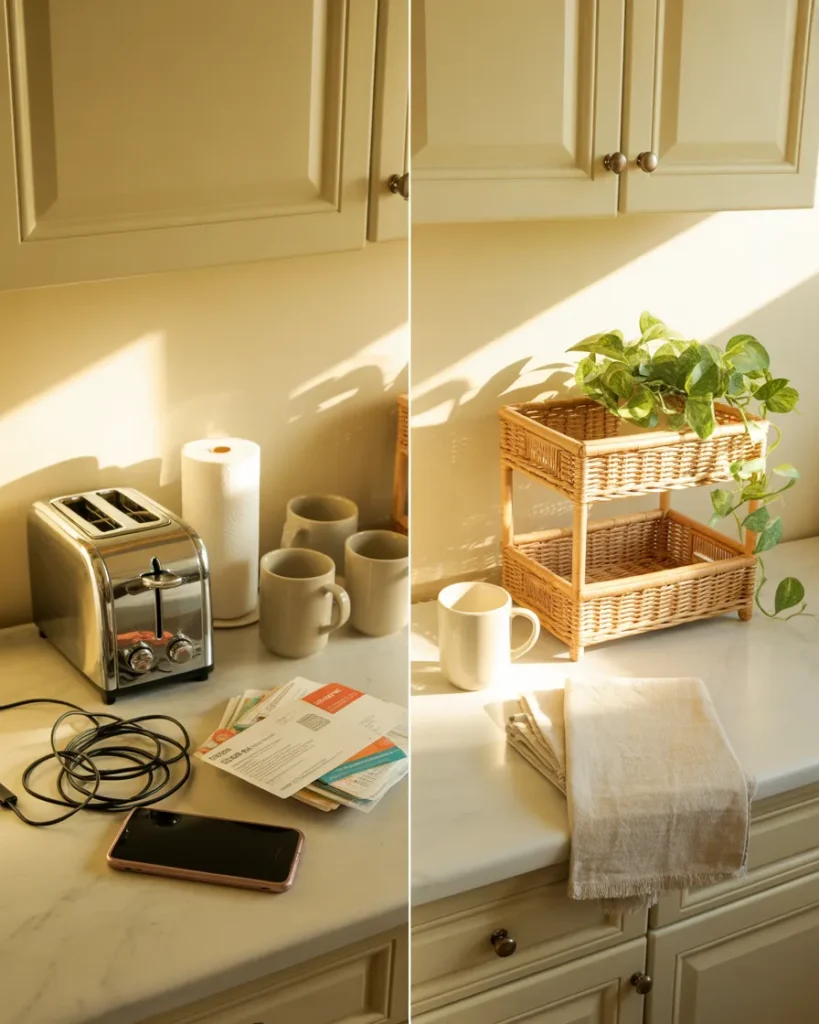
Here’s the thing nobody tells you. A small kitchen is not a problem to solve once. It’s a system you maintain in fifteen minutes a week. Pick three ideas from this list, start this weekend, and the muscle memory will do the rest.
Save this article to your “Kitchen Ideas” board so you have the budget chart handy next time you’re at Target. And if your pantry is the next mess on the list, our walk-in pantry organization layout walks through the exact same zone-by-zone approach for the next room over.
Which of these ideas are you trying first? The over-the-sink board is the one that changed my kitchen, but I want to know yours.