
How to Declutter When You’re Overwhelmed (Without Burning Out)
You want to declutter when you’re overwhelmed, but the pile stares back and your brain just… stalls. You are not lazy. Your nervous system is doing exactly what it does when a task feels too big: it freezes. Here’s the good news. You can start in the next ten minutes, and you can do it gently.
We’re going to skip the “clear your whole garage this weekend” advice. That’s the stuff that keeps you stuck. Instead, you’ll get tiny, doable moves, one screenshot-ready framework, and a plan for the days when you barely have energy to stand up. Let’s make your space feel lighter, one small win at a time.

Why Decluttering Feels Impossible When You’re Already Overwhelmed
Clutter is not just visual noise. It quietly taxes your attention and your mood. Researchers Darby Saxbe and Rena Repetti followed real families and found that people who described their homes as cluttered tended to have less healthy daily cortisol patterns, the hormone tied to stress.
So if a messy room leaves you tense and foggy, that reaction is real, not a character flaw. Your brain reads a hundred unfinished decisions and interprets the whole thing as a threat. That’s the freeze.
The fix is not more willpower. It’s shrinking the decision. When the next step is small enough, the freeze lifts.

Start With the 5-Minute Rescue (Your First Win)
Before any method, do this. Set a timer for five minutes and collect only trash. Wrappers, dead pens, junk mail, that crusty receipt from March. Nothing that requires a real decision, just obvious garbage into one bag.
Five minutes. That’s it. You’ll feel the shift almost immediately, because your eyes finally land on a clear patch. That clear patch is fuel.
Honestly, some days the five-minute trash sweep is the whole win, and that counts.

The Gentle Reset Method: A Framework You Can Actually Follow
Here’s the original framework I’d hand any overwhelmed friend. Call it The Gentle Reset. It has three moves, and you never do more than one at a time: Rescue, Reduce, Reset. Rescue clears the obvious (trash and things that already have a home). Reduce removes what you no longer use. Reset gives what’s left a real spot so it stops piling up.
The trick is that you can stop after any single move and still have made progress. No guilt, no half-finished chaos.
Move 1: Rescue (the 10-minute clear)
Pick one surface. Just one. A counter, the coffee table, a single shelf. For ten minutes you only do two things: toss trash, and carry away items that already have a home somewhere else. You are not organizing yet. You are rescuing the surface.
This pairs perfectly with the 10-10 decluttering method, which asks for ten items in ten minutes, if you want a repeatable daily version.

Move 2: Reduce (the four-box sort)
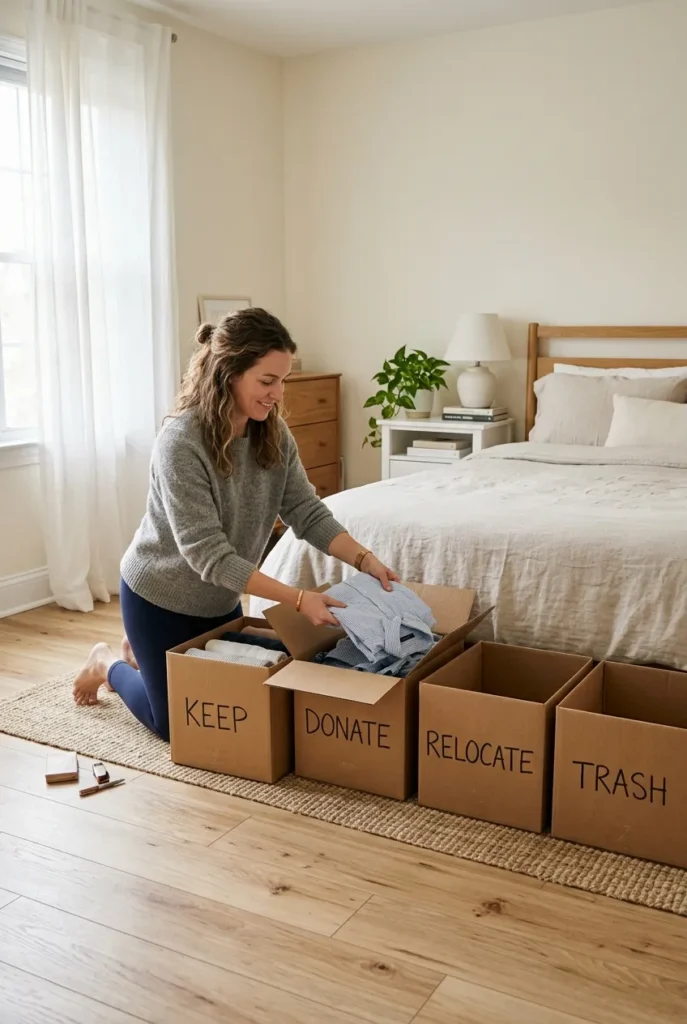
Now the real decluttering. Grab four containers and label them keep, donate, relocate, and trash. Work one small zone at a time, one drawer, one basket, one shelf. Touch an item, make a fast call, move on. If you genuinely cannot decide, it goes in keep for now. Speed matters more than perfection here.
For the “trash” box, a quick list of things to throw away can shortcut a hundred tiny decisions and keep you moving.
One kind reminder for inherited or sentimental pieces: you can donate or pass them down rather than feeling forced to keep everything. Letting an item help someone else is not the same as losing the memory.
Move 3: Reset (give everything a home)
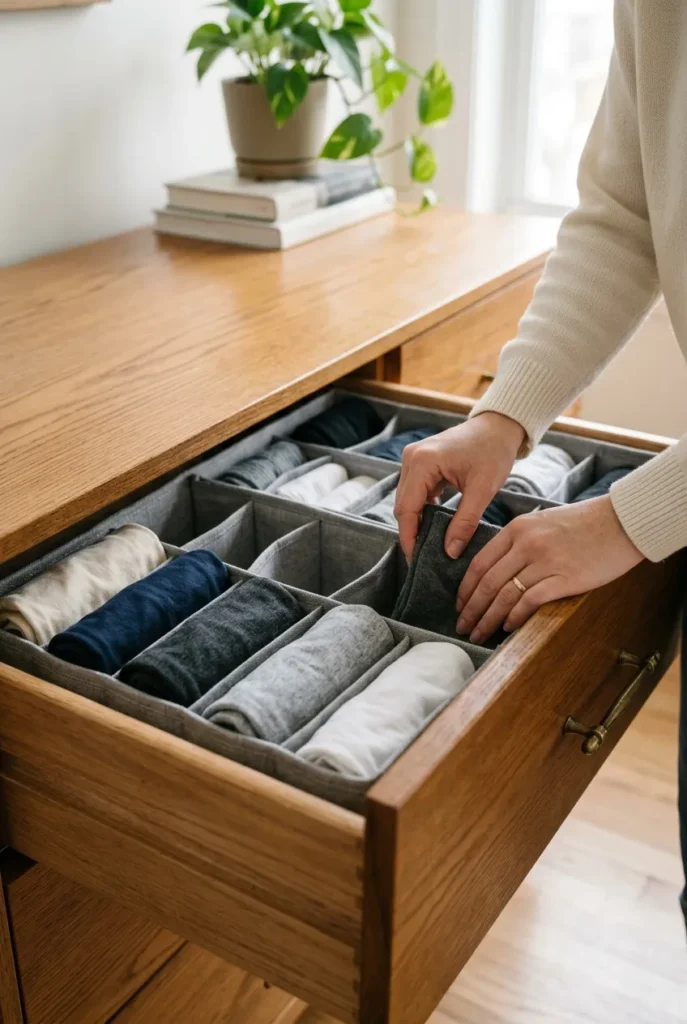
Whatever survived the sort needs a parking spot, or it drifts right back onto your counter. Group like with like, then contain it. Clear stackable bins, a lazy Susan for bottles, drawer dividers for the junk drawer. When every item has an address, tidying later takes seconds instead of an hour.
A simple habit locks it in: put it away with the one-touch rule, so things go straight to their home instead of a “temporary” pile that never leaves.
How to Declutter on Low-Energy or Bad Mental-Health Days
Some days you’ve got nothing. That’s allowed. On those days, forget the whole framework and pick one micro-task: clear one nightstand, fill one bag, wipe one counter. Two minutes counts.
Try body-doubling too. Call a friend, or put on a decluttering video, and work alongside them. The company makes the freeze easier to break.
And skip anything emotional. No old photos, no letters, no “maybe someday” boxes when you’re already low. Save those for a stronger day. Protecting your energy is part of the plan, not a detour from it.

Quick Decluttering Rules People Ask About
You’ve probably seen these floating around Pinterest. Here’s what they actually mean, fast.
The 3-3-3 rule: grab 3 items to keep, 3 to toss, 3 to donate, or spend 3 minutes in 3 rooms. It’s a warm-up, not a deep clean. The 5-5-5 rule: five minutes, five items to trash, five to put away, five to donate, a nice low-stakes daily reset. The 50% rule: for categories where you clearly own too much (mugs, tote bags, hotel toiletries), aim to keep about half. The 4 C’s often refer to a mindset loop: clear, categorize, contain, and keep it up.
Use whichever gets you moving. The best rule is the one that ends with you actually starting.
How to Keep the Overwhelm From Coming Back
Decluttering once feels amazing. Keeping it that way is where most of us slip. Two small habits do most of the heavy lifting.
First, a nightly five-minute reset. Walk one loop through your main room and return stray things to their homes before bed. Second, a one-in-one-out rule for the categories that breed clutter fastest, like clothes, mugs, and kids’ toys.
Keep a donate box parked in a closet, open and ready. When something stops earning its space, it goes straight in, no staging area, no pile.

A Gentle Note Before You Start
If your space feels heavy right now, be kind to the version of you reading this. A cluttered home says nothing about your worth. It usually just means you’ve been busy living a full life. You get to start small, and you get to be proud of five cleared minutes.
Pick one surface. Set a timer. That’s the whole first step.

Declutter When You’re Overwhelmed FAQS
Where do I start decluttering when I’m overwhelmed and don’t know where to begin?
Start with trash, not decisions. Set a five-minute timer and collect only obvious garbage from one room. A clear patch gives your brain the momentum to keep going.
What is the 3-3-3 rule for decluttering?
Pick 3 things to keep, 3 to throw away, and 3 to donate, or spend 3 minutes tidying in 3 different rooms. It’s a gentle warm-up designed to break the freeze, not to finish a whole space.
What is the 5-5-5 rule for decluttering?
Spend five minutes finding five items to toss, five to put back where they belong, and five to donate. It’s a quick daily reset that keeps clutter from building up.
What are the 4 C’s of decluttering?
They’re commonly described as clear, categorize, contain, and keep it up: clear a zone, sort like items together, put them in a defined container, then maintain the habit.
What is the 50% rule in decluttering?
For any category where you clearly own more than you use, aim to keep roughly half. It works well for duplicates like mugs, water bottles, tote bags, and travel toiletries.
How do I declutter when I feel depressed or have no energy?
Shrink the task to one tiny thing: one bag of trash, one cleared nightstand, two minutes. Skip anything emotional like old photos, and try working alongside a friend or a video for company.
How do I declutter without feeling guilty about what I paid?
The money is already spent whether you keep the item or not. Donating it lets the item be useful to someone else, which turns a stuck decision into a small good deed.
Conclusion
Learning to declutter when you’re overwhelmed isn’t about a dramatic before-and-after. It’s about proving to yourself that one small move is always possible, even on the hard days. Rescue a surface, reduce a drawer, reset a shelf, and let that be enough.
Save this guide to your favorite organizing board so it’s waiting for you next time the freeze hits, and come back to tell us which tiny win you started with. We’d genuinely love to hear it.