
7 Closet Sins You’re Probably Committing (And the Quick Fixes That Save Your Space)
You opened your closet this morning, slid two hangers across the rod, and a sweater landed on your bare foot. A pair of jeans you forgot you owned was crushed between two blazers. The top shelf is hiding a beach bag, a heating pad, and one sandal. Sound familiar? Most of us are making the same closet organization mistakes every single day, and we don’t even notice until the whole rod sags or we stand there in a towel at 7:14 a.m. with nothing to wear. Honestly, I’ve done all seven of these myself. Some of them more than once.
Here’s the good news. Every closet sin has a fix that takes under an hour, costs less than $25, and works whether you have a reach-in, a walk-in, or a tiny rental closet behind a sliding door. We’re going to walk through all seven, starting with the one that makes your closet feel smaller than it actually is.
Closet Sin #1: Buying Bins Before You Know What You Own
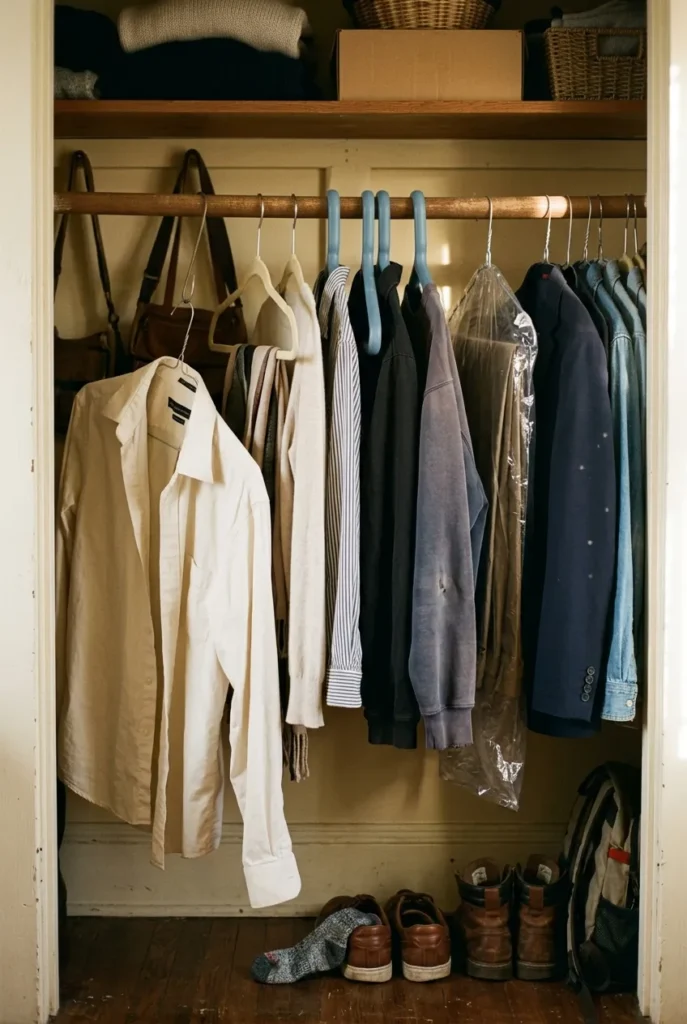
The single biggest closet organization mistake I see is the Target Brightroom haul that happens before any actual decluttering. You walk in for one thing, you walk out with six clear bins, two woven baskets, and a peg-rail you’ll never install. Then you get home, the bins sit empty in your hallway for three weeks, and the closet looks exactly the same.
The fix is boring but it works. Empty everything first, decide what stays, then measure the shelf depth and rod-to-shelf height in inches before you buy a single container. Most reach-in closets have shelves around 14 to 16 inches deep, which means a 12-inch bin slides in cleanly and a 17-inch bin pokes out and looks lumpy. A walk-in usually has 16 to 20-inch shelves, so you have more room to play with.
Pro tip from my own pantry, I mean closet (told you I’ve done these), measure twice and buy once. The Container Store’s clear stackable bins and IKEA Skubb fabric boxes are the two safest bets because they come in known sizes you can confirm before you check out.
Closet Sin #2: Mixing All Your Hangers (Yes, It Matters More Than You Think)
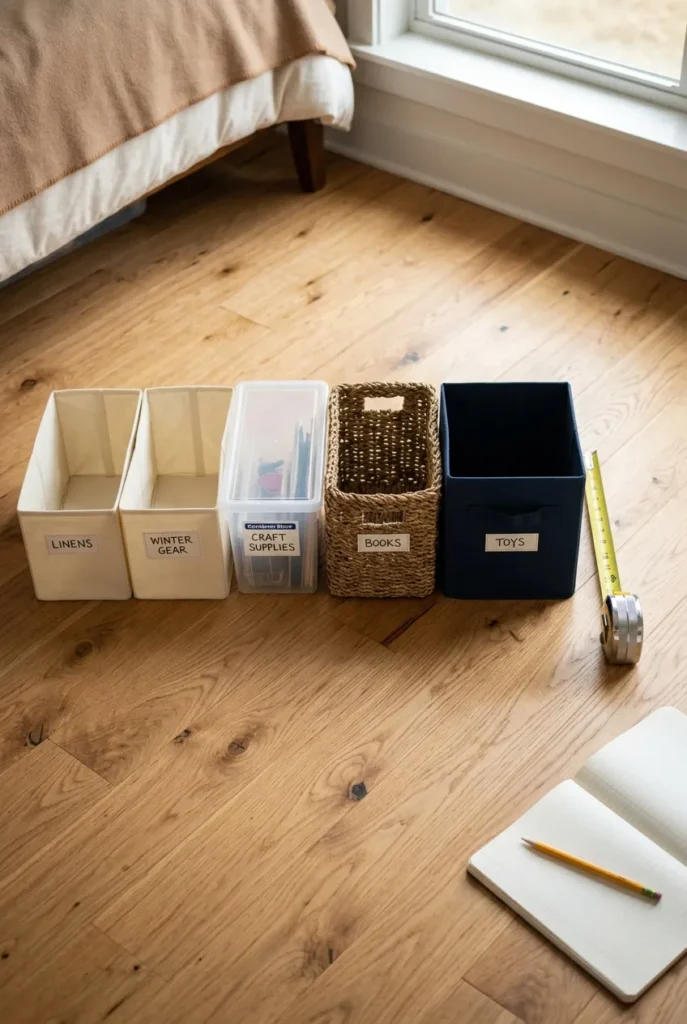
If your closet has three plastic hangers from Old Navy, two wire hangers from the dry cleaner, one wood hanger from a suit, and four slim velvets you bought last spring, your rod is doing eight different things at once. The shoulders of your shirts sit at eight different heights. The visual rhythm breaks. Your closet looks twice as cluttered as it is.
Here’s the catch. Hanger mismatch isn’t an aesthetic problem. It’s a space problem. Bulky plastic and chunky wood hangers eat three to four times the rod inches that slim velvet ones do. If your reach-in is 48 inches wide, you can hang roughly 30 shirts on slim velvets versus 12 to 14 on the chunky ones. That’s the difference between a closet that breathes and a closet that grunts when you push the rod.
Swap to one type of hanger. Amazon Basics slim velvet hangers, around $20 for a set of 50, are the entry-level fix most people pick. If you want a step up, the Container Store’s huggable velvet hangers feel sturdier and last longer. For coats and suits, keep three or four wood hangers, that’s it.
Closet Sin #3: Storing Off-Season Clothes in Prime Real Estate
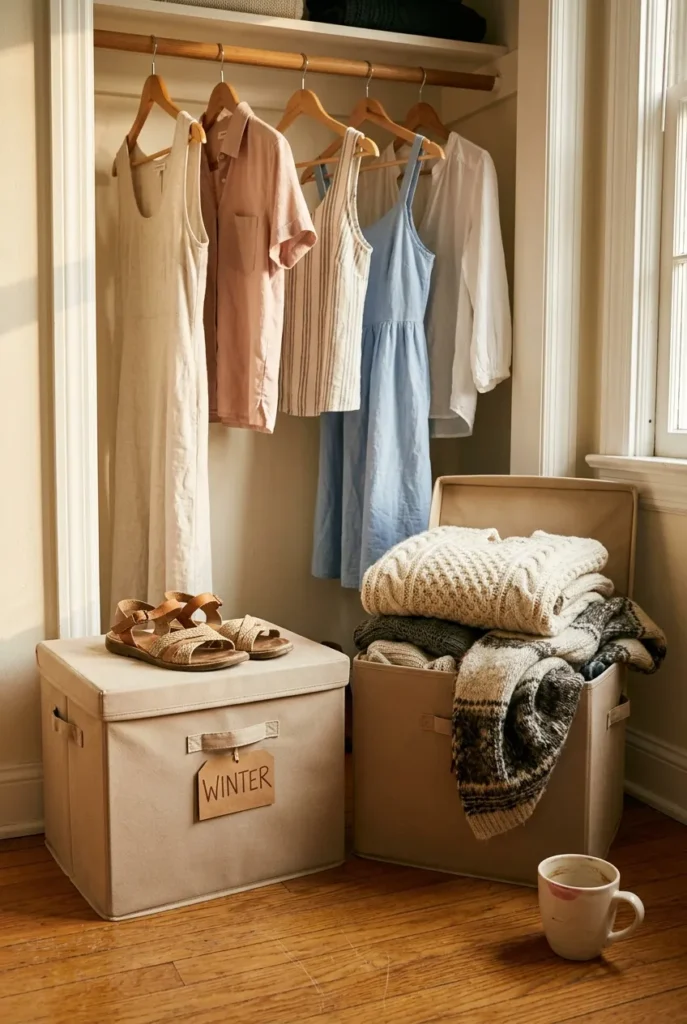
In May, the wool turtlenecks should not be living next to the linen shorts. In November, the linen shorts should not be hogging the rod in front of your peacoat. We covered this exact problem in our summer closet refresh and seasonal swap guide, but the short version is this. Your closet has roughly 80 inches of usable rod space, and half of it is being wasted on stuff you won’t touch for five months.
The 80/20 wardrobe rule says you wear 20 percent of your clothes 80 percent of the time. If you’re storing your off-season 80 percent in the prime middle zone of your closet, you’re forcing yourself to dig past it every single morning. Move off-season pieces to a labeled bin on the top shelf, under the bed, or in a hall closet. Keep the rod for what’s in rotation.
Closet Sin #4: Ignoring the Vertical (Especially in Small Closets)
This one wrecks small closet owners. You have one rod, one shelf above it, and you treat that single shelf like the whole apartment. But your closet has a ceiling, a floor, two side walls, and the back of the door. That’s five surfaces you’re not using.
The small closet organization mistakes I see most often:
- Empty space between the top shelf and the ceiling, where a second shelf or two stacked bins would fit.
- The closet floor used as a sock graveyard instead of a two-tier shoe rack.
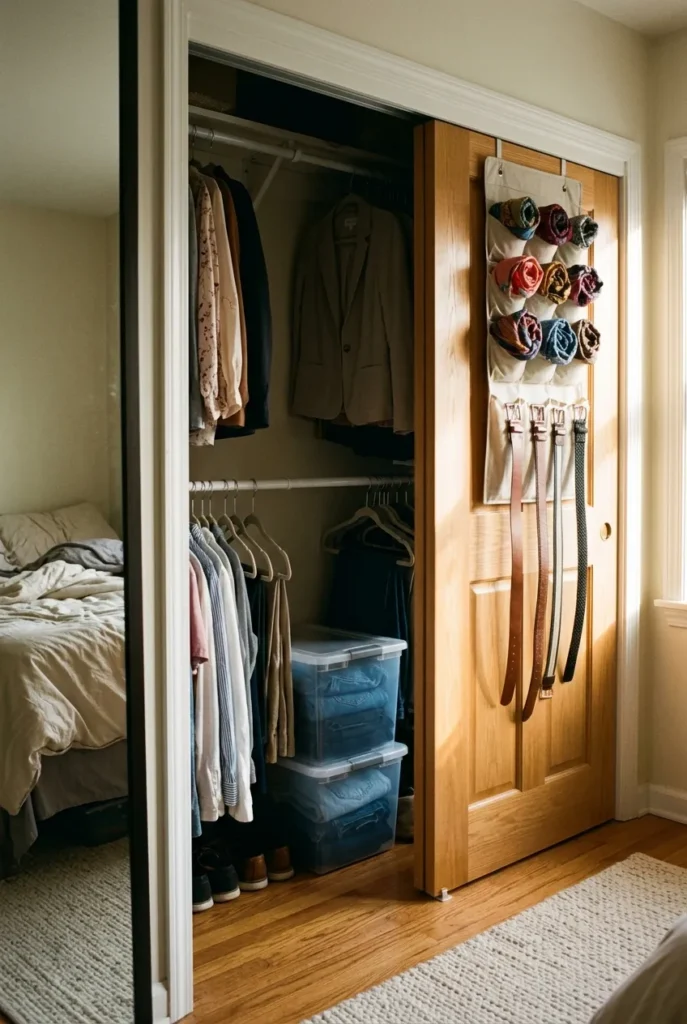
- The back of the closet door, completely blank, when a Command 3M hook strip or a slim over-the-door organizer would hold scarves, belts, and bags.
- The side walls of a reach-in, where a peg rail or three Command Hooks would hold hats, totes, or a robe.
If you rent, lean on Command 3M hooks and tension rods. No drilling. We have a no-drill closet hack roundup in our linen closet organization on a no-spend budget post that translates straight to a clothing closet too. The Vertical-First Rule is simple. Before you buy anything, look up, look down, and look at the back of the door.
Closet Sin #5: Organizing for Aesthetics Instead of How You Actually Get Dressed
This is the one Pinterest convinces us to commit. We see a closet styled in muted ceramics with seventeen amber jars and three woven baskets, and we copy the layout without asking whether it works for our morning. Then we wonder why the closet looks cluttered again by Wednesday.
Here’s the truth. A closet that photographs well and a closet that functions well are not the same closet. The aesthetic version groups by color. The functional version groups by use. If you grab the same three workout sets every Tuesday and Thursday, those need to live in the easiest drawer or the front of the rod, not buried behind a color-coded gradient that goes blush to cream to ivory.
The fix is what I call The 3-Layer Closet Rule. Treat your closet like a three-story building.
- Eye Level (the rod, roughly 40 to 60 inches off the floor) is for daily wear. Workwear, weekend basics, the five pieces you actually grab.
- Reach Zone (the shelf right above the rod and the drawers right below) is for weekly wear. Bags you use often, sweaters in rotation, the jeans you wear when laundry is behind.
- Dead Zone (the very top shelf, the very back of the closet, the floor corners) is for seasonal and rare-use. Formal dresses, ski gloves, the suitcase.
Color coordination is fine as a tiebreaker inside each layer. It is not the layer.
Closet Sin #6: Overstuffing the Rod (The 30-Hanger Test)
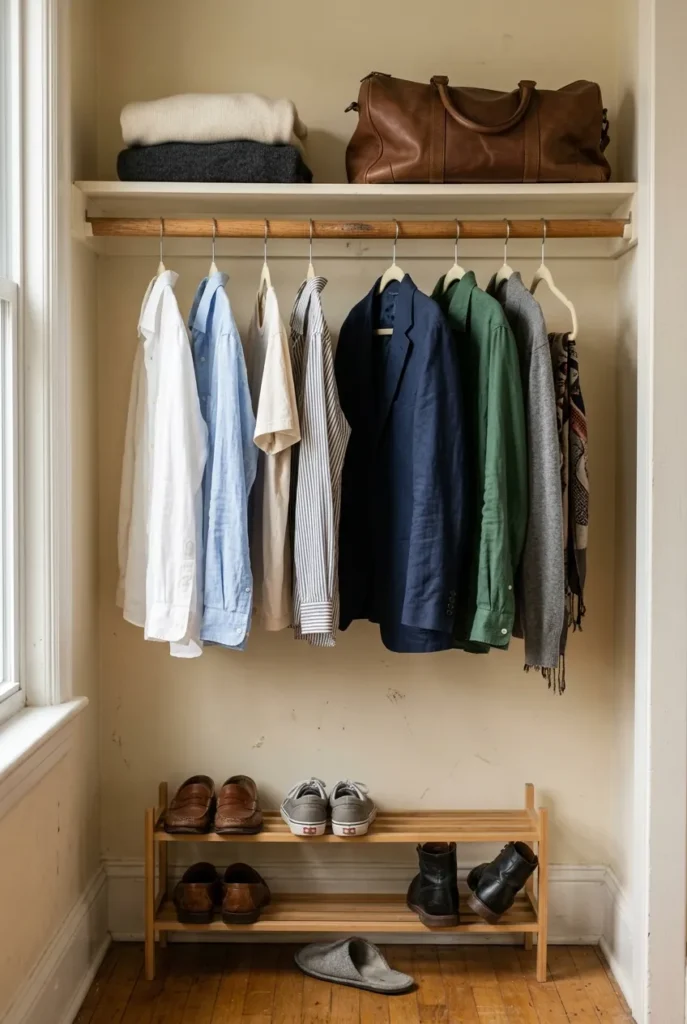
You should be able to slide any hanger across your rod without forcing it. If you have to wiggle, lift, and tug, your closet is overstuffed. The clothes wrinkle, the shoulders deform, and the rod itself starts to sag in the middle.
The 30-Hanger Reset is my own personal closet check, and it works. Count the hangers on your main rod. If it’s a standard 48-inch reach-in and you’ve got more than 30 hanging items, you’re probably over capacity. For a walk-in with a 72-inch rod, that number climbs to about 45. Anything beyond that, and you’ve crossed into wrinkle territory.
The fix isn’t always decluttering. Sometimes it’s adding a second rod. A tension-rod hung 36 inches below your main rod doubles your hanging space for shirts and pants. ClosetMaid sells a no-drill double-hang setup for under $25 that takes ten minutes to install. If you rent and can’t drill, the tension rod alone works.
Here’s the catch with overstuffing. The 90-90 rule for decluttering clothes, which we’ll cover in the FAQ below, is the cleanest test for what should leave the closet entirely.
Closet Sin #7: Treating the Closet Like a Junk Drawer
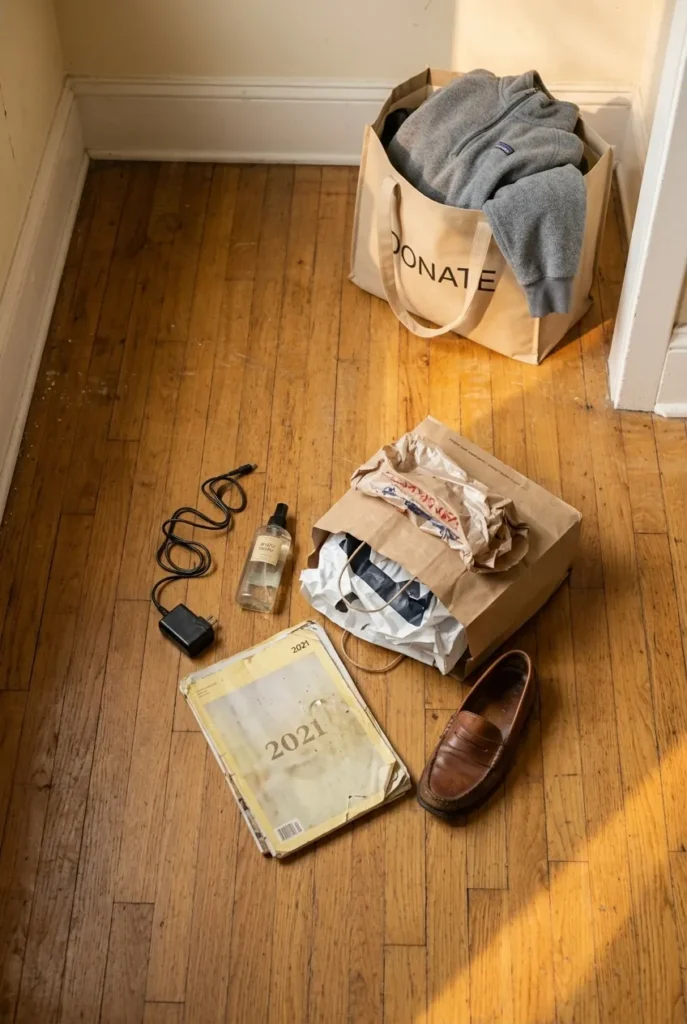
The final sin. The top shelf becomes a graveyard for old electronics. The floor becomes a shoe pile that doubles as gift wrap storage. The back corner has three empty shopping bags inside of three other shopping bags. None of these things belong in a clothing closet.
Walk through your closet right now and pull out everything that isn’t clothes, shoes, or active accessories (belts, scarves, bags in rotation). Be ruthless. Old phone chargers, expired sunscreen, holiday cards from 2019, a curling iron you replaced two years ago, all of it goes. The closet’s job is to dress you, not store the overflow from every other room in the house.
The Bonus Sin: Decluttering Your Closet All at Once
I almost made this Sin #8, but it deserves its own callout because it’s the meta-mistake that wrecks the other seven. You wake up Saturday, full of energy, and you decide to redo the entire closet in one day. By 2 p.m. the bedroom floor is covered, you’re exhausted, and you shove everything back in just to make the bed by dinner.
Closet organization is not a Saturday project. It’s a four-session project, fifteen to twenty minutes each.
- Session 1: Empty and sort the rod only.
- Session 2: Empty and sort the shelves only.
- Session 3: Empty and sort the floor and shoes only.
- Session 4: Refold, rehang, label.
Spread these across a week. You’ll finish, and the closet will actually stay organized.

Quick-Glance Fix Table: The 7 Closet Sins and Their One-Hour Fixes
| Closet Sin | One-Hour Fix | Cost Range |
|---|---|---|
| Buying bins before decluttering | Empty, measure, then buy | $0 to start |
| Mismatched hangers | Swap to slim velvet | $20 for 50 |
| Off-season hogging rod space | Move to labeled top-shelf bin | $10 to $15 |
| Ignoring vertical space | Add Command Hooks and tension rod | $15 to $25 |
| Organizing for looks not use | Apply The 3-Layer Closet Rule | $0 |
| Overstuffed rod | The 30-Hanger Reset + tension rod | $0 to $25 |
| Closet as junk drawer | Pull all non-clothing items out | $0 |
How These Fixes Translate to Walk-In Closet Mistakes vs Small Closet Mistakes
A walk-in closet has more square footage, but it also has more dead zones. The biggest walk-in closet mistakes I see are the unused middle of the room (where an island, a hamper, or a folding bench should live) and the corner shelves that hold three handbags collecting dust. Use the 3-Layer Rule for each wall, treat each wall like its own reach-in.
For small closet organization mistakes, the fix list is shorter but more aggressive. You need the tension rod, the over-the-door organizer, the slim velvet hangers, and the back-of-door Command Hook strip. Skip the woven baskets that look pretty but eat shelf inches. Pick stackable clear bins instead, so you can see what’s inside without pulling them down.
If your bedroom is also crammed, our nightstand organization guide for a clutter-free bedside pairs perfectly with this closet reset because most bedside clutter is closet overflow in disguise.
Closet Organization Ideas 2026: What’s Changing This Year
A couple of trends are reshaping closet organization ideas in 2026, and they’re worth knowing about because they map directly to the seven sins above.
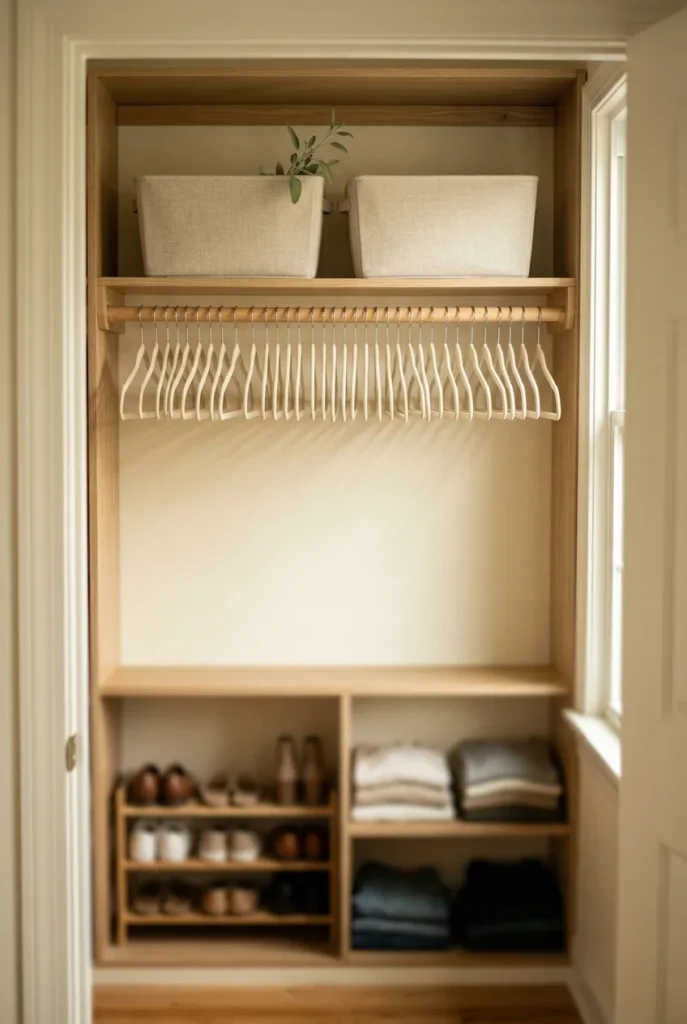
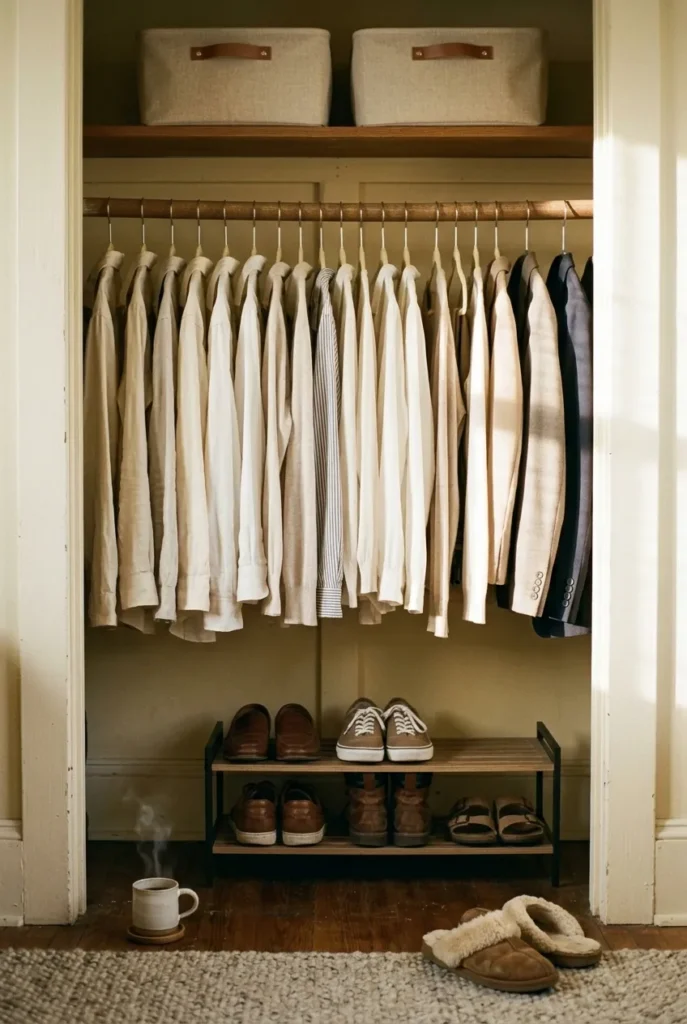
First, the rise of modular cube systems (IKEA Pax updates, ClosetMaid no-drill kits) means more renters are building custom-feeling closets without permanent hardware. Second, neutral fabric bins in cream, oat, and faded sage are replacing the all-clear-acrylic look from 2023. They hide visual noise better, which solves the visible top half problem we’ll cover in a second. Third, the 90-90 rule is having a moment on TikTok and Pinterest as a faster alternative to KonMari, and we’ll define it in the FAQ.
The Hidden Eighth Sin Almost Nobody Talks About: The Visible Top Half
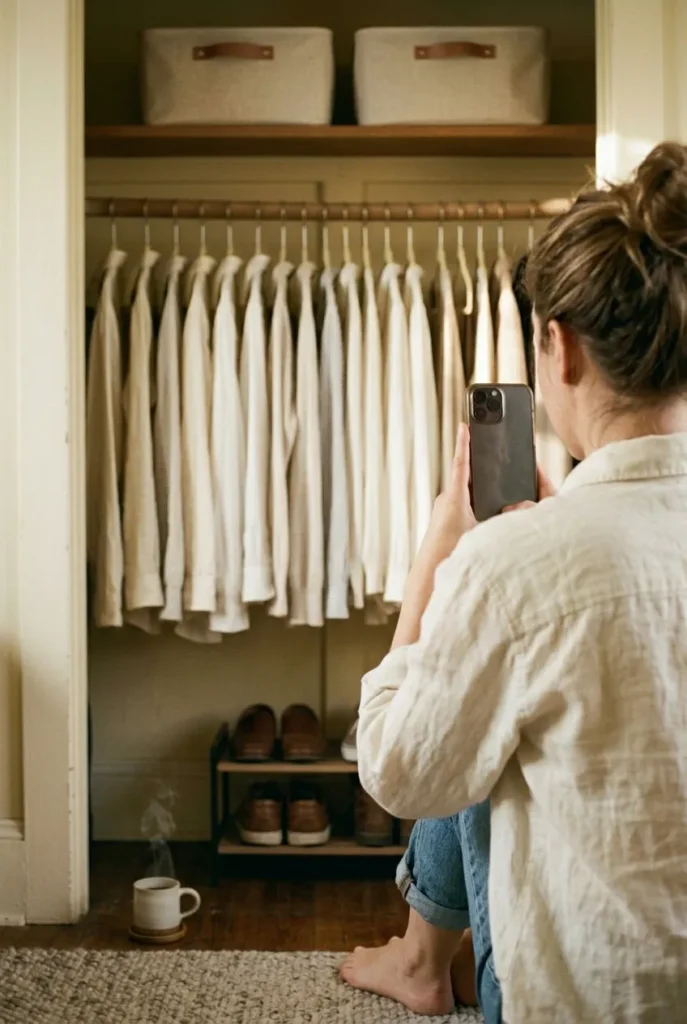
Here’s the thing your closet doesn’t tell you. Your eye scans the top half of any space first. The top shelf, the upper third of the rod, and the visible hangers control whether your closet feels organized, even if the bottom is a mess.
I call this The Visible Top Half Test. Stand in your closet doorway, take a phone photo, and crop it to just the top half. If that half looks clean, the whole closet reads as clean. If that half is chaotic, hangers tilted, sweaters bulging off the shelf, a beach bag flopping forward, the closet feels cluttered even after you’ve spent an hour fixing the bottom.
The fix is dead simple. Spend 80 percent of your tidying energy on the top half. Straighten every hanger so the shoulders line up. Use matching cream or oat fabric bins on the top shelf so the eye reads a clean line instead of mismatched packaging. The bottom half forgives you. The top half doesn’t.
Frequently Asked Questions About Closet Organization Mistakes
What is the 80/20 wardrobe rule?
The 80/20 wardrobe rule says you wear 20 percent of your clothes about 80 percent of the time. Once you identify that core 20 percent, give it the prime real estate in your closet (eye-level rod, front of the drawer) and move the other 80 percent to the Reach Zone or Dead Zone. It’s the fastest way to fix the morning dig-and-pull cycle.
What is the 90-90 rule for decluttering clothes?
The 90-90 rule is two questions you ask about any piece of clothing. Have you worn it in the last 90 days? Will you wear it in the next 90 days? If the answer to both is no (and it isn’t truly seasonal), it leaves the closet. It’s faster than KonMari for people who don’t want to hold every garment and ask if it sparks joy.
What is the rule of 3 for cleaning closets?
The rule of 3 is a quick sorting system. As you pull each item out, send it to one of three piles: Keep, Donate, or Maybe. The Maybe pile gets revisited at the end of the session and most of it ends up in Donate anyway. This is simpler than the four-box method and works well for a one-hour reset.
What are 5 quick tips for organizing your closet?
In order: swap to one type of slim hanger, apply The 3-Layer Closet Rule (Eye Level, Reach Zone, Dead Zone), move off-season clothes off the main rod, use vertical and back-of-door space before buying any shelving, and run The Visible Top Half Test before you call it done.
How often should I declutter my closet?
A light pass every season (four times a year) and a deep pass once a year. Tie the seasonal pass to your closet swap moments, late April for the spring/summer rotation and late September for the fall/winter rotation. A deep pass usually lands in January or right after a move.
What are the worst small closet organization mistakes to fix first?
Three fixes give the fastest visible win in a small closet. Swap chunky hangers for slim velvet (instant 30 percent more rod space), add a tension rod for a second hanging level, and use the back of the door for scarves, belts, and bags. You’ll see the difference inside an hour.
Do I need to buy new bins to organize my closet?
No. Most closet organization mistakes get fixed without buying anything. According to the U.S. Environmental Protection Agency guidance on reducing household waste, reusing what you already own beats buying new whenever possible. Empty the closet first, audit what you have in the rest of the house (shoeboxes, gift baskets, fabric bags), and only buy what you can’t fill from existing supplies.
Your Next Step
You don’t have to fix all seven closet sins this Saturday. Pick one. The fastest visible win is usually swapping to slim velvet hangers, you’ll feel the difference within minutes. The longest-lasting win is applying The 3-Layer Closet Rule, because once your brain learns the Eye Level, Reach Zone, and Dead Zone structure, you’ll never reorganize the same closet twice.
Before you close this tab, take the phone photo we talked about in The Visible Top Half Test. Snap your closet right now, crop the top half, and look at it like a stranger would. That photo is your starting point. If you want a free 7-Day Closet Reset checklist to walk you through each sin one at a time, head to a printable home reset checklist from a major home brand like Real Simple or grab the printable version from our resource library. Which sin are you fixing first? Drop a comment below and tell us, we love hearing which closet sin people commit the most (mine was overstuffing the rod, hands down).