
Toy Organization Ideas: How to Declutter Toys with Your Kids (Without the Meltdowns)
You walk into the living room with your coffee, and there it is. A plastic dinosaur on its side near the couch leg, a half-built LEGO set spread across the rug, three stuffed animals piled on the ottoman, and a wooden puzzle missing two pieces shoved under the TV stand. You step over a board book to reach the kitchen, and somewhere behind you a tiny car rolls out from under the sofa. We’ve all stood in that doorway, mug in hand, wondering when our adult living room became a toy minefield.
Here’s the good news. Toy organization ideas don’t require a Pinterest-perfect playroom or a Container Store credit limit. You need a clear system, a few smart bins, and a willingness to involve your kids in the process (yes, even the toddler). This guide is organized by room zone, so you can jump to the space that’s stressing you out most.
We’ll cover storage solutions for the living room, bedroom, small apartments, and closets, plus the decluttering rules every parent quietly wants to know about (the 20 toy rule, the 4 toy rule, and the 10 toy rule are all coming up).
Who This Guide Is For
This post is built for:
- Renters who can’t drill into walls or anchor heavy furniture
- Parents in small spaces and apartments working with under 800 square feet
- Budget-conscious families who want solutions under $25 per piece
- Homeowners ready to invest in heirloom storage that grows with the kids
- Style-minded parents who want toy storage that doesn’t scream “playroom” in the middle of an Organic Modern or Modern Farmhouse living room
If you’re somewhere on that spectrum, you’re in the right place. Now let’s get to it.
Start With the Big Purge (The 90-Minute Method)
Before you buy a single bin, you need to know what you’re storing. Skipping this step is the number-one reason toy storage fails six weeks later. Set aside 90 minutes on a Saturday morning, brew real coffee, and pull every toy in the house into one central pile in the living room. Yes, all of them. The bath toys, the car toys, the random Happy Meal prize hiding in a drawer.
Here’s what the pile teaches you. You’ll spot duplicates instantly (three sets of plastic dinosaurs, two unopened art kits). You’ll see what your kid hasn’t touched in six months. And you’ll feel the weight of the volume, which is the emotional kick most parents need to finally let go.
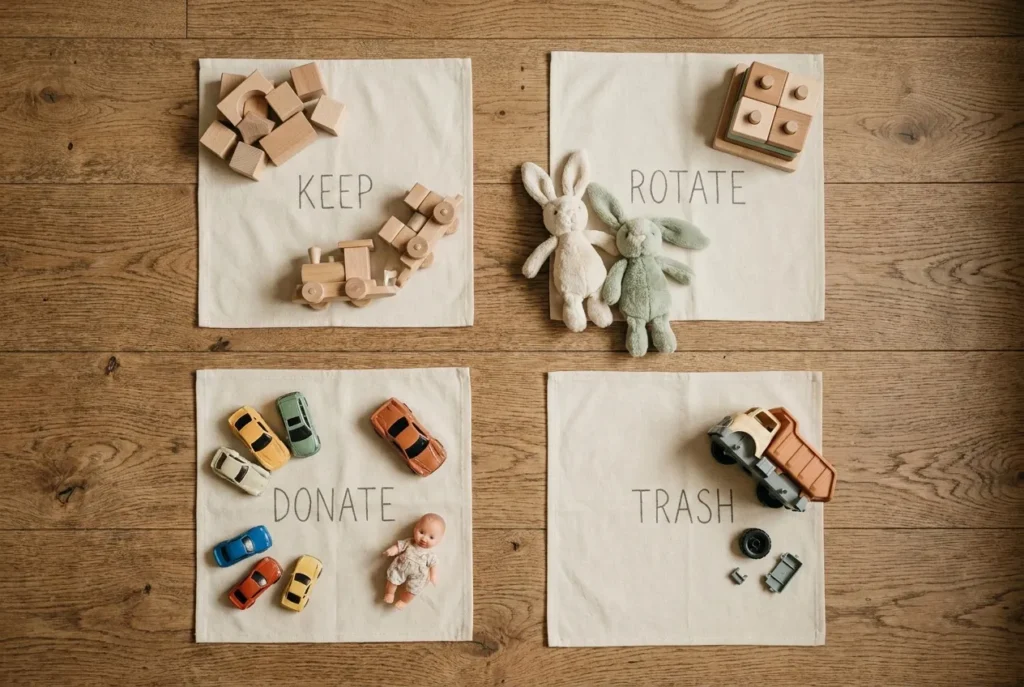
Then sort into four zones on the floor:
- Keep and display (current favorites, age-appropriate, in good condition)
- Rotate and store (good toys your child loves but doesn’t need out daily)
- Donate or sell (good condition, no longer used)
- Trash or recycle (broken, missing pieces, sticky beyond saving)
For the donate pile, Goodwill accepts gently used toys at most drop-off centers, and many local shelters take new or like-new items year-round. Bag the donate pile and put it in your trunk the same day. If it sits by the door for a week, half of it migrates back into the kid’s room. I learned this the hard way after a “donation bag” lived in my entryway for an entire February.
Open-Ended Toys vs. Close-Ended Toys: Which to Keep
Once you’re sorting, this distinction matters. Open-ended toys (wooden blocks, magnetic tiles, play kitchens, art supplies, dolls, dress-up clothes) have no fixed outcome. Kids can play with them five different ways across five different ages. Close-ended toys (single-function light-up gadgets, most battery-powered electronic toys, branded toys tied to one TV show) have one job, get boring fast, and pile up in the donation bag within a year.
The American Academy of Pediatrics recommends prioritizing simple, traditional toys like blocks, puzzles, dolls, and art supplies because they support brain development and grow with the child. When you’re deciding what to keep, lean open-ended. Your shelves will look calmer too, since open-ended toys tend to be made of wood, fabric, and natural materials that photograph beautifully on Pinterest and live happily in a grown-up living room.
Living Room Toy Organization Ideas (Where Most Families Need Help Most)
If your toys live in the living room, you’re not failing at parenting, you’re just being realistic. Most American homes have one main hangout space, and kids want to be where you are. The trick is storing the chaos so the room still looks like adult furniture took the lead.
1. The Storage Ottoman That Pretends It’s Just a Coffee Table
A lift-top storage ottoman is the single highest-impact piece of furniture for living room toy storage. It holds an embarrassing amount (think two full bins of plastic toys and a basket of board books), doubles as a coffee table or footrest, and looks like grown-up furniture from across the room.
- Budget-friendly ($75 to $120): Walmart and Amazon basics carry linen tufted versions in cream, oat, and gray that hold up well for two to three years.
- Mid-range ($150 to $300): Target’s Threshold line and HomeGoods rotate strong options seasonally, often in performance fabric.
- Splurge ($400 to $700): West Elm and Crate & Barrel offer leather and boucle ottomans that read as design pieces and last a decade.
2. The Console Table With Baskets (Rental-Friendly Hero)
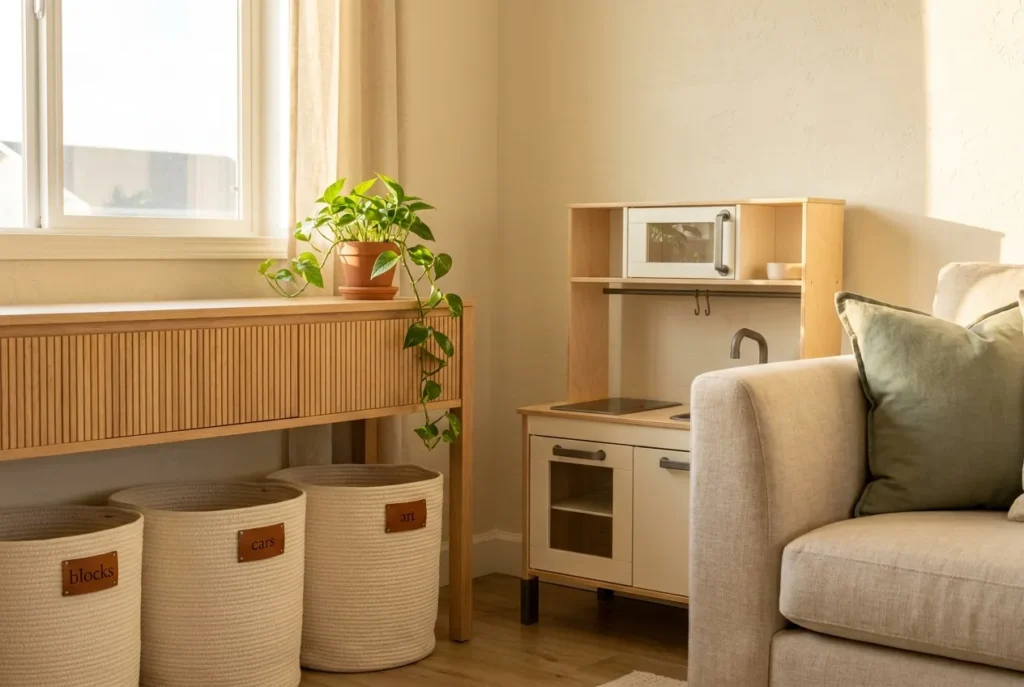
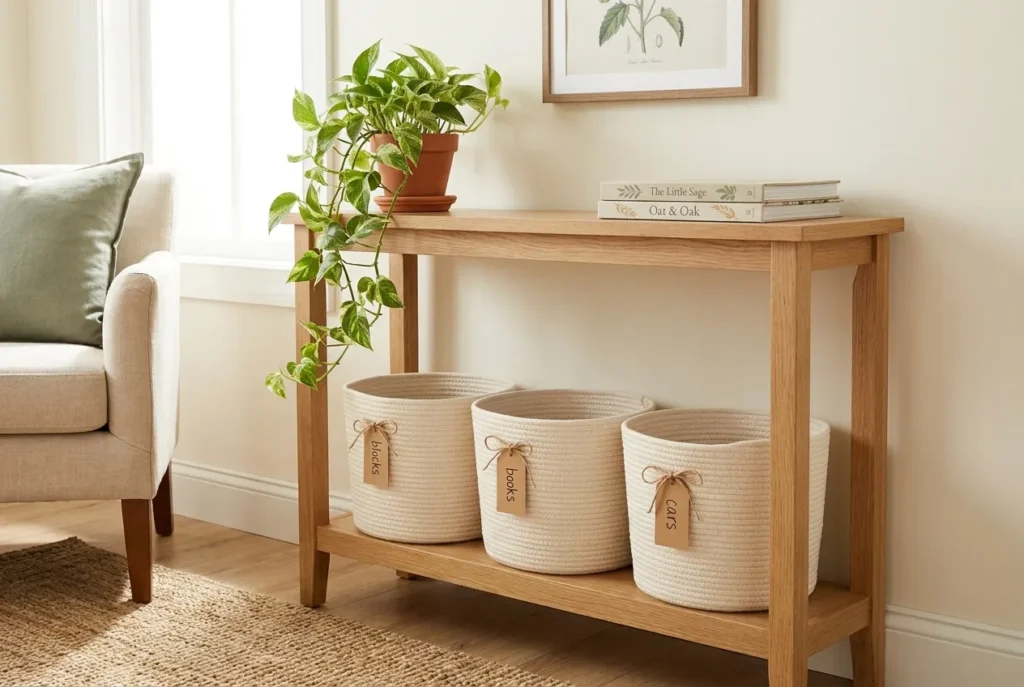
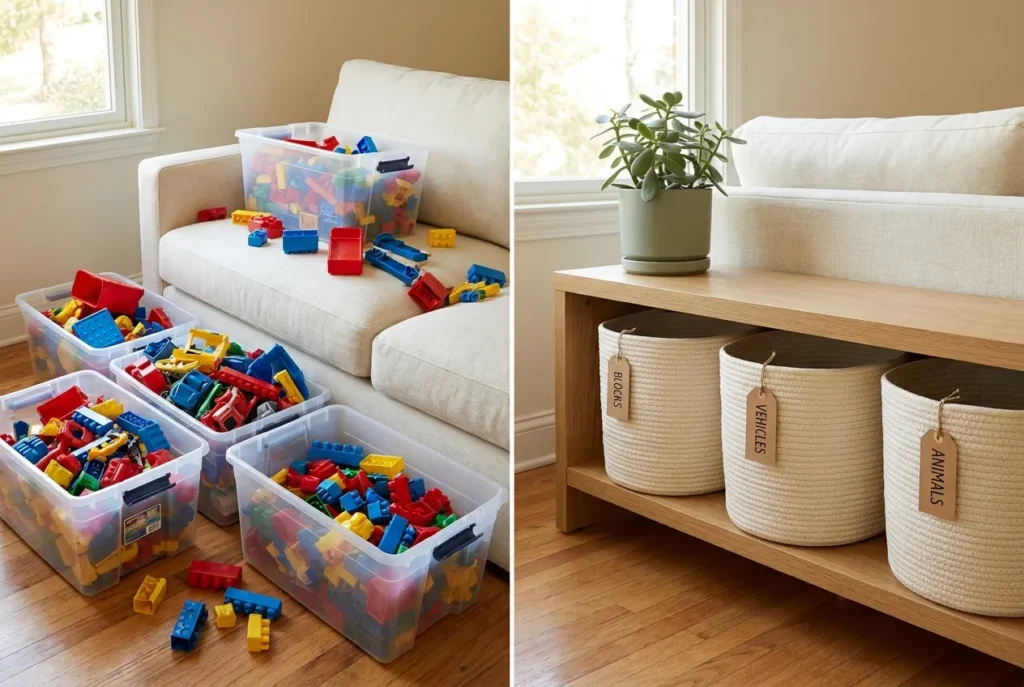
A narrow oak or walnut console table (10 to 14 inches deep) tucked behind your sofa or along an empty wall is the rental-friendly toy storage answer almost nobody talks about. Slide three matching woven baskets underneath, label them with leather or kraft paper tags, and you’ve created a styled toy zone that requires zero drilling.
Look for baskets in seagrass, water hyacinth, or cream cotton rope. Target’s Threshold and HomeGoods both consistently stock baskets in the 14 by 14 inch range that fit standard console table shelves. Avoid open wire baskets here. Small toys fall through the gaps and the metal reads more “garage” than “living room.”
3. Closed Cabinets Beat Open Shelves (Most of the Time)
Pinterest will sell you the dream of color-sorted toys on open Billy bookcases. Real life will dump them on the floor within 48 hours. For living rooms where you want visual calm, closed cabinet doors do 80 percent of the styling work for you. The IKEA Hauga cabinet (around $169) and the Sauder Anda Norr (around $230 at Walmart) are both apartment-friendly options under 16 inches deep that hide the chaos behind two clean doors.
If you do want open shelving, reserve the top two shelves for adult styling (books, ceramics, a small plant) and only the bottom shelf for kid-accessible toys in matching bins. That way the room reads as a styled space first, a toy zone second.
💡 Mini Framework: The 70/30 Visual Rule Aim for 70 percent of any room visible from your couch to read as adult styling, and 30 percent or less to read as toy storage. This is what makes the difference between “lived in with kids” and “the toys took over.” Screenshot this one.
Toy Storage Ideas for Small Spaces and Apartments
Working with under 800 square feet, a one-bedroom apartment, or a shared kids’ room? Vertical storage and dual-purpose furniture are your best friends. Floor space is the most valuable real estate you have, so anything that climbs the wall or doubles its job wins.
Use Vertical Wall Space (Rental-Friendly Version)
Command-strip wall pockets, over-the-door canvas organizers, and tension-rod systems all give you vertical toy storage without a single hole in the wall. The over-the-door clear shoe organizer is the most underrated toy storage hack of all time. Each pocket holds a category (Barbie shoes, Hot Wheels, MagnaTiles, art supplies), kids can see everything at a glance, and the whole thing costs around $12 at Target.
For renters, we covered an entire deep-dive on this approach in 25 genius uses for over-the-door organizers, and at least eight of those uses translate directly to toy storage.
The Bed-Frame Bin Solution
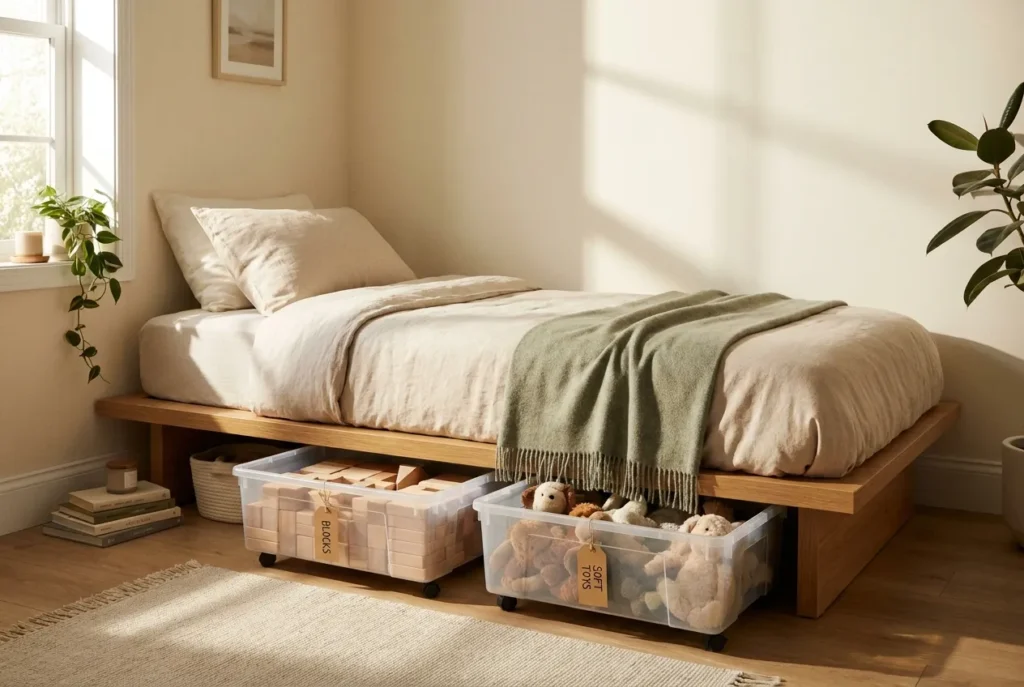
Under-bed storage bins are the small-space parent’s secret weapon. Look for low-profile rolling bins (around 5 to 6 inches tall) that fit under standard bed frames. Sterilite makes a 30-quart underbed box for around $11 at Walmart, and IKEA’s SKUBB box set runs about $20 for three. Label them by category and rotate them out weekly. Your kid gets the thrill of “new” toys without you buying a single thing.
Toy Storage Ideas for the Bedroom
Kids’ bedrooms benefit from a totally different layout than living rooms because the toys can be visible without breaking the design of your main living space. The IKEA Trofast system (around $90 to $160 depending on size) is genuinely worth the hype here. The frame is solid pine, the plastic bins come in primary colors or a softer cream and gray palette, and kids can pull them out independently from age two onward.
Pair the Trofast with a low oak slat shelf above it for stuffed animals and books, and a small basket on the floor for “stuff that doesn’t have a home yet.” Every kid’s room needs a “no home yet” basket. It’s the only thing standing between you and a daily tantrum about where the new birthday gift goes.
For a deeper system that kids can actually maintain on their own, our full guide on kids room organization walks through the routines and labels that make it stick past the first week.
The Toy Rotation System That Actually Works
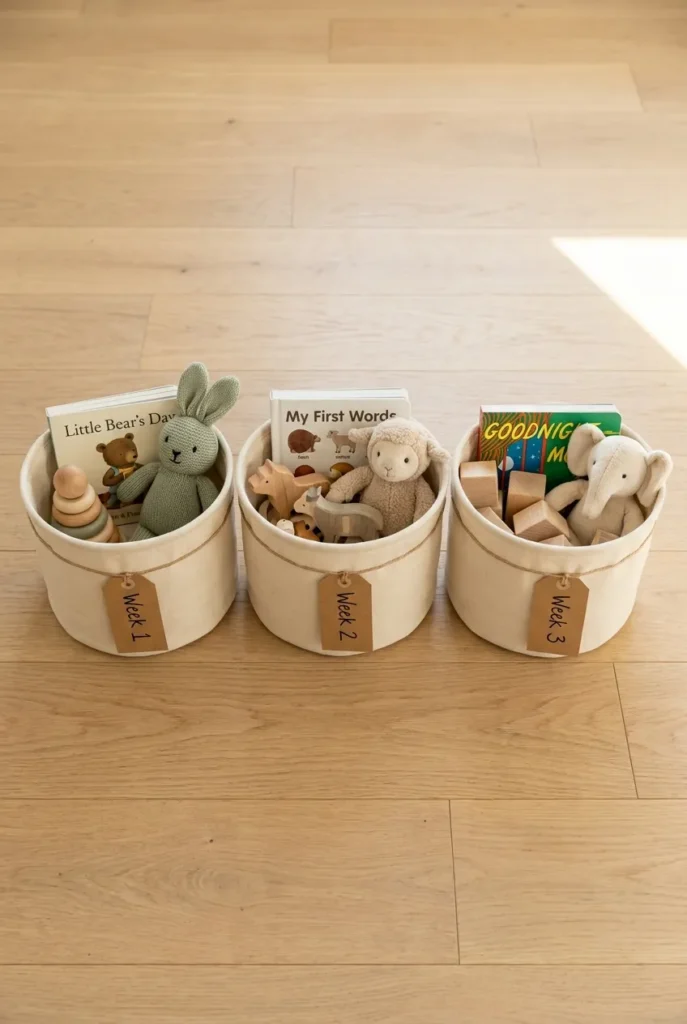
Toy rotation is the single biggest behavior change you can make. The concept: keep 30 to 40 percent of toys accessible at any time, store the rest in labeled bins out of sight, and swap every two to three weeks. Kids play longer with fewer toys (this is well documented in early childhood research), the living room stays calmer, and birthday gifts feel exciting again instead of overwhelming.
Here’s the setup:
- Three bins, hidden storage. Use under-bed bins, a closet shelf, or the top of a wardrobe. Label each bin with the rotation week.
- One “always out” zone. Open-ended favorites stay accessible (blocks, art supplies, dolls, MagnaTiles).
- Swap on a slow morning. Sunday morning, while kids eat breakfast, swap the active bin with one from storage. Don’t announce it. Most kids notice within 20 minutes and act like Christmas arrived.
Skip rotation entirely if your kid is neurodivergent and finds change distressing, or if a specific comfort toy is non-negotiable. The whole point is calmer kids, not stricter rules.
Closet Toy Organization Ideas
The closet is the unsung hero of toy storage. A shared kids’ closet, a coat closet near the living room, or even a linen closet shelf can absorb half your toy volume if you set it up right.
The setup that works:
- Top shelf: Backstock and rotation bins (labeled, lidded, out of reach)
- Middle shelf: Active toys in matching woven bins (kid-accessible)
- Floor: Two large baskets for bulky items (a play kitchen accessories basket, a stuffed animal basket)
- Inside the door: A clear over-the-door shoe organizer with small toys sorted by pocket
Add adhesive hooks (Command 3M strips hold up to 5 pounds) for dress-up clothes, tutus, and capes. Skip wire shelving if you can. Wooden or laminate shelves hold weight better and look intentional even with the door open.
Budget vs. Splurge: Toy Storage Compared
Here’s the side-by-side most posts skip. Both columns work. The right one depends on your budget, how long your kids will use the space, and how much you care about the storage looking like adult furniture.
| Storage Need | Budget-Friendly Pick | Splurge Pick |
|---|---|---|
| Living room toy bin | Dollar Tree fabric cube ($1.25 each) | Crate & Barrel woven seagrass basket ($79) |
| Storage ottoman | Walmart linen lift-top ($89) | West Elm boucle storage ottoman ($599) |
| Toy shelving | IKEA Trofast frame with plastic bins ($120) | Pottery Barn Kids Cameron system ($799) |
| Console table with baskets | Amazon oak-look 3-tier ($69) | West Elm Mid-Century narrow console ($499) |
| Labels | Kraft paper tags + twine ($4 for 50) | Engraved leather tags from Etsy ($18 for 6) |
| Under-bed bin | Sterilite 30-quart ($11) | The Container Store rolling underbed ($49) |
The splurge column lasts 10+ years and gets passed to siblings. The budget column gets you organized this weekend for under $200 total. There is no wrong answer.
The Toy Rules Every Parent Quietly Wants to Know About
These show up constantly in Pinterest searches and Google’s People Also Ask, so let’s break them down clearly.
The 20 Toy Rule
Your child keeps a maximum of 20 toys out and accessible at any time. Everything else goes into rotation storage, gets donated, or gets trashed. Sets count as one toy (a 50-piece LEGO set is one toy, a 30-block wooden set is one toy). This rule is popular with minimalist parents and works best for kids ages 3 and up.
The 10 Toy Rule
A stricter version. Ten toys total, accessible. Best for toddlers ages 1 to 3, who actually play longer and more creatively with fewer options. Pair this rule with weekly rotation so it never feels like deprivation.
The 4 Toy Rule
Used most often for gift-giving, not daily storage. The 4 toy rule says each child receives four gifts per holiday: something they want, something they need, something to wear, something to read. It’s a sanity-saving framework for Christmas and birthdays that prevents the post-holiday toy avalanche.
DIY Toy Organization Ideas (Weekend Projects)
If you’ve got a free Saturday and a basic toolkit, three DIY projects punch above their weight for toy storage.
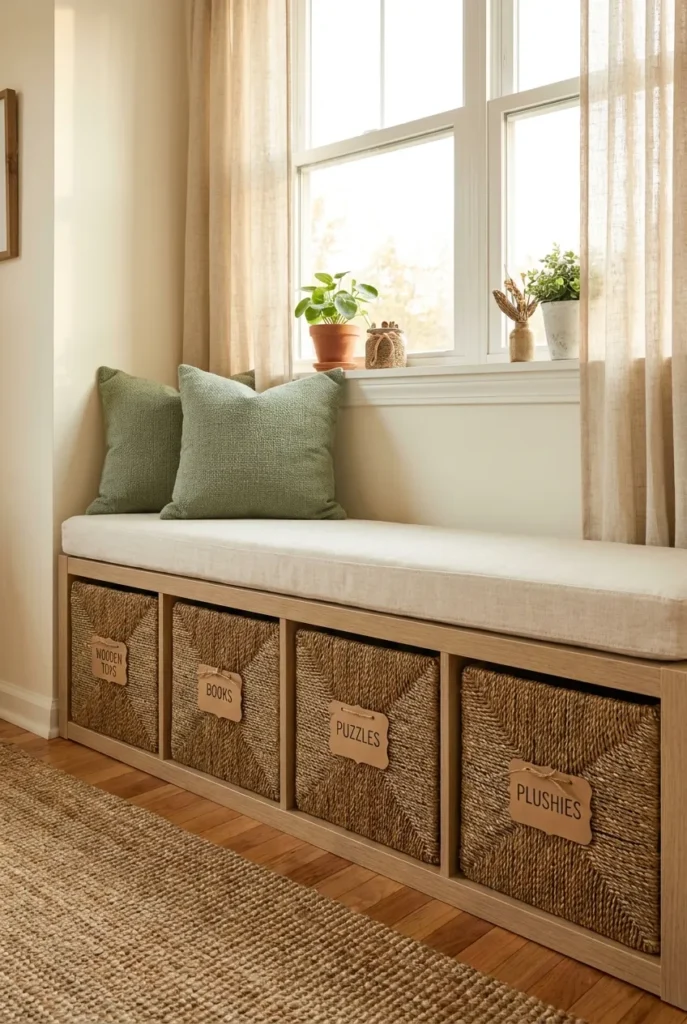
1. The IKEA Kallax Hack. A four-cube Kallax ($69) turned on its side becomes a low bench with toy storage cubbies. Add a $30 cushion on top from Amazon and you’ve got a window seat that hides toys. The whole project costs under $120 and takes 45 minutes.
2. Repainted thrift store dresser. A small thrift dresser (often $20 to $40 at Goodwill) sanded, primed, and painted in cream chalk paint becomes a stunning toy dresser for the living room corner. Each drawer holds a category. Add wooden knob pulls for around $15 total.
3. The pegboard wall. A 2-foot by 4-foot pegboard (around $25 at Home Depot) painted cream and mounted on the wall holds dress-up clothes, tote bags of art supplies, and even small wooden toy bins on shelves. Hugely customizable and removable with patch-and-paint when you move.
For more inspiration on dollar-store DIY storage that looks expensive, we walk through 10 tested ideas in Dollar Tree organization hacks that look expensive, and most of them adapt directly to toy storage.
Labels: The Step Everyone Skips (And Shouldn’t)
Labels are the unsexy step that decides whether your system survives. Kids put toys back when they know where they go. Adults stop reorganizing the same bins weekly. Visitors and grandparents can help tidy up without asking.
Three label styles that look intentional:
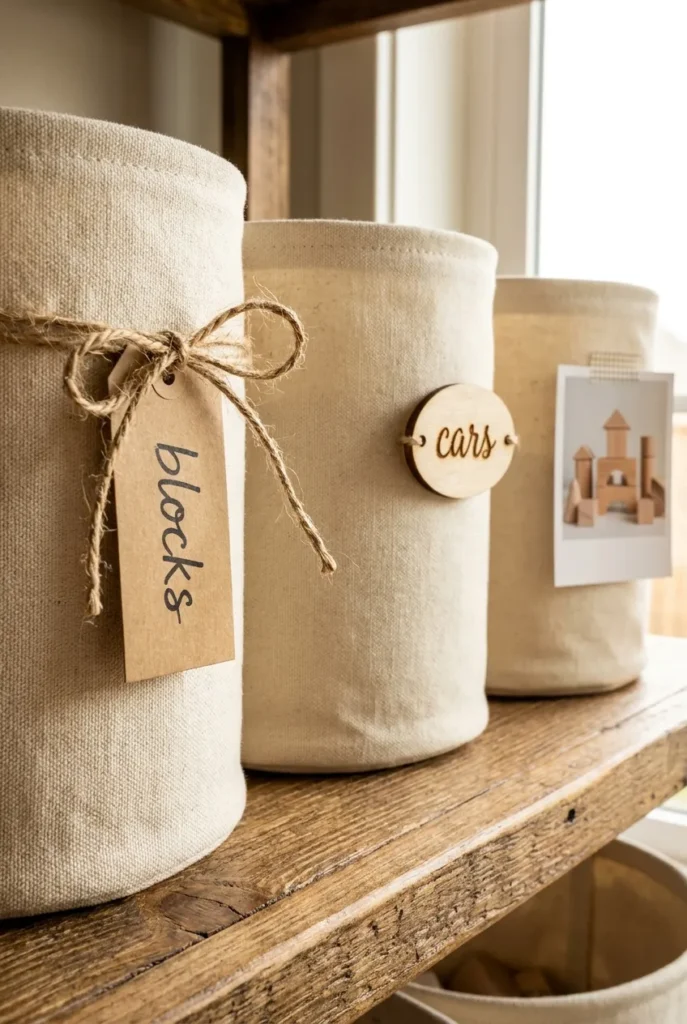
- Kraft paper tags with twine (warm Modern Farmhouse vibe, kid-friendly to read, around $4 for 50 tags)
- Engraved wooden tags (Etsy, around $12 to $20 for a set of 6, last forever)
- Photo labels for pre-readers (a small printed picture of the toy taped to the bin, the genius hack nobody talks about for toddlers age 2 to 4)
For toddlers, photo labels change the game. A picture of three wooden blocks on the “blocks” bin means a two-year-old can put toys away without asking. That’s worth more than any storage system you’ll ever buy.
Common Toy Organization Mistakes to Avoid
Eight years and a lot of trial and error taught me these the hard way. Skip them and you’ll skip months of frustration.
- Buying bins before you purge. You’ll buy the wrong sizes every single time. Purge first, measure second, shop third.
- Using clear bins for everything. Visible chaos is still chaos. Cream, oat, or sage opaque bins hide the mess and lower visual noise dramatically.
- Skipping labels. Without labels, the system collapses in 10 days. Every time. No exceptions.
- Storing toys too high. If your kid can’t reach it, they can’t put it away. Active toys live below 36 inches.
- Buying matching plastic primary-color bins. Unless they’re hidden inside a closet or Trofast frame, they fight every adult color palette in your home. Default to neutrals.
- Forgetting to rotate. Toys you forget about get donated by mistake or rediscovered with disappointment. Calendar reminder on Sundays. Set it once, thank yourself forever.
- Asking your kid to “clean up the toys.” That’s too vague. “Put all the blocks in the blue bin” works. Specific commands, specific bins, specific wins.
Seasonal Toy Refresh: Two Times a Year Beats Constant Tidying
Twice a year (early September before school starts, and early January after the holiday gift avalanche) do a 90-minute full reset. Pull everything out, repurge with the kids, donate the outgrown, swap rotation bins, and reset the labels. This rhythm beats trying to constantly maintain perfection. Two big resets and weekly rotation are all you need.
If you want to make decluttering a daily 10-minute habit instead of a twice-a-year project, the approach in the 10-10 decluttering method adapts perfectly to toy zones and keeps the chaos from rebuilding between resets.
Quick Wins for This Weekend (Under $50)
If you only have $50 and one Saturday, here’s the highest-impact playbook:
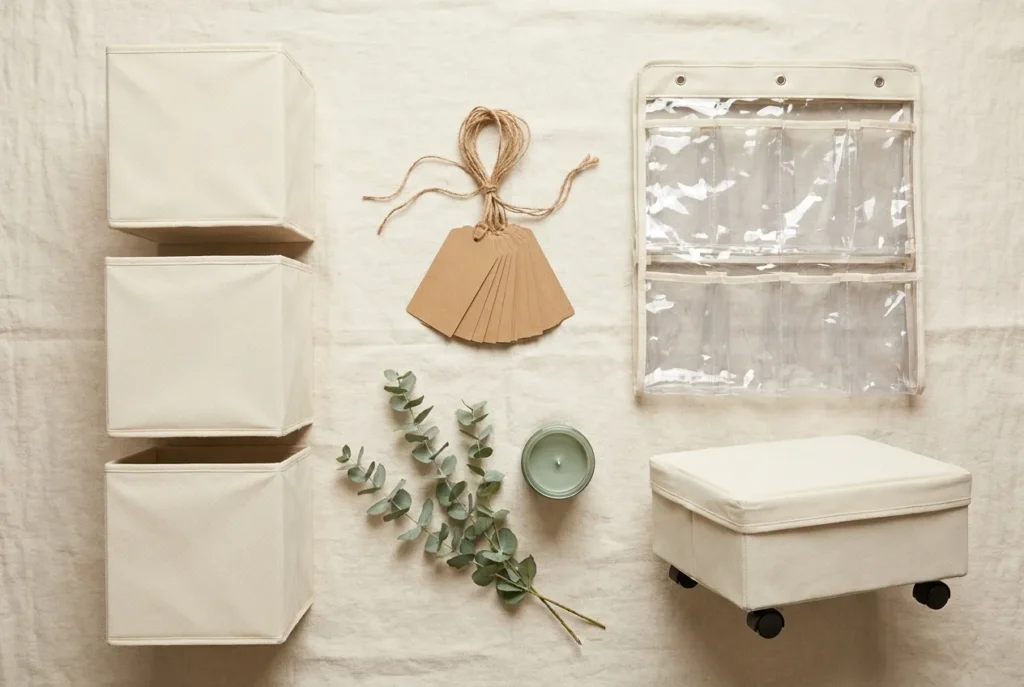
- Three matching cream fabric storage cubes from Walmart or Target ($15 total)
- One pack of kraft paper tags with twine ($4)
- One over-the-door clear shoe organizer ($12)
- One under-bed rolling bin ($11)
- The 90-minute purge (free)
Total: about $42. You’ll have a functioning system by Saturday night. Refine and upgrade from there.
Frequently Asked Questions
What’s the best way to organize toys?
The best way to organize toys is to purge first, sort by category second, and store in labeled, opaque bins kids can reach. Pair that with a rotation system (active toys visible, rotation toys hidden) and a twice-yearly reset. Skipping the purge or skipping labels is what causes 90 percent of toy storage to fail within a month.
What is the 20 toy rule?
The 20 toy rule limits your child to 20 toys accessible at any time. Sets count as one toy. Everything else either rotates, donates, or gets trashed. It works best for kids 3 and up and pairs well with a two-week rotation system.
What is the 10 toy rule?
The 10 toy rule is a stricter version of the 20 toy rule, limiting accessible toys to 10. It’s best suited for toddlers ages 1 to 3, who play longer and more creatively with fewer options. Use weekly rotation to keep it fresh.
What is the 4 toy rule?
The 4 toy rule is a gift-giving framework, not a daily storage rule. Each child receives four gifts per holiday: something they want, something they need, something to wear, and something to read. It prevents the post-Christmas toy avalanche.
How do I organize toys in a small space or rental?
Lean on vertical storage that doesn’t require drilling: over-the-door organizers, command-strip wall pockets, under-bed rolling bins, and dual-purpose furniture like storage ottomans and console tables with basket shelves. Keep colors neutral so the storage blends into adult living spaces, and rotate toys aggressively to fit a smaller footprint.
What’s the budget version of toy organization?
A $40 to $50 starter kit gets you 80 percent of the way there: three fabric storage cubes from Walmart ($15), kraft paper tags ($4), an over-the-door clear shoe organizer ($12), and one underbed rolling bin ($11). Pair that with a free 90-minute purge and you’ve got a functioning system by Saturday night.
What if I don’t have a playroom?
You don’t need one. Most US families don’t. Use a living room console table with three baskets underneath, a storage ottoman that doubles as a coffee table, and a small bin in your kid’s bedroom for overflow. The 70/30 visual rule (70 percent adult styling, 30 percent toy storage) keeps it from feeling like the toys took over.
How long does a full toy organization project take?
The initial purge and setup runs 90 minutes to 3 hours depending on toy volume. Ongoing maintenance is roughly 10 minutes a day for the daily tidy, plus a 90-minute reset twice a year. Total annual time investment: about 6 hours.
Save This Post (And Pick Your First Pin)
Here’s your move. Save this post to your “Home Organization” or “Mom Life” Pinterest board so you can come back when you’re ready to start. If you want the quick-win route, pin the under-$50 starter kit image. If you’re investing in a longer-term setup, save the budget vs. splurge comparison.
Then pick one zone this weekend (just one) and start with the 90-minute purge. You’ll be shocked how much breathing room one room can give you by Sunday night.