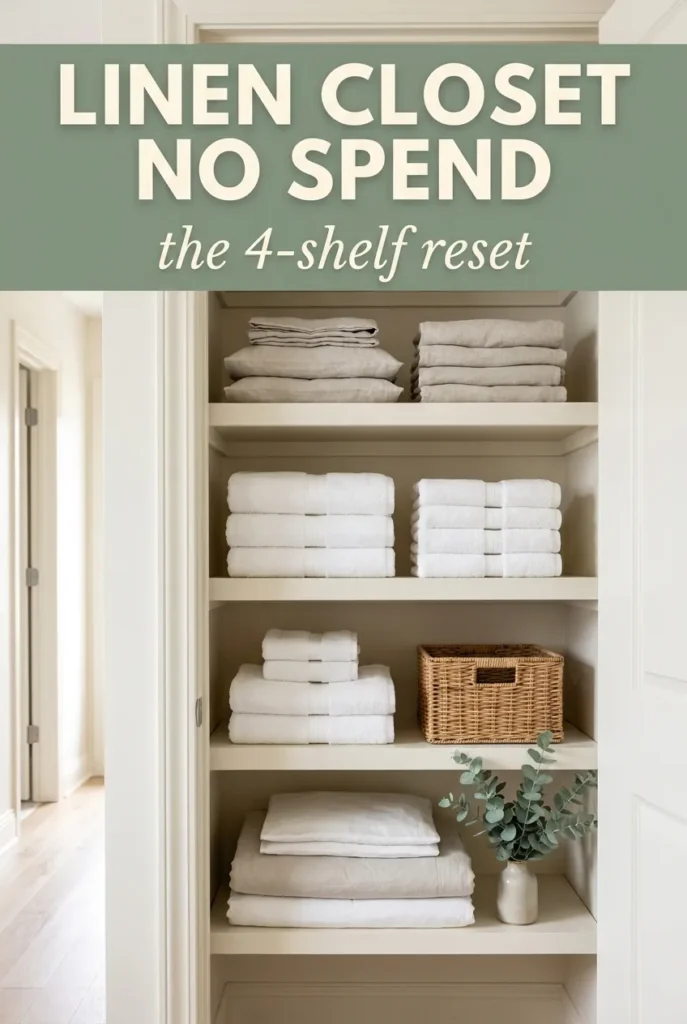

How to Organize a Linen Closet Without Buying Anything New
You opened the linen closet this morning, and a fitted sheet avalanched onto your bare feet. A hand towel you forgot you owned slid out behind it. The top shelf is hiding a flat sheet from a duvet set you replaced in 2022, and the bottom shelf has a folded beach towel still gritty from last August. Sound familiar? A messy linen closet is the quietest source of daily friction in a home, and the loudest reason people throw $80 at a bin haul they didn’t need.
Here is the catch. You can fully organize a linen closet without spending a dollar. Not one. We have done this in three different homes, including a 600-square-foot rental in Cincinnati where the closet was 22 inches deep and 28 inches wide, and the only “container” we bought was nothing. Shop your home, work the 4-Shelf Linen Reset, and you will finish in one Saturday afternoon with a closet that photographs well enough to pin.
This is the no-spend linen closet plan: a friendly, expert walkthrough you can follow this weekend, with renter-safe swaps, real measurements, and shop-your-home substitutions for every product the competing articles try to sell you.
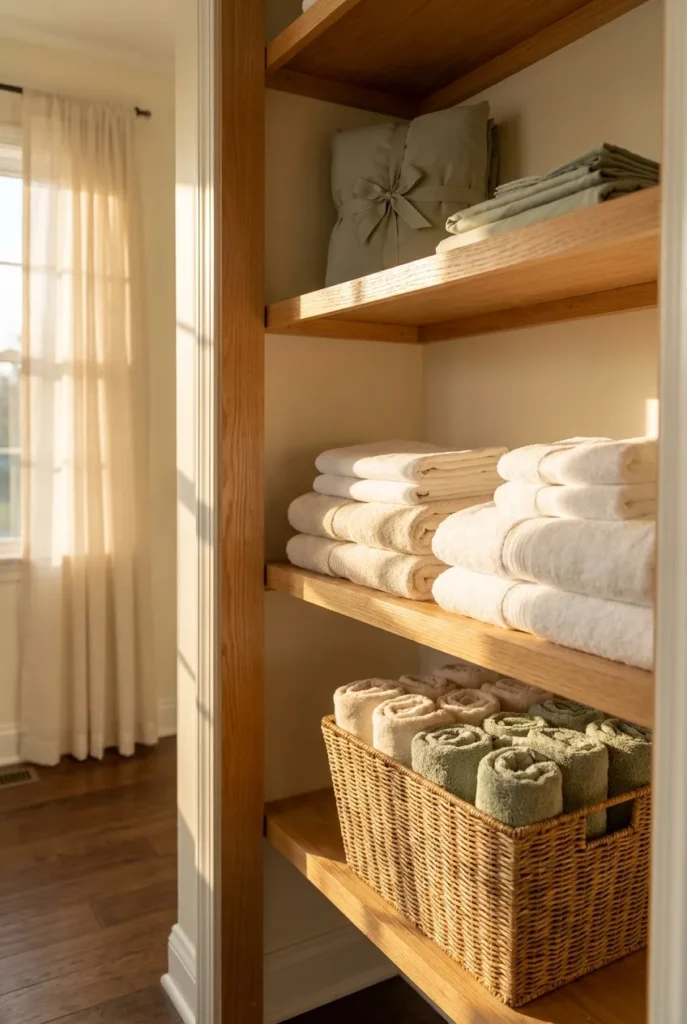
Start With the No-Spend Mindset (Before You Touch a Single Towel)
The reason most linen closet projects fail is simple. People shop first, then declutter, then realize the bins do not fit the shelf. We flip that order. You declutter, you measure, then you shop your home.
The no-spend mindset rests on one rule: every container, divider, or label you need is already somewhere else in your house. A shoebox is a drawer divider. A gift bag is a pillowcase pouch. An old pillowcase is, well, a pillowcase pouch. A coffee mug from the back of the cabinet is a cotton-ball holder. Once you start looking, the closet practically organizes itself.
Try this honestly: walk through your home for ten minutes with a laundry basket. Collect every empty container you spot. Shoeboxes from the bedroom floor. A stray Amazon mailer (sturdier than you think). The mesh produce bags from your last grocery trip. A kid’s plastic shoebox from the playroom. Bring them all to the hallway. That is your bin stash.
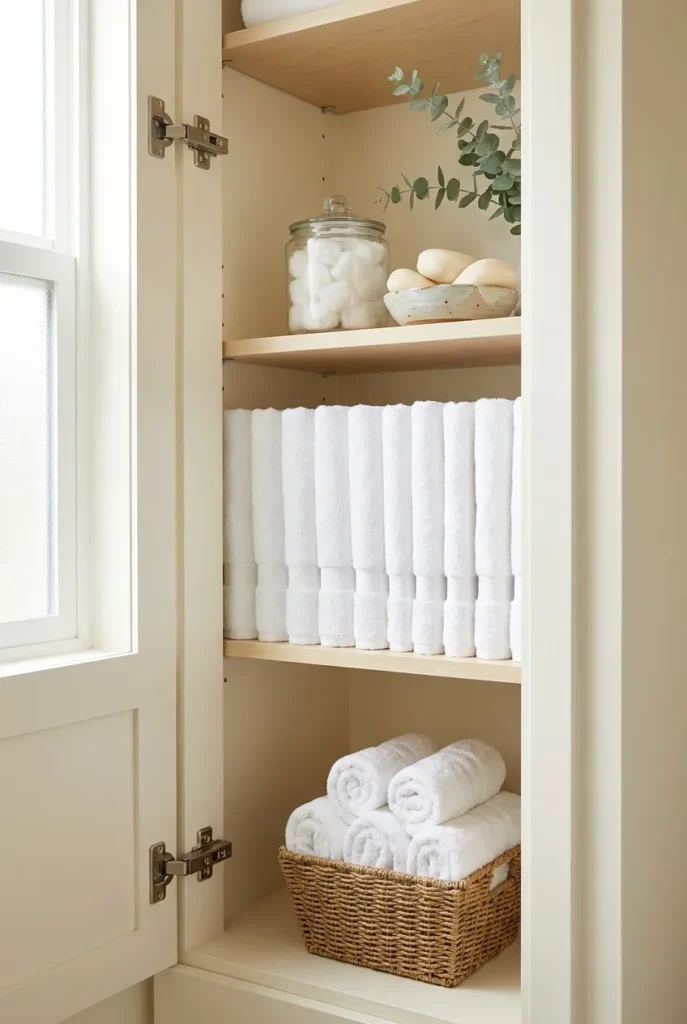
The 4-Shelf Linen Reset (the framework that runs the whole closet)
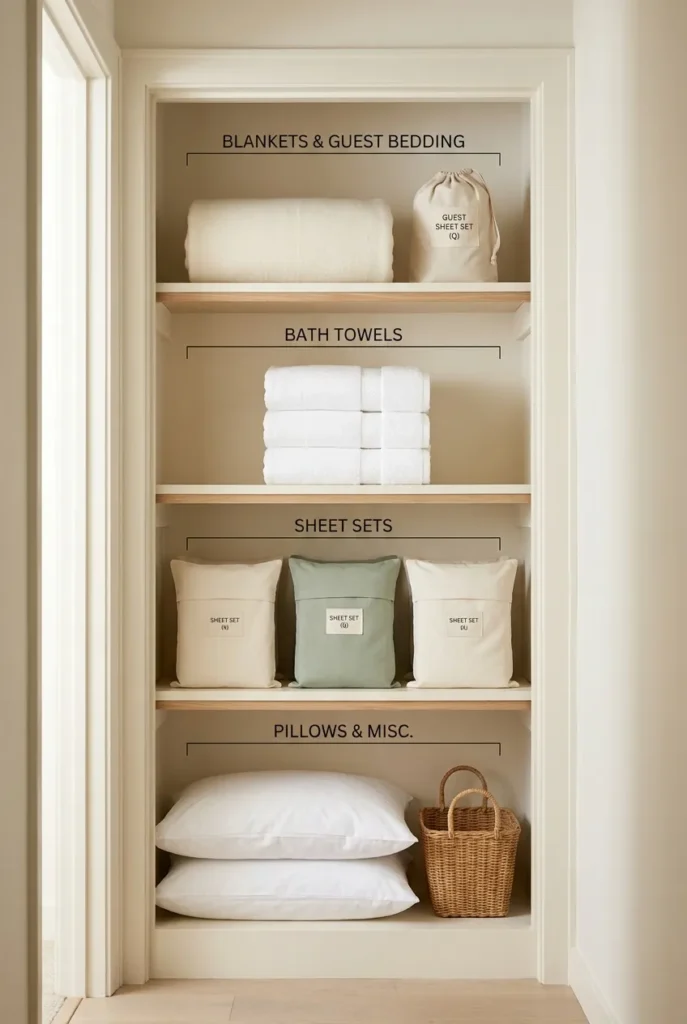
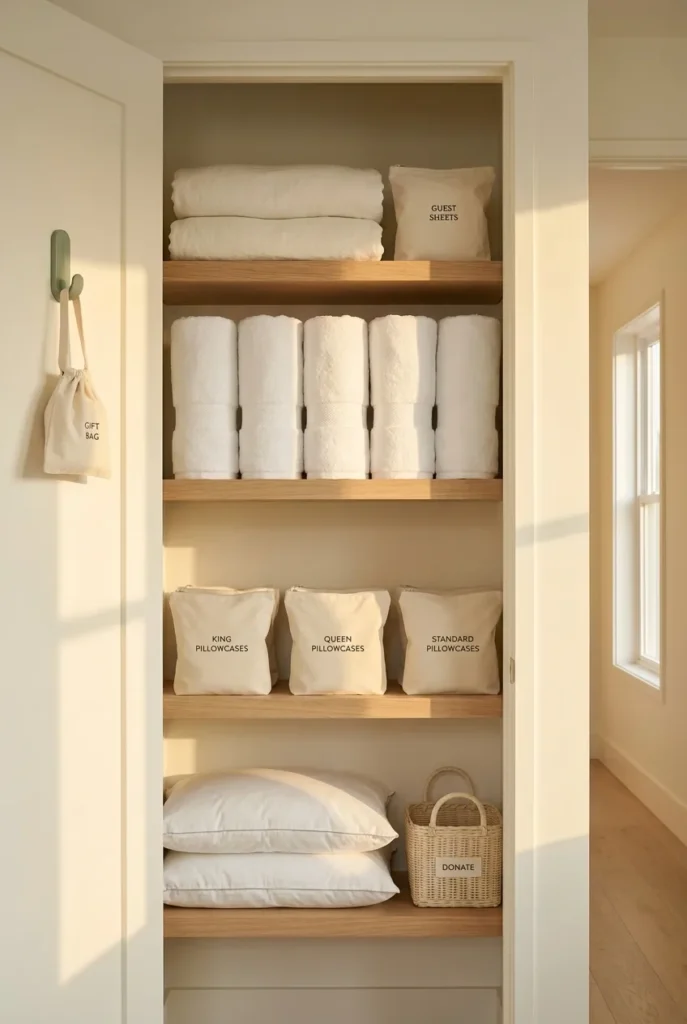
Here is the original framework we use, and the one this article hangs on. The 4-Shelf Linen Reset assigns every shelf in your closet a daily-use frequency, then matches that frequency to a specific category of linen.
- Top shelf (rarely used): out-of-season blankets, guest sheets, the spare quilt.
- Eye-level shelf (daily): bath towels, hand towels, washcloths.
- Hip-level shelf (weekly): sheet sets in pillowcase pouches, mattress covers.
- Bottom shelf (heavy + bulk): extra pillows, throws, a small donation tote.
That is it. Four shelves, four frequencies. If your closet has five or six shelves, split the eye-level shelf in half (bath towels on top, hand towels below). If you have three shelves, combine hip-level and bottom-level.
The rule is the rule. Daily-use items live where your hand naturally reaches. Bulky and rare lives high or low. We will use this map at every step.
Step One: Empty the Closet Completely
Yes, completely. Every towel, every sheet, every random heating pad. Pile it on your bed or the hallway floor. This step is non-negotiable. You cannot organize a space you cannot see.
While the closet is empty, do three things. Wipe the shelves with a damp cloth (a microfiber rag works, no spray needed). Vacuum the corners where dust bunnies hide behind the back wall. Sniff each shelf. If any shelf smells musty, sprinkle a thin layer of baking soda, leave it for an hour, then wipe clean. According to the EPA’s Safer Choice program, baking soda is one of the simplest household solutions for absorbing closet odors without harsh chemicals.
Measure each shelf width, depth, and the gap above. Write the numbers down. Most hallway linen closets run 22 to 28 inches wide and 14 to 18 inches deep, with shelves spaced 12 to 14 inches apart. You will need these numbers in the next step.
Step Two: Declutter Ruthlessly (No Bin Will Save You From Volume)
This is where most linen closets quietly bloat. We hold onto sheets from beds we no longer own, towels with frayed corners, pillowcases with no match, and three sets of guest sheets when one is plenty.
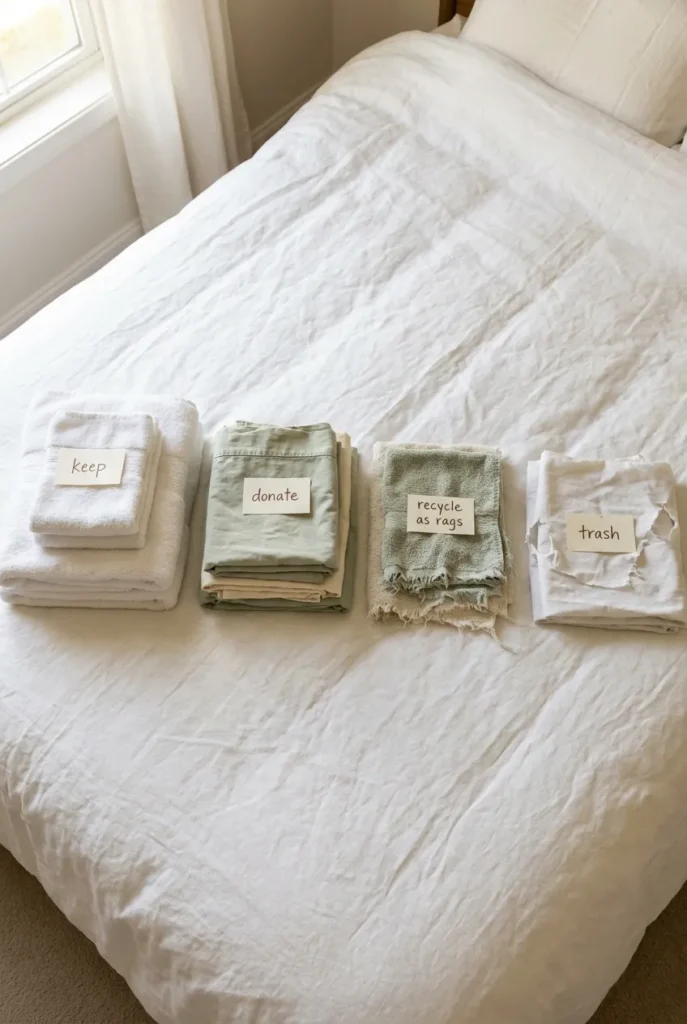
Use a four-pile system on the bed: keep, donate, recycle (rag pile), trash. The Good Housekeeping Institute recommends keeping two full sheet sets per bed and three towels per regular user in the household. That math alone usually clears half a shelf.
Trash gets the stained, the torn beyond rag use, the truly done. Recycle into a rag pile what is structurally sound but ugly (we use old hand towels for car cleaning and floor spills). Donate what is in good shape to Goodwill, a local animal shelter (they often take old towels and sheets), or a Buy Nothing group. If you want a deeper decluttering pass on the bathroom side, our guide to things in your bathroom you can toss tonight pairs perfectly with this step.
Be a little ruthless. Marie Kondo’s “spark joy” works fine here, but Dana K. White’s “container concept” works better: your closet is the container, not your stuff. Anything that does not fit the container has to leave.
Step Three: Shop Your Home for Free “Bins”
Here is where the no-spend magic lives. Walk back through your home with the empty laundry basket and collect the following candidates. We have personally used every one of these in a real linen closet.
- Shoeboxes (sturdy kind): perfect drawer dividers for small things, washcloths, travel toiletries, or backup soaps. Sit one on each side of a shelf to corral hand towels.
- Plastic shoeboxes from the kids’ closet: clear and stackable. Great for sheet sets if you do not love the pillowcase method.
- An old pillowcase: the gold-standard sheet pouch (more on this in a minute).
- A reusable shopping tote or two: the small kind that collapse. Excellent for the bottom shelf as a “donate later” catch-all.
- A cereal-box magazine file: cut at an angle, it holds folded hand towels upright like books on a shelf.
- A small wicker basket from a coffee table or bathroom counter: repurpose it as your hand-towel hub.
- Gift bags from the closet: the small ones with handles work as hanging pouches on a Command Hook.
- Mesh produce bags: wash them, use them for travel-size toiletries you want to see through.
- Old coffee mugs or mason jars: Q-tips, cotton balls, hair ties, small soaps.
- A spare tension rod (if you have one from a curtain swap): mount it horizontally at the back of a deep shelf to create a “second tier” or a hanging spot for small bags.
Most of these we have salvaged from kitchen drawers and bedroom corners. The cereal-box file alone replaces three of the products West Elm tried to sell us. Honestly, half the linen closet bins on Amazon are just nicer-looking versions of these.
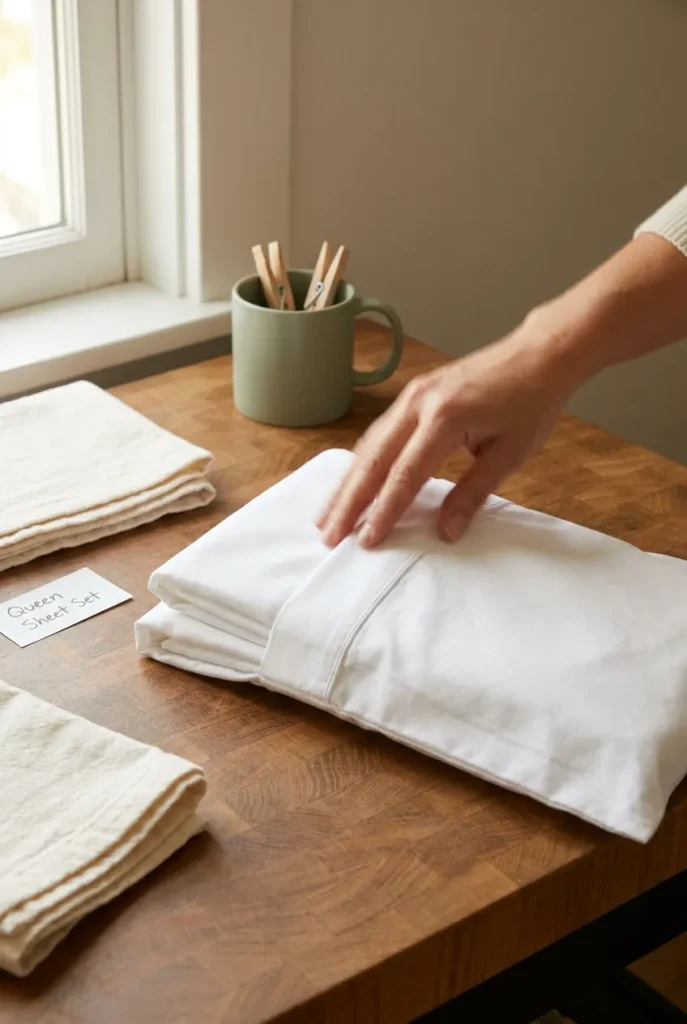
Step Four: The Pillowcase Pouch (the single best no-spend linen hack)
If you remember one thing from this article, remember the pillowcase pouch. It is the hack that transforms a chaotic sheet shelf into a Pinterest-ready row.
Here is how it works. Take a full sheet set: flat sheet, fitted sheet, one extra pillowcase. Fold them all to roughly the same rectangle. Tuck the whole stack inside the second matching pillowcase. Smooth flat. Stack on the shelf. Now every set lives inside its own labeled pouch (the pillowcase tells you the size by feel, but you can write the size on a small piece of masking tape and stick it on the open edge).
Why this beats every product on the market: pillowcase pouches stack flat, breathe well, and never let you grab the wrong-size fitted sheet. They cost zero dollars. They came with the sheets.
For a queen-size set, the rectangle should measure roughly 12 by 14 inches when folded. That fits inside a standard pillowcase with about an inch of slack. The fold takes practice. Give it three tries. The second one is always better than the first.
Step Five: Fold Towels the Right Way for Your Shelf Depth
Folding is where shelf depth matters. A 14-inch-deep shelf wants a different fold than an 18-inch-deep shelf. Get this wrong and your towels avalanche.
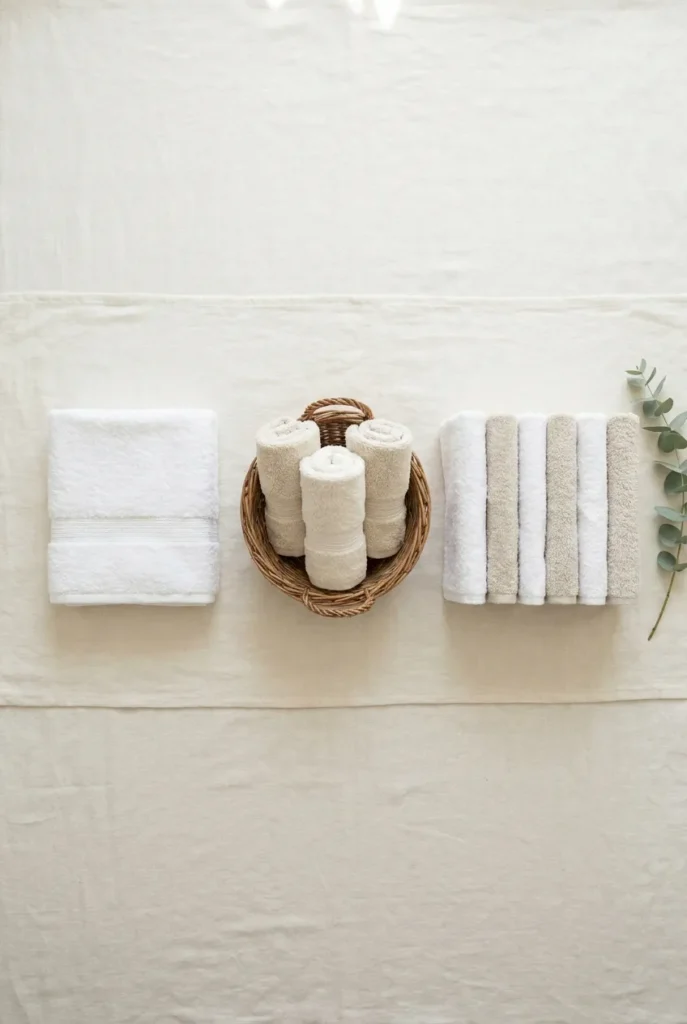
For shelves 14 inches deep or less, use the thirds-then-thirds fold. Lay the towel flat, fold the long sides into thirds (so it is now a long narrow strip), then fold the strip into thirds again. You end up with a compact rectangle about 11 by 9 inches. Stack with the smooth folded edge facing out.
For shelves 16 to 18 inches deep, use the roll method. Fold the towel in half lengthwise, then roll tightly from one short end. Stand the rolls upright in a wicker basket like wine bottles. You can fit eight to ten rolled bath towels in a basket sized 12 by 16 inches.
For shelves deeper than 18 inches (rare but they exist in older homes), use the file fold. Folded rectangles stand on edge like books, smooth side up, so you can read the whole row at a glance. KonMari fans will recognize this; it works as well on towels as it does on T-shirts.
Step Six: Renter-Safe Hacks for Adding Storage Without Drilling
If you are renting, you cannot drill. You can still double your storage. Every hack below uses zero dollars (assuming you have the items somewhere) and zero hardware.
- Command Hooks 3M (the one product worth mentioning): if you have any in a junk drawer from your last apartment, use them on the inside of the closet door to hang small gift-bag pouches. They hold up to five pounds and remove without paint damage.
- A spare tension rod: install horizontally at the back of a deep shelf to create a second tier for folded items, or vertically inside the door to hang washcloths over.
- A cereal-box magazine file: stands tall on a shelf and creates a vertical pocket for flat-folded hand towels.
- A repurposed shoe-organizer pocket panel (if you have one in storage): hang on the inside of the door for travel toiletries, soaps, and small bottles.
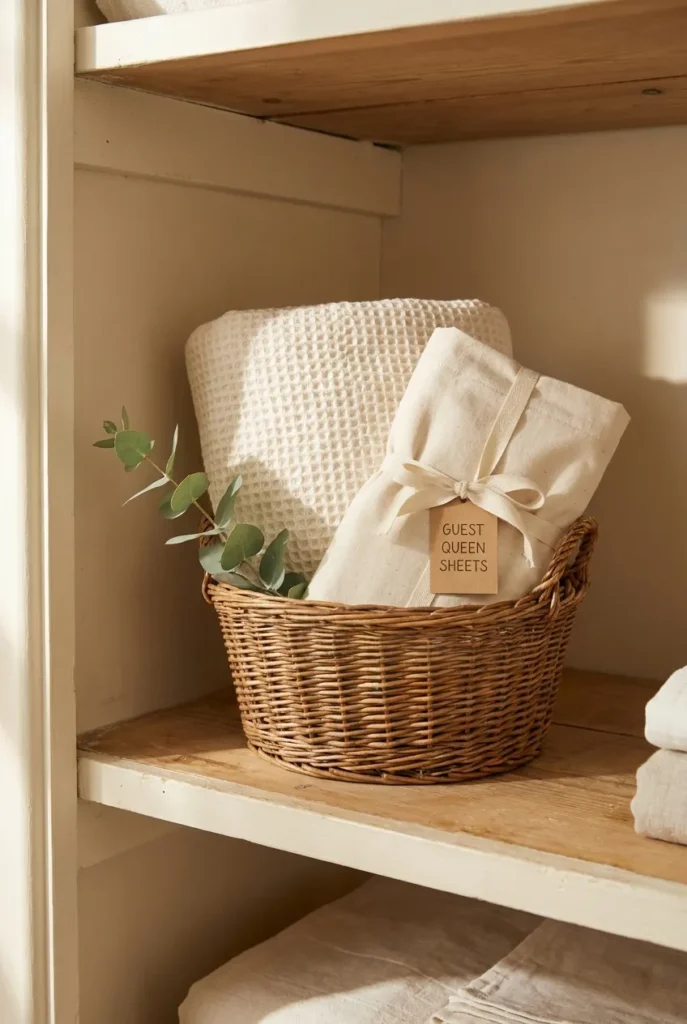
- A wicker basket on top of the closet: the wasted space above the top shelf is real estate. Fold a soft blanket and a guest pillow inside; it doubles as decor and storage.
We mention Command Hooks once because they are the only purchasable item readers may already own. Everything else is shop-your-home.
Step Seven: Label Everything (Without a Label Maker)
Labels are not optional. They are what keeps the system alive after week three. But you do not need a label maker.
Use masking tape and a sharpie. Write the category, slap it on the shelf edge. Replace easily when the system shifts. If you want it prettier, use a strip of kraft paper from a leftover gift bag, write with a black gel pen, and tape with a small piece of washi tape (if you have any from a craft drawer).
Categories to label: bath towels, hand towels, washcloths, queen sheets, king sheets, twin sheets, guest sheets, blankets, seasonal, donate. Ten labels max. If you cannot describe a shelf in one word, the shelf is doing too much.
Step Eight: Keep It Smelling Fresh (the No-Spend Way)
Closets get musty. Especially small hallway closets without ventilation. You do not need a Method spray or a Mrs. Meyer’s anything.
Three free options:
- Eucalyptus or rosemary clipping from your yard or grocery store kitchen herbs. Tie with twine, hang from a Command Hook on the back wall. Replace every three weeks.
- A bowl of baking soda. Tuck on the top shelf. Replace monthly. Pulls moisture and odor at the same time.
- An old soap bar still in its wrapper. Stash on a back corner. The soap stays usable, and the closet smells lightly of soap for months.
A printable freshness rotation chart helps. We will share ours in the FAQ section below. For a deeper clean-out beyond the linen closet, see our cleaning caddy guide for the no-spend supply kit that handles every shelf wipe-down.
Step Nine: Rotate Seasonally (the Sunday Linen Swap)
Twice a year, swap. Flannel sheets and heavy throws move down to eye level in October. Light cotton sheets and beach towels move down in May. Out-of-season items move to the top shelf in pillowcase pouches or to a labeled basket in the bottom.
The whole swap takes 20 minutes if your closet is already on the 4-Shelf Reset. We do ours the Sunday before Memorial Day weekend and the Sunday before Thanksgiving. Pair it with the summer closet refresh and you have hit the two biggest seasonal swap moments of the year in one afternoon.
Step Ten: Maintain With the 5-Minute Friday Reset
A linen closet stays organized for one reason: a 5-minute maintenance touch every Friday. Open the door. Re-stack what slid. Refold one set if needed. Toss any towel that found its way in mid-week. Done.
Five minutes. Once a week. That is the entire maintenance commitment. Skip it and the closet falls apart in three weeks. Honor it and the system you built this Saturday will still be running next spring.
Small Linen Closet, Bathroom Linen Closet, or No-Shelf Closet?
Three quick variants for the closet you actually have:
- Small linen closet (under 24 inches wide): skip the wicker baskets entirely. Stack everything as file-folded rectangles. Use the door for everything you can.
- Bathroom linen closet (no hallway version): keep the bath towels and washcloths here, send sheets to the bedroom closet shelf. Mixing toiletries on the bottom shelf is fine if the bottom shelf is labeled and contained.
- No-shelf closet (just a rod): hang a fabric drawer-organizer pocket panel over the rod. Each pocket is a “shelf.” Sheet pouches fit two per pocket.
Whichever variant you have, the 4-Shelf Linen Reset still works. Adapt the categories to your real shelf count and keep the daily-use rule alive.
What Competitor Articles Miss (and What We Just Covered)
Most top-ranking linen closet articles push you toward a Container Store haul. We just showed you a real system that needs nothing more than what you already own. The 4-Shelf Reset, the pillowcase pouch, the cereal-box file, the eucalyptus clipping, the masking-tape labels. Every one of those is a Pinterest-worthy solution for $0.
The trends in 2026 are quietly shifting toward shop-your-home organizing. People are tired of bin hauls that arrive, get unboxed, and end up in a different kind of clutter. The cleverest closet hacks are the ones that use what you have, in the shelves you have, in the closet you rent.
Frequently Asked Questions
What is the best way to organize a linen closet?
The best way is to declutter first, measure your shelves, then assign each shelf a daily-use frequency before you bring in any bins. The 4-Shelf Linen Reset (rarely used on top, daily at eye level, weekly at hip level, heavy at the bottom) works in almost every standard hallway or bathroom closet.
How do I organize a closet without buying anything?
Shop your home first. Shoeboxes, plastic kid shoeboxes, gift bags, an old pillowcase, a cereal-box magazine file, a wicker basket from another room, and any spare Command Hook in a junk drawer will replace every product on a typical linen closet checklist.
How do I organize towels in a small linen closet?
File-fold them. Stand the folded rectangles on edge like books along the shelf. This stops the avalanche, lets you see every towel at once, and uses every inch of shelf depth even in closets under 14 inches deep.
What are the latest closet organizer trends?
The biggest 2026 shift is toward shop-your-home, no-spend systems with neutral palettes. Pillowcase pouches, fabric-bin reuse, eucalyptus sachets, and masking-tape labels are replacing acrylic bins and label-maker prints on Pinterest right now.
What are some clever closet hacks?
The pillowcase pouch (sheet set tucked inside its matching case), the cereal-box magazine file as a vertical towel holder, a tension rod across a deep shelf as a second tier, and a Command Hook with a gift-bag pouch on the inside of the door are the four highest-leverage hacks we have personally tested.
How do I keep my linen closet smelling fresh?
Tie a fresh eucalyptus or rosemary clipping with twine and hang from a Command Hook. Replace every three weeks. Add a small open bowl of baking soda on the top shelf and replace monthly. Both pull odor for free.
How often should I redo my linen closet?
A full reset twice a year (the Sunday before Memorial Day and the Sunday before Thanksgiving), with a 5-minute Friday touch-up every week in between. That is the whole maintenance schedule.
The Real Win Here
You finished the article. The closet is still messy. Here is the soft push: pick one Saturday in the next two weeks, empty the closet, and run the 4-Shelf Reset. Not next month. The next free Saturday. The hack only works once your hands touch the shelves.
Save this guide to your Pinterest closet board, screenshot the 4-Shelf Reset graphic for your phone, and reset one shelf this Sunday. Tell us in the comments which “bin” from your own home surprised you the most. Was it the cereal box? The pillowcase? The mug? We bet the answer is something you almost threw away yesterday.